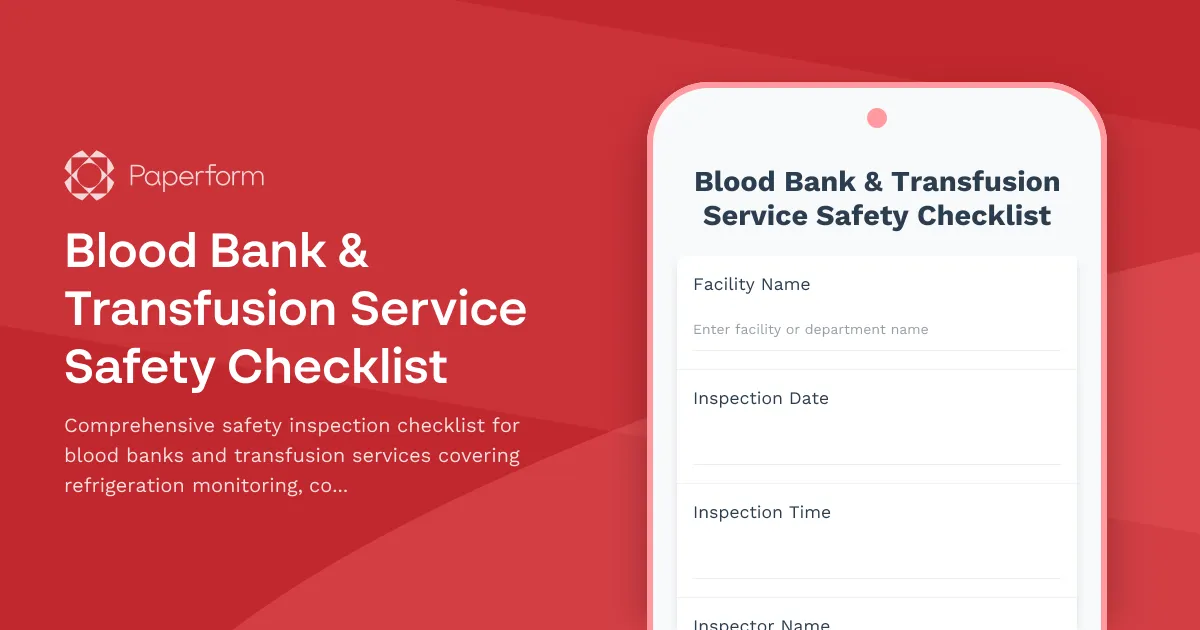
Blood Bank & Transfusion Service Safety Checklist Template
Running a safe and compliant blood bank or transfusion service requires meticulous attention to detail across multiple critical areas—from refrigeration temperature monitoring and contamination prevention to emergency power systems and biohazard disposal protocols. This Blood Bank & Transfusion Service Safety Checklist template provides healthcare facilities with a structured, repeatable framework for conducting thorough safety inspections that meet regulatory standards and protect both patients and staff.
Why blood bank safety inspections matter
Blood banks and transfusion services operate under some of the strictest safety and compliance requirements in healthcare. Temperature excursions can compromise blood product integrity, contamination can lead to life-threatening infections, and improper specimen labeling can result in catastrophic transfusion errors. Regular, documented safety inspections are essential for:
- Maintaining FDA, AABB, and state regulatory compliance with blood banking standards
- Preventing adverse transfusion events through rigorous quality control
- Protecting blood product integrity with proper storage and handling
- Ensuring emergency preparedness with tested backup systems
- Creating audit trails for accreditation reviews and internal quality assurance
This template transforms paper-based checklists and scattered spreadsheets into a centralized digital system that laboratory supervisors, quality managers, and compliance officers can access, complete, and review from any device.
Who should use this template
This blood bank safety checklist is designed for:
- Blood bank directors and supervisors overseeing daily operations and compliance
- Laboratory managers and medical technologists conducting routine safety inspections
- Quality assurance officers tracking compliance trends and corrective actions
- Hospital safety coordinators managing facility-wide inspection programs
- Regulatory affairs professionals preparing for accreditation surveys and audits
Whether you manage a hospital-based transfusion service, a standalone blood collection center, or a regional blood bank network, this template adapts to your facility's specific protocols and regulatory requirements.
Key features of this safety checklist template
This comprehensive template covers the critical safety domains required for blood bank operations:
Refrigeration & temperature monitoring: Document current temperatures for blood refrigerators, platelet agitators, and freezers, verify alarm functionality, and confirm temperature log accuracy. Temperature control is foundational to maintaining viable blood products.
Contamination prevention protocols: Inspect sterile technique compliance, equipment cleaning records, environmental controls, and staff protective equipment usage. These protocols prevent bacterial contamination that could lead to sepsis or other serious complications.
Emergency power backup systems: Test generator functionality, verify automatic transfer switch operation, check fuel levels, and confirm that critical equipment transfers properly during simulated power failures. Blood products cannot be stored without reliable refrigeration.
Specimen labeling compliance: Review labeling accuracy, barcode scanner functionality, patient identification procedures, and label inventory. Proper specimen identification is the most critical step in preventing wrong-blood-in-tube errors.
Biohazard disposal procedures: Verify proper segregation of sharps, infectious waste, and regulated medical waste, confirm pickup schedules, review training documentation, and inspect disposal container integrity.
How Paperform makes blood bank inspections more effective
Traditional paper checklists create compliance gaps—they're easy to lose, hard to analyze, and often completed inconsistently. This Paperform template brings your blood bank safety program into a digital workflow that's both more rigorous and easier to manage:
- Mobile-friendly inspection forms that laboratory staff can complete on tablets or phones while moving through the facility
- Conditional logic that reveals follow-up questions when issues are identified, ensuring proper documentation of corrective actions
- Photo upload fields for capturing visual evidence of equipment issues, temperature logs, or facility conditions
- Automatic timestamp and inspector signature capture for audit-ready documentation
- Instant submission notifications to alert supervisors and quality managers when critical issues are identified
- Centralized submission database that makes it easy to track trends, identify recurring problems, and demonstrate continuous improvement
For facilities managing multiple inspection schedules, Paperform's flexibility means you can create daily temperature check forms, weekly equipment inspections, monthly comprehensive audits, and quarterly emergency system tests—all from one platform with consistent formatting and data collection.
Automate your blood bank quality workflows with Stepper
Once inspection data is submitted, Stepper (stepper.io)—your AI-native workflow automation tool—can transform compliance documentation from a filing exercise into an active quality management system:
- Route critical findings directly to the appropriate department heads or safety officers for immediate action
- Trigger corrective action workflows when temperature excursions or equipment failures are reported
- Update quality management systems automatically with inspection results and trend data
- Generate scheduled reports for leadership, quality committees, and accreditation bodies
- Create maintenance tickets in your facility management system when equipment issues are identified
- Send reminder notifications for follow-up inspections or incomplete corrective actions
By connecting Paperform submissions to Stepper workflows, you create a closed-loop quality system where no safety issue falls through the cracks and every inspection contributes to continuous improvement.
Built for healthcare compliance and security
Blood bank operations handle sensitive patient information and must comply with HIPAA, FDA, and state health department regulations. Paperform is SOC 2 Type II compliant and provides the security controls healthcare organizations require:
- Encrypted data transmission and storage to protect patient information
- Access controls and user permissions to limit who can view and complete inspection forms
- Audit logs that track who accessed forms and when
- Data residency options for facilities with specific geographic requirements
- GDPR compliance for international healthcare organizations
While Paperform is not HIPAA compliant, it provides robust security features suitable for many healthcare administrative and quality workflows that don't involve protected health information.
From inspection to accreditation success
Regular, thorough safety inspections aren't just about checking boxes—they're about building a culture of quality that protects patients and earns the trust of regulators, accreditation bodies, and the communities you serve. This template helps blood banks and transfusion services:
- Demonstrate due diligence during AABB, CAP, or Joint Commission surveys
- Identify equipment issues before they lead to blood product loss or patient safety events
- Train new staff on comprehensive safety protocols and expectations
- Benchmark performance across shifts, staff members, or facility locations
- Support root cause analysis when adverse events do occur
With digital inspection forms that are easy to complete, impossible to lose, and simple to analyze, your quality program becomes more proactive and your compliance posture becomes stronger.
Get started with your blood bank safety checklist
This template is ready to use immediately, or you can customize it to match your facility's specific protocols, equipment, and regulatory requirements. Add your organization's logo, adjust inspection frequency, modify question wording to match your SOPs, and integrate with the quality management tools you already use.
Whether you're digitizing an existing paper-based inspection program or building a new quality system from scratch, Paperform gives you the flexibility to create forms that work the way your facility works—no coding, no IT tickets, and no compromise on safety or compliance.
Start with this template today and transform your blood bank safety inspections from a compliance burden into a strategic advantage for patient safety and operational excellence.



More templates like this
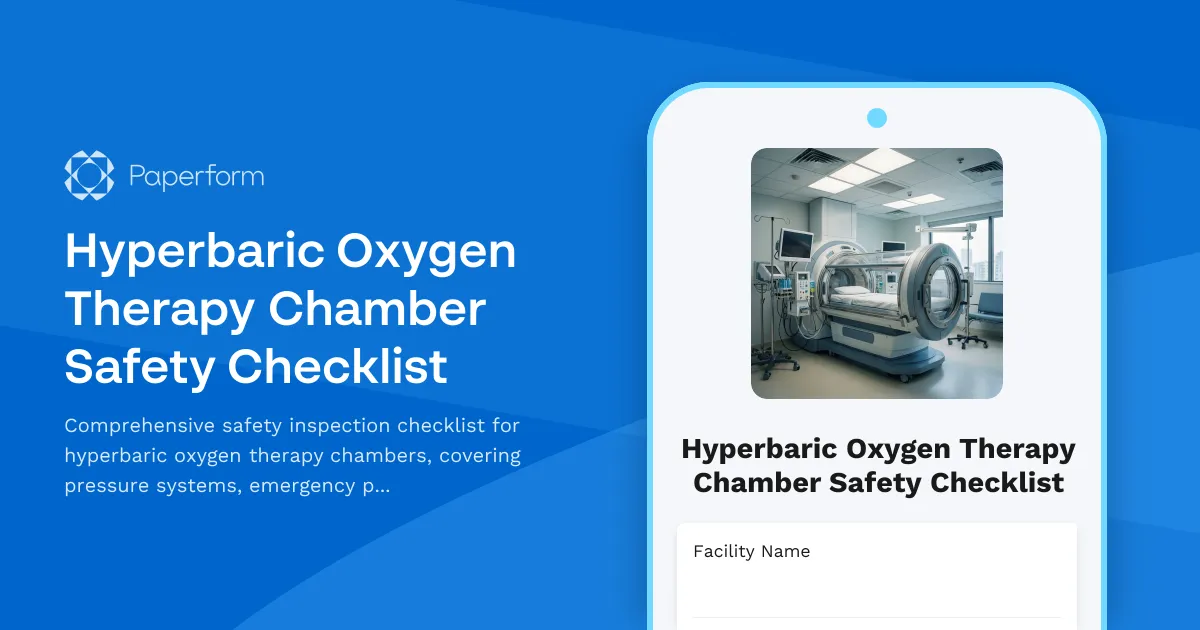
Hyperbaric Oxygen Therapy Chamber Safety Checklist
Comprehensive safety inspection checklist for hyperbaric oxygen therapy chambers, covering pressure systems, emergency protocols, fire prevention, and patient monitoring equipment.
Healthcare Emergency Operations Center Activation Checklist
A comprehensive checklist form for activating healthcare emergency operations centers during critical incidents. Streamlines incident classification, resource coordination, and communication protocols.
Mobile Blood Collection Unit Safety Checklist
Comprehensive safety inspection checklist for mobile blood donation units, covering refrigeration monitoring, infection control, donor screening compliance, and emergency preparedness.
Mobile COVID-19 Testing Site Safety Checklist
Comprehensive safety inspection checklist for mobile COVID-19 testing sites covering PPE availability, donning procedures, specimen handling, waste disposal, and emergency decontamination protocols.
Medical Transcription Service Compliance Audit Checklist
Comprehensive compliance audit checklist for medical transcription services covering HIPAA compliance, accuracy verification, turnaround time tracking, quality assurance, and client satisfaction monitoring.
Mobile Mammography Unit Safety Checklist
Comprehensive safety inspection checklist for mobile mammography units covering radiation shielding, electrical systems, patient privacy, equipment calibration, and emergency preparedness.
Mobile Ultrasound Diagnostic Unit Safety Checklist
Comprehensive safety inspection and compliance checklist for mobile ultrasound units, covering equipment calibration, electrical safety, patient privacy, and emergency readiness.
Plasma Donation Center Compliance Audit Checklist
A comprehensive compliance audit checklist for plasma donation centers covering donor screening, equipment sterilization, temperature monitoring, FDA compliance, and adverse reaction documentation to ensure regulatory adherence.
Plasma Donation Center Safety Inspection Checklist
Comprehensive safety inspection checklist for plasma donation centers covering needle stick prevention, donor screening compliance, temperature monitoring, biohazard handling, and emergency preparedness.
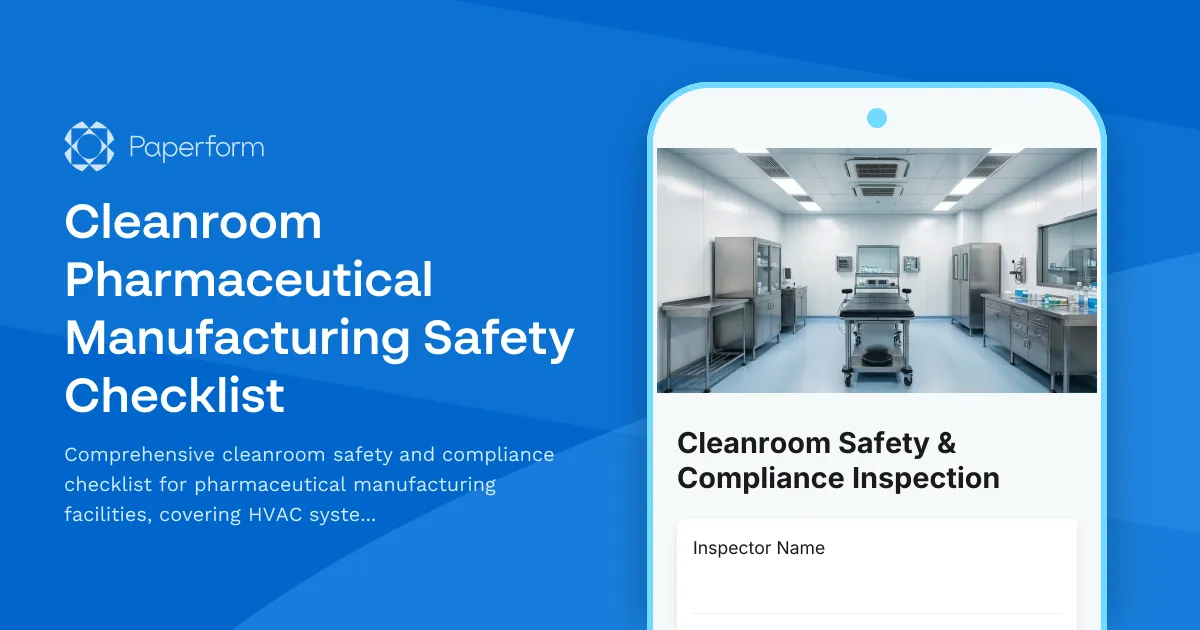
Cleanroom Pharmaceutical Manufacturing Safety Checklist
Comprehensive cleanroom safety and compliance checklist for pharmaceutical manufacturing facilities, covering HVAC systems, gowning procedures, material handling, and personnel screening.
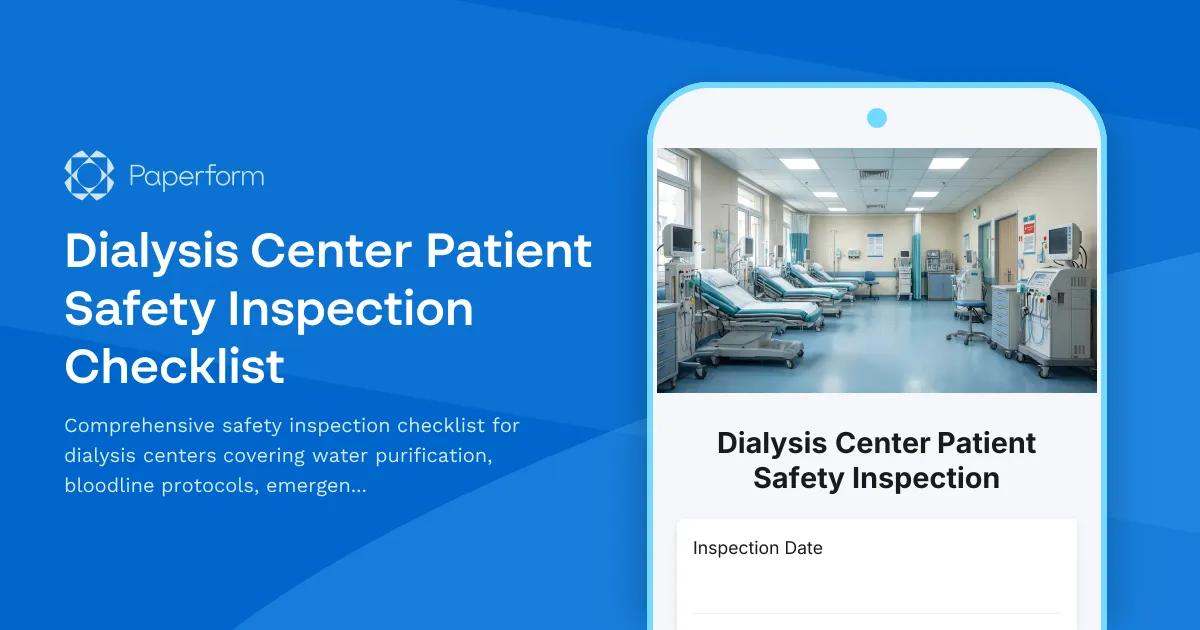
Dialysis Center Patient Safety Inspection Checklist
Comprehensive safety inspection checklist for dialysis centers covering water purification, bloodline protocols, emergency systems, infection control, and medical equipment readiness to ensure patient safety and regulatory compliance.
Home Healthcare Agency Compliance Audit Checklist
A comprehensive compliance audit checklist for home healthcare agencies covering caregiver background checks, care plan documentation, medication records, patient visit verification, and HIPAA compliance review.