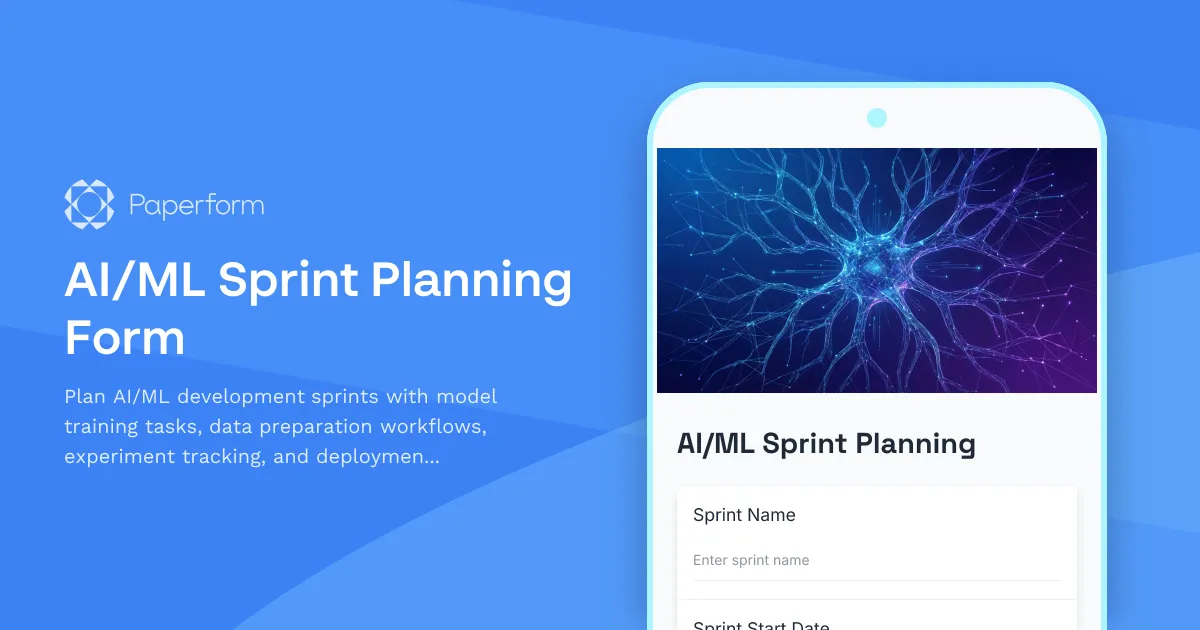
Streamline Your AI/ML Sprint Planning with Paperform
Planning sprints for AI and machine learning teams requires a different approach than traditional software development. Between data preparation, model training, experiment tracking, and deployment pipelines, ML teams need a structured way to organize their work that accounts for the unique challenges of machine learning workflows.
This AI/ML Sprint Planning Form template helps data science and machine learning teams plan effective sprints by capturing all the critical details—from dataset preparation and feature engineering to model experiments and production deployment tasks. Built specifically for ML workflows, this template ensures nothing falls through the cracks during your agile ceremonies.
Why AI/ML Teams Need Specialized Sprint Planning
Machine learning projects differ significantly from traditional software development. ML sprints often involve:
- Experimental work where outcomes are uncertain and require iteration
- Data dependencies that can block progress if not properly planned
- Compute resource allocation for training jobs and experimentation
- Model versioning and experiment tracking across multiple attempts
- Pipeline orchestration from data ingestion through deployment
This template addresses these unique needs by providing dedicated sections for data tasks, model development, infrastructure, and deployment—giving your team a clear roadmap for each sprint cycle.
Perfect for Data Science and ML Engineering Teams
Whether you're building recommendation systems, computer vision models, natural language processing applications, or predictive analytics, this sprint planning form adapts to your workflow. It's ideal for:
- Machine learning engineers managing model training and deployment
- Data scientists running experiments and optimizing algorithms
- ML platform teams building infrastructure and pipelines
- AI product teams coordinating cross-functional ML initiatives
- Research teams tracking experiments and reproducing results
The form captures sprint goals, individual task breakdowns, resource requirements, and success metrics—all in one organized submission that can be shared with stakeholders and integrated into your project management tools.
Key Features for ML Workflows
This template includes specialized fields for AI/ML sprint planning:
Sprint Overview & Goals: Set clear objectives for each sprint, define success criteria, and establish the sprint timeline with start and end dates.
Data Preparation Tasks: Track data collection, cleaning, labeling, feature engineering, and exploratory data analysis work. Data quality is foundational to ML success, and this section ensures data tasks get proper visibility.
Model Development & Experimentation: Plan model architecture changes, hyperparameter tuning sessions, training runs, and experiment tracking. Teams can specify which experiments to run and what metrics to optimize.
Infrastructure & Resources: Document compute resource needs (GPU/TPU requirements), storage requirements, and any infrastructure setup needed for training or deployment.
Deployment & MLOps: Plan model validation, A/B testing, deployment tasks, monitoring setup, and production rollout activities. This ensures models don't just train—they actually ship.
Blockers & Dependencies: Identify potential blockers early, note dependencies on other teams or datasets, and flag risks before they impact the sprint.
Integrate Seamlessly with Your ML Stack
Paperform connects with the tools ML teams already use. Send sprint planning data to:
- Project management tools like Jira, Linear, or Asana to create task tickets automatically
- Slack to notify the team when sprint planning is complete
- Google Sheets or Airtable to maintain a sprint planning database
- Notion to update your team wiki with sprint details
- CRM tools if you're coordinating with stakeholders or clients
Using Stepper (stepper.io), Paperform's AI-native workflow builder, you can automate the entire post-sprint-planning workflow: create tickets in your task tracker, assign owners, set up recurring standup reminders, and even trigger notifications when certain sprint milestones are reached—all without writing code.
Built for Collaboration and Clarity
ML projects succeed when cross-functional teams align. This form facilitates collaboration by:
- Making sprint goals visible and explicit
- Breaking down complex ML workflows into manageable tasks
- Clarifying ownership and accountability for each work stream
- Providing a historical record of what was planned vs. delivered
The clean, professional design ensures stakeholders can quickly understand sprint objectives, while the detailed task breakdown gives individual contributors the clarity they need to execute.
Automate Your Agile Ceremonies
Beyond sprint planning, you can use Paperform for other agile ceremonies:
- Create daily standup forms to track progress, blockers, and priorities asynchronously
- Build sprint retrospective surveys to gather team feedback and improve processes
- Design experiment review templates to document model performance and learnings
By digitizing these ceremonies, remote and distributed ML teams can maintain strong agile practices without requiring everyone to be in the same meeting at the same time.
Enterprise-Ready for ML Teams at Scale
As your ML practice grows, Paperform scales with you. With SOC 2 Type II compliance, role-based permissions, and data residency controls, you can confidently use Paperform across teams and projects. The Agency+ plan supports multiple workspaces—perfect for ML teams managing different product lines or client projects.
For teams that need advanced automation, Stepper can orchestrate complex workflows that span multiple tools, route approvals based on sprint complexity, and keep your ML platform, experiment tracking tools, and project management systems perfectly in sync.
Get Started with AI/ML Sprint Planning
This template is ready to use immediately, but you can customize every element to match your team's specific workflow. Add custom fields for your preferred experiment tracking framework (MLflow, Weights & Biases, etc.), adjust the task categories to match your team's structure, or incorporate your own sprint rituals and metrics.
Paperform's document-style editor makes customization intuitive—no technical skills required. You can add conditional logic to show certain sections only for specific sprint types, embed the form on your team wiki, or use it as a standalone sprint planning page.
Whether you're a startup building your first ML product or an established company scaling your AI capabilities, this AI/ML Sprint Planning Form template helps you run more organized, effective sprints that ship real value. Start planning better sprints today with Paperform—trusted by over 500,000 teams worldwide for forms and workflows that actually work.
More templates like this
Machine Learning Pipeline Automation Retrospective
A specialized retrospective form for ML teams to review pipeline automation initiatives, capture lessons learned on training time reduction, model versioning improvements, and reproducibility achievements.
AI Model Deployment Approval Form
A comprehensive approval form for AI model deployments that evaluates training data, bias assessment, performance metrics, security controls, and ethical considerations before production release.
Software Release Planning Form
Plan and coordinate software releases with feature prioritization, timeline mapping, risk assessment, and cross-team dependency tracking for agile development teams.
Agile Definition of Ready Checklist
Ensure user stories are fully prepared and ready for sprint planning with this comprehensive Definition of Ready checklist covering story completeness, dependencies, acceptance criteria, and team understanding.
Agile Project Intake Form
A comprehensive agile project intake form for capturing epic descriptions, business cases, success metrics, and initial story mapping to kick off new sprints and initiatives.
API Development Project Brief
A comprehensive project brief template for planning API development projects, covering endpoint specifications, authentication, rate limiting, documentation standards, and versioning strategies.
Async Daily Standup for Distributed Teams
A timezone-friendly async standup form that keeps distributed agile teams aligned. Share progress, blockers, and help requests without scheduling conflicts.
Incident Postmortem to Sprint Planning Form
Document incident retrospectives and automatically convert lessons learned into actionable sprint items, including preventive user stories, technical debt, and follow-up tasks for agile teams.

Machine Learning Platform Support Request
Streamline technical support for ML platform issues including model training errors, deployment problems, and feature store troubleshooting with automated escalation to ML engineering teams.
Topological Quantum Computing Scope of Work
Define project scope for topological quantum computing initiatives including qubit design, error correction protocols, algorithm implementation, system integration, and performance benchmarking.
Accessibility Compliance Project Brief
A comprehensive project brief template for managing accessibility compliance projects, including WCAG audit findings, remediation priorities, testing requirements, and training needs.
Agile Experiment Design Form
A structured form for designing and documenting agile experiments with clear hypotheses, test approaches, data collection methods, and success criteria to drive data-informed decision making.