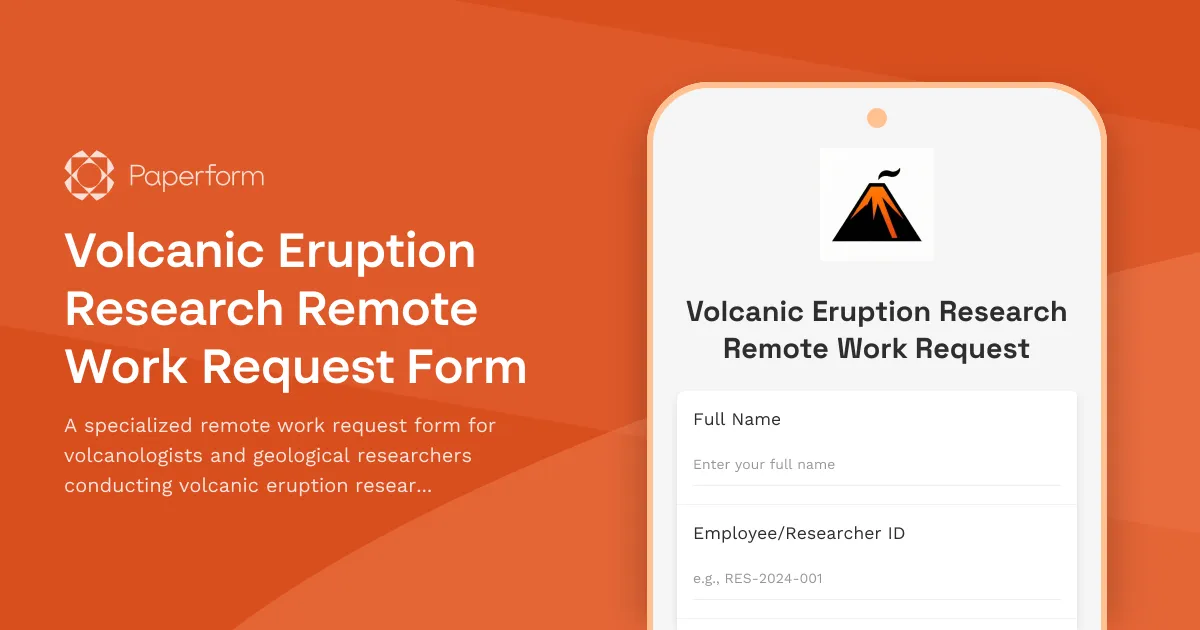
Flexible Remote Work for Volcanic Research Teams
Volcanic eruption research requires unprecedented flexibility. When your team is monitoring seismic activity across remote field sites, conducting geological surveys in evacuation zones, or responding to natural disaster events, traditional office-based work simply isn't feasible.
This Volcanic Eruption Research Remote Work Request Form is purpose-built for geological research organizations, universities, and disaster response agencies that need to coordinate remote work arrangements for scientists in the field. Whether you're a volcanologist deploying seismology equipment, a field researcher collecting samples near active vents, or a data analyst processing real-time monitoring data, this form streamlines the approval process while ensuring safety protocols are maintained.
Paperform makes it easy to manage complex remote work requests with conditional logic that adapts based on fieldwork location, duration, and risk level. Integrate directly with your HR systems, project management tools, and emergency response protocols using Stepper to automatically route approvals, notify safety coordinators, and update team availability calendars.
For research institutions managing multiple field teams across volcanic regions, this template helps you maintain clear communication, document safety procedures, and ensure every remote work arrangement meets institutional requirements—whether your scientists are working from a temporary field station in Iceland, monitoring equipment in the Pacific Ring of Fire, or analyzing data from a home office between expeditions.
Built with the unique needs of geological research in mind, this form is ideal for university geology departments, USGS teams, volcano observatories, disaster preparedness agencies, and international research consortiums conducting volcanic hazard assessments.
More templates like this
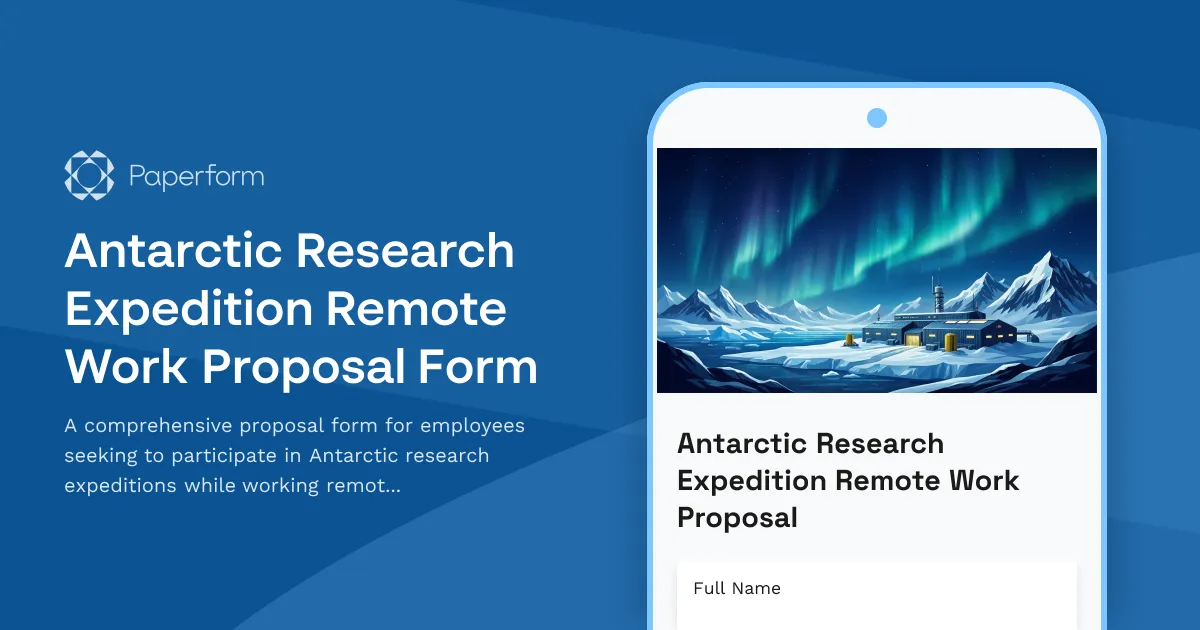
Antarctic Research Expedition Remote Work Proposal Form
A comprehensive proposal form for employees seeking to participate in Antarctic research expeditions while working remotely, covering extreme environment preparation, scientific involvement, and extended isolation protocols.
Distributed Astroparticle Physicist Onboarding Form
A comprehensive onboarding form for astroparticle physicists joining distributed research teams, covering particle detector data access, analysis tools, collaboration platforms, and safety protocols.
Remote Cosmic Ray Researcher Onboarding Form
A comprehensive onboarding form for remote cosmic ray researchers joining particle detector array teams, covering data access, analysis tools, collaboration platforms, and high-altitude research protocols.
Distributed Neutrino Physicist Onboarding Form
A comprehensive remote onboarding form for neutrino physicists joining distributed research collaborations, covering data access, analysis tools, safety protocols, and international collaboration systems.
Remote Tsunami Researcher Onboarding Form
Comprehensive onboarding form for remote tsunami researchers covering wave modeling software access, early warning systems, coastal assessment tools, emergency protocols, and field deployment procedures.
Hybrid Schedule Accessibility Accommodation Request Form
A comprehensive form for employees to request accessibility accommodations, ergonomic support, and workplace modifications for hybrid work arrangements, ensuring inclusive and comfortable work environments.
Phased Retirement Remote Work Proposal Form
A comprehensive proposal form for employees transitioning to phased retirement with remote work arrangements, reduced hours, knowledge transfer planning, and mentorship commitments.
Remote Exoplanet Researcher Onboarding Form
A comprehensive onboarding form for remote exoplanet researchers to set up telescope data access, spectral analysis software, planetary characterization tools, and international observatory collaboration protocols.
Remote Paleontologist Onboarding Form
Comprehensive digital onboarding for remote paleontologists including fossil database access, excavation coordination, lab procedures, and research collaboration setup.
Remote Seismologist Onboarding Form
Streamline the onboarding of remote seismologists with comprehensive access setup for earthquake monitoring networks, analysis software, and emergency protocols.
Remote Wildlife Biologist Onboarding Form
Comprehensive onboarding form for remote wildlife biologists covering credentials, system access, field protocols, and conservation project assignments.
Biotechnology Researcher Offboarding Form
A comprehensive offboarding form for biotechnology researchers covering laboratory notebook handover, cell line inventory, protocol documentation, and hazardous waste disposal records.