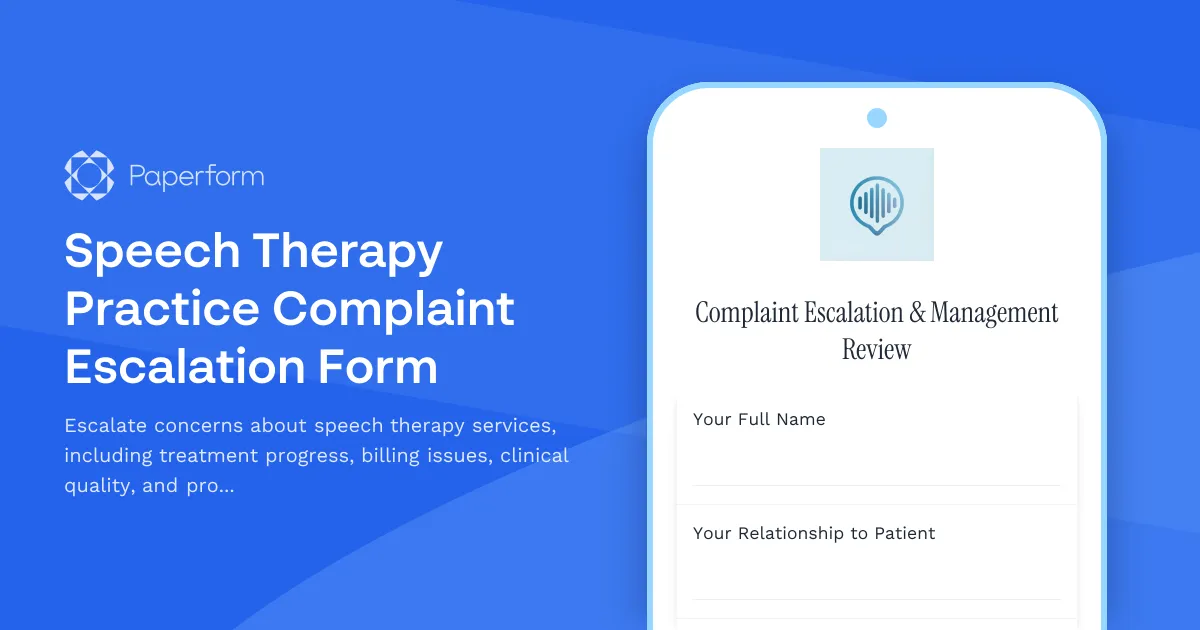
Professional Speech Therapy Complaint Escalation Form
When concerns arise about speech therapy services—whether related to treatment progress, insurance billing, clinical quality, or professional conduct—having a clear escalation path is essential for both patient advocacy and practice improvement. This Speech Therapy Practice Complaint Escalation Form provides a structured, respectful channel for patients, caregivers, and referring providers to raise serious concerns that require management review.
Why Speech Therapy Practices Need a Formal Escalation Process
Speech-language pathology services involve vulnerable populations, including children with developmental delays, adults recovering from stroke or brain injury, and individuals with complex communication needs. When standard feedback channels don't resolve concerns—or when issues involve clinical safety, professional boundaries, or billing disputes—a formal escalation process protects both patients and providers.
This template helps speech therapy practices, rehabilitation centers, pediatric clinics, and healthcare facilities:
- Document clinical concerns about treatment effectiveness, assessment accuracy, or progress reporting
- Address insurance and billing disputes including authorization issues, claim denials, and payment discrepancies
- Review professional standards related to therapist conduct, scope of practice, and ethical obligations
- Track quality indicators for continuous improvement and risk management
- Maintain compliance with state licensing boards, ASHA standards, and healthcare regulations
Key Features for Healthcare Complaint Management
This form captures essential details for thorough management review:
- Complaint categorization to route issues to the appropriate department or reviewer
- Patient and service information with privacy protections for sensitive health data
- Timeline documentation to establish when issues began and what resolution attempts have been made
- Conditional logic that adapts follow-up questions based on complaint type
- Supporting documentation upload for clinical notes, billing statements, or correspondence
- Desired resolution fields to understand complainant expectations and facilitate mediation
Who Benefits from This Template
Speech-Language Pathologists in private practice can demonstrate professionalism and accountability by maintaining a transparent escalation process that goes beyond informal conversations.
Pediatric Therapy Clinics serving children with autism, apraxia, or developmental language disorders can use this form to address parent concerns about IEP coordination, treatment intensity, or developmental milestone achievement.
Hospital Rehabilitation Departments need structured escalation for post-stroke or traumatic brain injury patients whose families have concerns about discharge planning, therapy frequency, or functional outcomes.
Skilled Nursing Facilities can route concerns about swallowing safety, cognitive-communication therapy, or resident advocacy through a documented management review process.
School-Based Speech Therapy Programs can handle concerns from parents, teachers, or administrators about service delivery models, caseload sizes, or evaluation procedures.
Streamline Resolution with Paperform and Automation
Built with Paperform, this template goes beyond simple complaint logging. The professional, accessible design ensures families and caregivers can clearly articulate concerns, while conditional logic tailors the form experience to the specific issue type.
When a complaint is submitted, you can:
- Route notifications automatically to the practice manager, clinical director, or compliance officer based on complaint category
- Create case files in your practice management system or CRM to track resolution progress
- Trigger follow-up workflows using Stepper to schedule investigative interviews, document reviews, or mediation meetings
- Generate acknowledgment emails with case numbers and expected response timeframes
- Flag high-priority issues that involve patient safety, licensing violations, or legal exposure
Integration with tools like Google Sheets, Airtable, Slack, or your EHR system means complaint data flows into your existing quality assurance and risk management workflows without manual data entry.
Professional Standards and Ethical Practice
For ASHA-certified clinicians, maintaining a formal complaint process demonstrates adherence to the ASHA Code of Ethics, particularly principles related to competence, communication, and accountability. For state-licensed practitioners, documented escalation procedures provide evidence of good faith efforts to resolve disputes and can be protective in the event of licensing board inquiries.
This form template helps practices balance patient advocacy with fair investigation—giving complainants a voice while ensuring therapists receive due process during internal reviews.
Addressing Common Speech Therapy Complaint Scenarios
Progress Concerns: Parents or caregivers who feel their child isn't making expected gains can detail specific communication goals, therapy frequency, and what progress indicators they expected versus what they've observed.
Billing and Insurance Issues: Patients can upload EOBs and billing statements when they've been charged incorrectly, had claims denied unexpectedly, or received services that weren't pre-authorized.
Clinical Quality Indicators: Referring physicians, case managers, or family members can raise concerns about assessment procedures, treatment plan appropriateness, or adherence to evidence-based practices.
Professional Conduct: Issues related to therapist punctuality, communication style, boundary concerns, or scope-of-practice questions can be documented for HR or clinical director review.
Build Trust Through Transparency
Having a clear escalation process demonstrates to patients and families that your practice takes concerns seriously and is committed to continuous improvement. Rather than fearing complaints, forward-thinking practices use structured escalation as a quality assurance tool—identifying system issues, training gaps, and opportunities to enhance the patient experience.
Paperform makes it easy to create complaint forms that are accessible, WCAG-compliant, and available 24/7, so concerns can be raised when they're fresh rather than festering into larger disputes. With secure data handling, encrypted submissions, and role-based access controls, you can maintain confidentiality throughout the investigation process.
Start with this template, customize it to your practice's specific escalation protocols, and integrate it with your quality management workflows to turn patient concerns into opportunities for excellence in speech-language pathology services.
More templates like this
Addiction Treatment Facility Patient Complaint Escalation Form
A comprehensive escalation form for addiction treatment facilities to manage patient complaints involving clinical care quality, insurance authorization issues, and accreditation body notifications.
Behavior Therapy Practice Parent Complaint Escalation Form
A comprehensive escalation form for parents to raise concerns about behavior therapy services, treatment effectiveness, insurance barriers, clinical supervision, and overall outcomes for their child's care.
Crisis Intervention Service Complaint Escalation Form
Report and escalate serious concerns about crisis intervention services including response time failures, clinical quality issues, training deficiencies, and matters requiring management or accreditation review.
Dental Patient Complaint Escalation Form
A comprehensive escalation form for dental practices to professionally manage patient complaints, treatment concerns, and informed consent issues with built-in peer review and regulatory reporting pathways.
Healthcare Office Relocation Patient Communication Form
Notify patients of your practice relocation and manage appointment rescheduling, medical records transfer, and accessibility needs for a seamless transition to your new location.
Healthcare Practice Patient Referral Form
A streamlined patient referral form for healthcare practices to collect new patient information, condition details, and manage referral rewards while maintaining privacy standards.
Medical Records Management Complaint Escalation Form
Professional escalation form for healthcare organizations to document and escalate medical records complaints including release delays, accuracy issues, privacy breaches, and HIPAA compliance concerns requiring management review.
Pediatric Mental Health Screening Consent Form
A comprehensive consent form for pediatric mental health screening that includes parental authorization, HIPAA compliance, family history assessment, school performance review, and medication considerations.
Residential Treatment Program Application for Adolescent Depression
Comprehensive application form for adolescent residential mental health treatment programs, including intake assessment, safety evaluation, academic planning, and family visitation preferences.
Telemental Health Complaint Escalation Form
A comprehensive escalation form for telemental health platforms to handle serious complaints about prescriber concerns, crisis response, licensure issues, and clinical supervision.
ABA Therapy Callback Request Form
A specialized callback form for families seeking Applied Behavior Analysis (ABA) therapy services. Collects essential information about the child, autism diagnosis, and insurance status to help providers prepare for consultations.
Accelerated Resolution Therapy (ART) Session Booking Form
Book your Accelerated Resolution Therapy session for rapid trauma processing and PTSD symptom reduction. Complete treatment typically takes 1-5 sessions using evidence-based techniques.