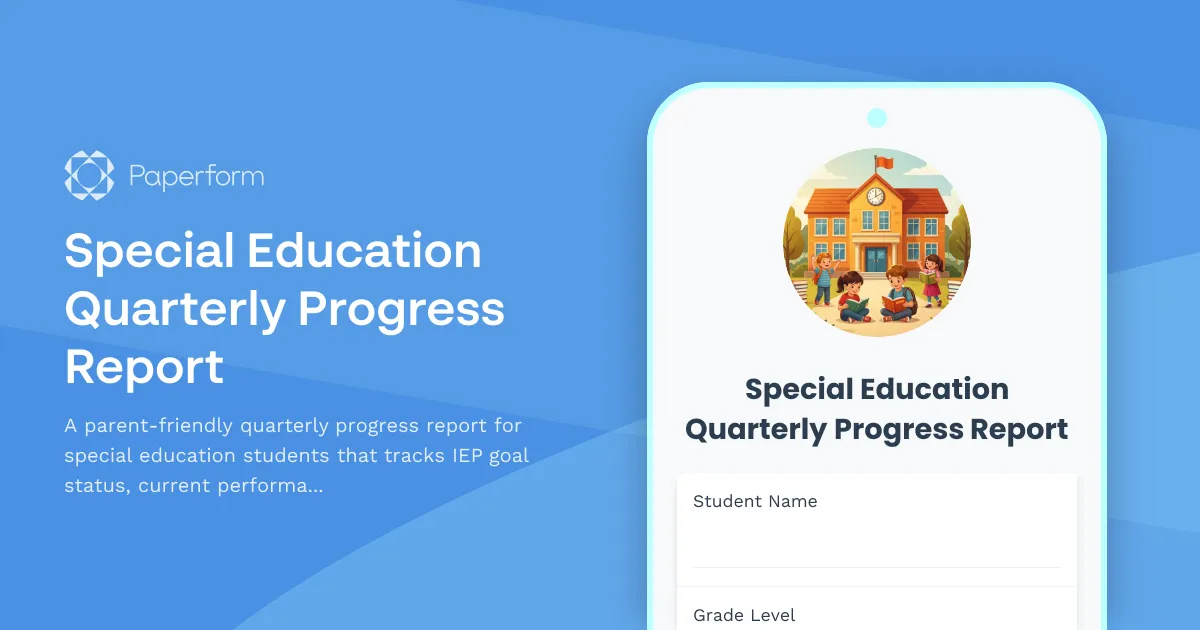
Special education progress reporting is essential for keeping families informed and engaged in their child's learning journey. This Special Education Quarterly Progress Report template makes it easy for teachers, special education coordinators, and support staff to create comprehensive, parent-friendly progress updates that meet compliance requirements while remaining accessible and actionable.
Built for special education teachers, resource specialists, and school administrators, this template streamlines the quarterly reporting process by capturing goal progress, current performance levels, work samples, and practical strategies families can use at home. Instead of juggling multiple documents or struggling with generic report formats, educators can deliver clear, personalized updates that help parents understand their child's growth and how to support continued progress between reporting periods.
Paperform makes special education documentation easier by combining form fields, calculations, and conditional logic in one intuitive platform. Educators can customize the template to match their district's IEP framework, embed it on secure school portals, and use Stepper (stepper.io) to automatically route completed reports to administrators for review, notify parents via email, or sync data to student information systems. For schools requiring parent signatures on progress reports, Papersign (papersign.com) lets you turn each submission into a legally binding eSignature document, creating a complete audit trail without printing a single page.
Whether you're reporting on academic goals, behavioral objectives, or functional skills, this template helps you maintain compliance, strengthen family partnerships, and ensure every student's progress is clearly documented and celebrated.
More templates like this
Acting Class Student Performance Video Release Form
A comprehensive video release form for acting schools to obtain consent from students for using performance footage in demo reels, promotional materials, and industry showcases.
Adapted Curriculum Modification Form
A comprehensive form for documenting curriculum modifications and alternate achievement standards for students with significant cognitive disabilities, focusing on functional skill development and individualized learning goals.
Adapted Physical Education Evaluation Request Form
A comprehensive evaluation request form for adapted physical education programs, assessing gross motor skills, fitness levels, adaptive equipment needs, and inclusive sports participation opportunities for students with diverse abilities.

Agriculture Scholarship Nomination Form
A comprehensive nomination form for agriculture scholarships that evaluates 4-H or FFA project records, farm management experience, rural community service contributions, and includes agricultural educator recommendations.
AP Accommodations Request Form for Students with Disabilities
Request testing accommodations for AP exams including extended time, separate testing environment, and assistive technology. Streamlines the College Board SSD approval process for students with documented disabilities.
Assistive Technology Evaluation Request Form
Request an assistive technology evaluation for students with learning barriers. Assess current technology use, identify needs, and connect with AT specialists for personalized support.
Auditory Processing Disorder Support Plan
A comprehensive support plan form for students with auditory processing disorder, documenting classroom accommodations, sensory needs, and therapy collaboration for optimal learning.
Augmentative and Alternative Communication (AAC) Device Trial Request Form
Request a trial of AAC devices for students or individuals with communication needs. Assess current communication methods, device preferences, training requirements, and funding options to support communication goals.
Autism Social Narrative Creation Form
Create personalized social stories and visual narratives for students with autism to support social understanding, expected behaviors, and skill generalization across different environments.
Autism Spectrum Disorder Diagnostic Observation Consent Form
A comprehensive consent and information form for ASD diagnostic observation including ADOS-2 assessment, parent interview, school observation, and multidisciplinary team evaluation.
Autism Spectrum Support Services Intake Form
A comprehensive intake form for autism spectrum support services that captures sensory profiles, communication preferences, social skills assessments, and behavior patterns to create personalized support plans.
Back to School Standardized Testing Accommodation Request Form
A comprehensive form for students to request testing accommodations for standardized exams, including disability documentation, specific needs, time extensions, and environment preferences.