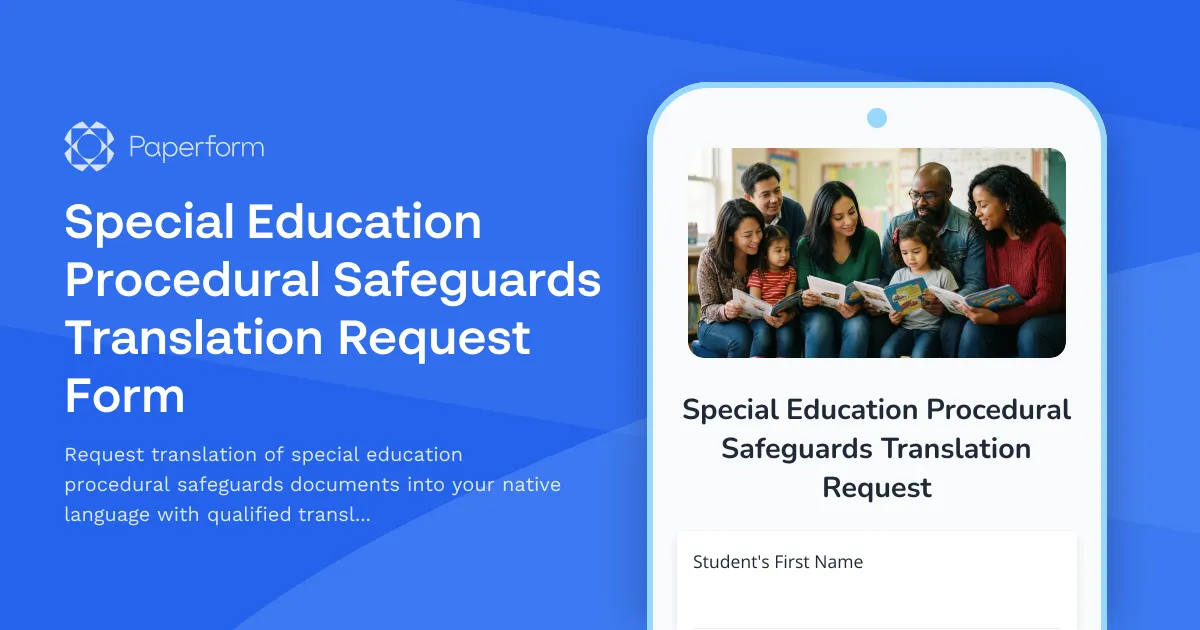
Special Education Procedural Safeguards Translation Request Form
Every parent has the right to understand their child's special education rights in their native language. Our Special Education Procedural Safeguards Translation Request Form makes it simple for school districts, special education departments, and education agencies to collect and process translation requests for critical procedural safeguards documents.
Why Translation Access Matters in Special Education
Under IDEA (Individuals with Disabilities Education Act), parents must receive procedural safeguards notices in their native language or other mode of communication, unless it's clearly not feasible. This isn't just a legal requirement—it's about ensuring every family can meaningfully participate in their child's education.
When parents understand their rights regarding evaluations, IEP meetings, dispute resolution, and consent procedures, they become empowered advocates for their children. Language barriers should never prevent families from accessing the support and services their children deserve.
How This Form Template Helps
This comprehensive form template streamlines the entire translation request process for educational institutions:
- Collect essential student and family information while maintaining privacy and compliance
- Identify specific language needs including dialects and regional variations
- Determine document urgency to prioritize critical translation requests
- Capture accessibility requirements such as Braille, large print, or audio formats
- Document preferred delivery methods to ensure families receive materials in the most helpful format
- Gather cultural adaptation preferences to make documents more meaningful for diverse communities
The form is designed with both administrators and families in mind, making it easy for parents to submit requests through any device while giving staff the structured data they need to fulfill requests efficiently.
Perfect for School Districts and Education Agencies
This template is ideal for:
- Special education departments managing translation services for IEP processes
- School district administrators ensuring IDEA compliance across multiple schools
- Education service agencies coordinating translation resources for member districts
- Multilingual education coordinators tracking and fulfilling language access requests
- Student services teams working with diverse family populations
Whether you're a small rural district or a large urban school system, this form helps you meet federal requirements while building trust with multilingual families.
Streamline With Paperform's Smart Features
Paperform makes this form even more powerful with features designed for education workflows:
- Conditional logic shows or hides questions based on language selection, urgency level, or accessibility needs
- File uploads let families attach relevant documents that need translation
- Email notifications alert the right team members immediately when urgent requests come in
- Integration with Stepper to automatically route translation requests to qualified translators, track completion status, and notify families when documents are ready
- Custom success pages provide families with clear next steps and expected timelines in their language
Connect this form to your student information system, CRM, or project management tool through Stepper to create an automated workflow that tracks each request from submission to delivery.
Compliance and Accessibility Built In
Educational institutions need forms that respect student privacy and meet accessibility standards. This Paperform template is built on a platform that's SOC 2 Type II certified and GDPR compliant, giving you peace of mind about data security.
The form itself can be embedded directly into your school website, shared via parent portals, or sent through multilingual communications—and it works beautifully on any device, making it easy for families to submit requests from home or on the go.
Making Special Education More Equitable
When families can read and understand procedural safeguards in their native language, they're better equipped to:
- Make informed decisions about evaluations and services
- Participate meaningfully in IEP meetings
- Understand their rights regarding discipline and placement
- Navigate dispute resolution processes when needed
- Exercise informed consent at every stage
This form template is a small but significant step toward educational equity, ensuring that language differences don't create barriers to accessing special education rights and services.
Getting Started
With Paperform's intuitive editor, you can customize this template to match your district's specific requirements, add your logo and brand colors, and adjust questions to reflect your local procedures—all without writing a single line of code.
Whether you're implementing a new multilingual support initiative or improving an existing process, this Special Education Procedural Safeguards Translation Request Form gives you a professional, compliant starting point that respects the needs of every family you serve.
Start collecting translation requests more efficiently and ensure every parent can understand their child's special education rights, regardless of the language they speak at home.
More templates like this
Bilingual IEP Meeting Interpretation Request Form
Request qualified interpretation services for IEP meetings, including native language support, document translation, and cultural liaison assistance to ensure effective communication for all families.
Nonverbal Communication Assessment Form
A comprehensive assessment tool for evaluating nonverbal communication methods in students with complex needs, including gestures, vocalizations, eye gaze, and AAC systems.
Adapted Curriculum Modification Form
A comprehensive form for documenting curriculum modifications and alternate achievement standards for students with significant cognitive disabilities, focusing on functional skill development and individualized learning goals.
Adapted Physical Education Evaluation Request Form
A comprehensive evaluation request form for adapted physical education programs, assessing gross motor skills, fitness levels, adaptive equipment needs, and inclusive sports participation opportunities for students with diverse abilities.
AP Accommodations Request Form for Students with Disabilities
Request testing accommodations for AP exams including extended time, separate testing environment, and assistive technology. Streamlines the College Board SSD approval process for students with documented disabilities.
Assistive Technology Evaluation Request Form
Request an assistive technology evaluation for students with learning barriers. Assess current technology use, identify needs, and connect with AT specialists for personalized support.
Auditory Processing Disorder Support Plan
A comprehensive support plan form for students with auditory processing disorder, documenting classroom accommodations, sensory needs, and therapy collaboration for optimal learning.
Augmentative and Alternative Communication (AAC) Device Trial Request Form
Request a trial of AAC devices for students or individuals with communication needs. Assess current communication methods, device preferences, training requirements, and funding options to support communication goals.
Autism Spectrum Disorder Diagnostic Observation Consent Form
A comprehensive consent and information form for ASD diagnostic observation including ADOS-2 assessment, parent interview, school observation, and multidisciplinary team evaluation.
Autism Spectrum Support Services Intake Form
A comprehensive intake form for autism spectrum support services that captures sensory profiles, communication preferences, social skills assessments, and behavior patterns to create personalized support plans.
Back to School Standardized Testing Accommodation Request Form
A comprehensive form for students to request testing accommodations for standardized exams, including disability documentation, specific needs, time extensions, and environment preferences.
Bilingual Special Education Assessment Request Form
Request a comprehensive bilingual special education evaluation with language dominance testing, cultural considerations, and qualified evaluator assignment for students in multilingual households.