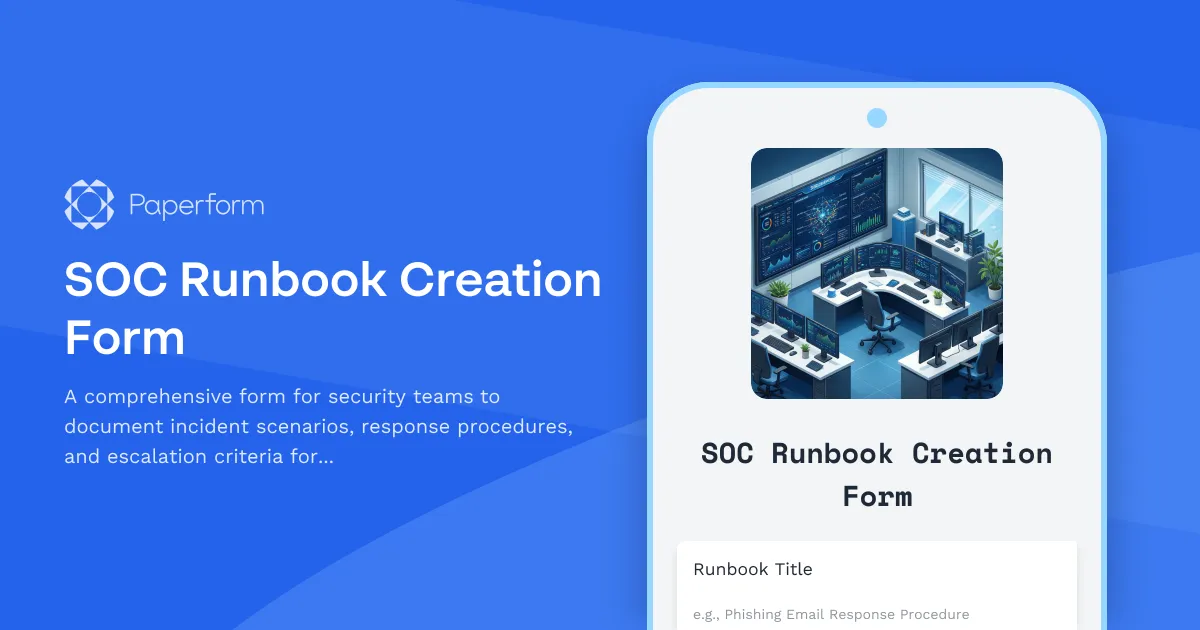
Build SOC Runbooks That Keep Your Security Team Ready
A Security Operations Center runbook is your team's playbook when incidents strike. Without clear, documented procedures, security incidents can spiral into confusion, delayed response times, and increased damage. This SOC Runbook Creation Form helps security teams standardize their incident response documentation in one central, accessible place.
Built for IT security teams, SOC analysts, and security managers, this template guides you through capturing every critical detail: incident scenarios, step-by-step response procedures, required tools and access, escalation thresholds, and post-incident actions. Instead of scattered Word docs or wikis that go out of date, you can use Paperform to collect structured runbook submissions from your team and maintain a living library of security procedures.
Why security teams choose Paperform for runbook documentation
Paperform's document-style editor makes it easy to create forms that match your security team's workflows. Add conditional logic to show different fields based on incident severity or type, embed reference materials directly in the form, and use calculated fields to auto-generate runbook IDs or priority scores.
Once a runbook is submitted, connect it to your security stack using Stepper (stepper.io) to automatically create tickets in Jira, update your incident management platform, notify team leads in Slack, or push the runbook to your documentation repository. This keeps your SOC playbooks current and accessible when seconds matter.
Whether you're building runbooks for phishing attacks, DDoS incidents, data breaches, or insider threats, this template provides the structure your security operations team needs to respond consistently and confidently. Trusted by IT security teams worldwide, Paperform offers SOC 2 Type II compliance, SSO, and role-based access controls to keep your security documentation secure.
Start building your SOC runbook library today and ensure your team knows exactly what to do when an incident occurs.



More templates like this
Cybersecurity Incident Report Form
Report and document cybersecurity incidents with threat classification, affected systems tracking, and automatic escalation to security leadership.
Infrastructure Security Incident Response Form
Report and respond to infrastructure security incidents with threat classification, containment protocols, forensic preservation, and stakeholder communication tracking.
Backup and Disaster Recovery Security Audit Form
A comprehensive security audit form for evaluating backup systems, encryption compliance, restoration testing, and offsite storage protocols to ensure business continuity and data protection.
Cloud Workload Protection Platform Effectiveness Review
Comprehensive assessment form for evaluating cloud workload protection platform performance, including container runtime security, serverless coverage, and threat detection capabilities.
Data Center Server Room Access Request Form
Request secure access to data center server rooms with two-factor authentication setup, equipment authorization, and compliance acknowledgment for IT professionals and technicians.
Incident Response Team On-Call Rotation Management Form
Streamline your incident response team's on-call rotations with skill coverage tracking, escalation contact verification, and burnout prevention monitoring to ensure your security operations run smoothly.
IT Security Compliance Attestation Workflow Change Request
A comprehensive form for managing IT security compliance change requests, enabling control owners to submit attestations, review evidence, and track certification deadlines throughout the approval workflow.
IT Security Tool Integration Testing Change Request
A comprehensive change request form for IT security tool integration testing, including connectivity validation, data flow verification, and performance benchmarking assessments.
Malware Analysis Report Form
Document malware incidents with behavioral analysis, IoCs, and containment recommendations. Track threat details, system impact, and security response actions in one structured report.
Network Security Incident Log
A comprehensive form for logging network security incidents, intrusion detection alerts, firewall rule analysis, and threat intelligence correlation. Streamline your incident response process with structured data collection.
Privileged Access Management Change Request Form
Streamline privileged access requests with automated approval workflows, audit trails, and time-based access controls for enhanced security compliance.
Quantum-Safe Cryptography Readiness Assessment
Evaluate your organization's preparedness for post-quantum cryptography threats with a comprehensive assessment of current cryptographic algorithms, migration planning, and implementation roadmap.