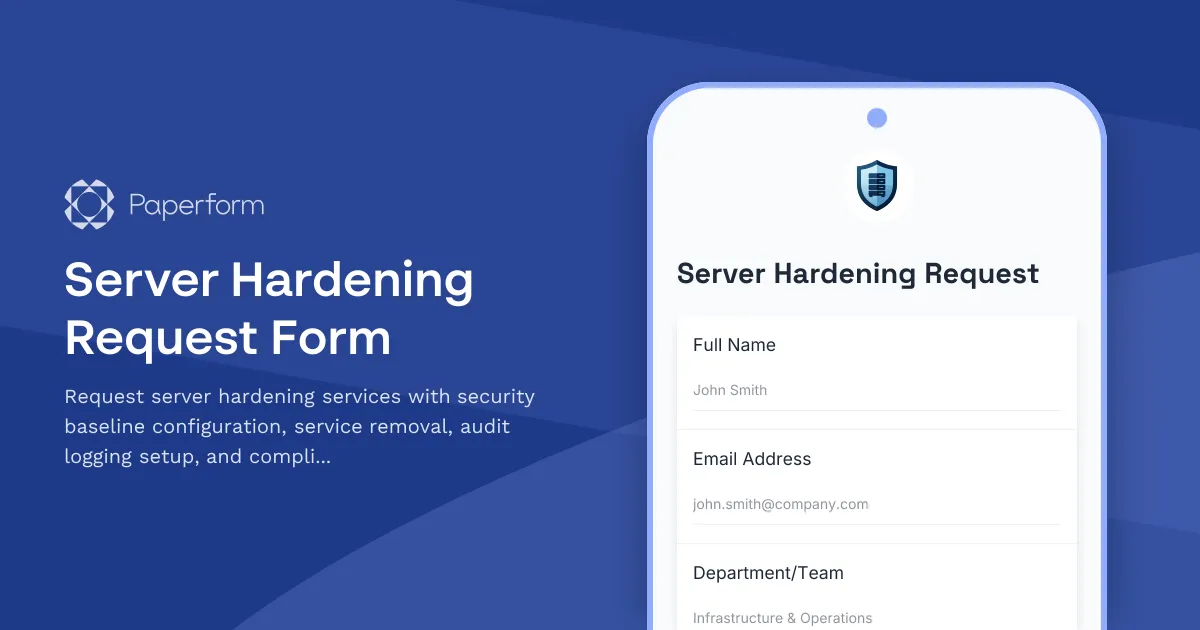
Strengthen Your IT Infrastructure with Professional Server Hardening
Server security is non-negotiable in today's threat landscape. Whether you're managing on-premise infrastructure, cloud environments, or hybrid systems, a server hardening request form streamlines how your IT and security teams assess, prioritize, and execute critical security configurations across your server estate.
This Server Hardening Request Form template is built for IT departments, managed service providers, security operations teams, and infrastructure managers who need a standardized, repeatable process for implementing security baselines, removing unnecessary services, configuring comprehensive audit logging, and verifying compliance with industry standards like CIS, NIST, PCI DSS, HIPAA, and SOC 2.
Why IT teams choose Paperform for server hardening requests
Traditional server hardening workflows often involve lengthy email threads, unclear requirements, and inconsistent implementations across environments. This template replaces scattered documentation with a single, structured intake process that captures all the essential details your security and infrastructure teams need to harden servers correctly the first time.
Paperform's conditional logic ensures requesters only see relevant questions based on their server type, operating system, and compliance requirements—keeping the form streamlined while gathering comprehensive technical details. IT professionals can select from predefined security baselines (CIS Benchmarks, DISA STIGs, vendor-specific hardening guides), specify which unnecessary services to disable, define audit logging requirements, and indicate compliance frameworks that must be verified.
The form integrates seamlessly with your existing IT service management stack. Connect submissions to ServiceNow, Jira Service Management, or Freshservice to automatically create tickets with complete hardening specifications. Use Stepper (stepper.io) to build automated workflows that route requests to the appropriate security or infrastructure team, trigger approval processes for production systems, schedule hardening maintenance windows, and send status updates as work progresses.
Built for security-conscious IT operations
This template addresses the full spectrum of server hardening requirements across diverse environments:
- Security baseline selection: Choose from industry-standard frameworks including CIS Benchmarks (Level 1/Level 2), DISA STIGs, NIST 800-53 controls, vendor hardening guides, or custom organizational baselines
- Operating system coverage: Support for Windows Server, Linux distributions (RHEL, Ubuntu, CentOS, Debian), Unix variants, and cloud-optimized OS images
- Unnecessary service removal: Identify and document services, ports, protocols, and software components to disable or remove to reduce attack surface
- Audit logging configuration: Specify logging requirements for security events, access attempts, configuration changes, privileged operations, and compliance-relevant activities
- Compliance verification: Align hardening activities with regulatory and industry standards including PCI DSS, HIPAA, SOC 2, ISO 27001, FedRAMP, and GDPR
- Environment specification: Differentiate requirements across development, staging, and production environments with appropriate urgency and change control
- Rollback planning: Document backup and rollback procedures to ensure safe implementation
Automate your security operations workflow
Once a hardening request is submitted through Paperform, Stepper becomes your automation engine for the entire remediation lifecycle. Build workflows that:
- Route requests to specialized teams based on OS type, environment, or compliance framework
- Trigger automated pre-hardening assessments using vulnerability scanning or configuration management tools
- Create change requests in your ITSM platform with complete hardening specifications
- Send approval notifications to security leads or change advisory boards for production systems
- Schedule maintenance windows based on business impact and system criticality
- Update CMDB records with new security configurations and baseline versions
- Generate post-hardening compliance reports and archive them in your documentation system
- Send completion notifications with verification evidence to the original requester
This level of automation transforms server hardening from a manual, inconsistent process into a standardized, auditable security practice that scales across your infrastructure.
Who benefits from this template
IT security teams use this form to enforce consistent hardening standards across all server deployments, ensuring every system meets minimum security baselines before going into production.
Infrastructure engineers and system administrators rely on it to clearly communicate hardening requirements, track hardening tasks alongside other infrastructure work, and maintain documentation of security configurations.
Managed service providers implement it to standardize hardening services across multiple clients, demonstrate due diligence in security operations, and provide transparent hardening workflows that clients can track.
Compliance officers appreciate the built-in compliance framework mapping, which ensures server configurations support audit requirements and regulatory obligations without additional documentation overhead.
DevOps and platform teams integrate it into infrastructure-as-code pipelines and automated provisioning workflows, ensuring new server instances are hardened according to organizational standards from day one.
Security, compliance, and enterprise-ready
Paperform is SOC 2 Type II compliant and offers enterprise features that IT security professionals require: SSO for centralized authentication, roles and permissions for segregation of duties, data residency controls for regulatory compliance, and comprehensive audit logging of all form submissions and changes.
All server hardening requests are encrypted in transit and at rest, with granular access controls ensuring only authorized personnel can view sensitive infrastructure details. You can configure submission retention policies, set up scheduled exports to your security information and event management (SIEM) system, and maintain complete audit trails for compliance verification.
Get started in minutes
Simply customize this template with your organization's security baselines, compliance requirements, and approval workflows. Embed it in your IT portal, link it from your intranet, or share it directly with infrastructure and development teams. As hardening requests flow in, you'll have structured, actionable data that drives consistent security outcomes across your entire server infrastructure.
Whether you're managing a handful of critical servers or thousands of instances across multi-cloud environments, this server hardening request form brings clarity, consistency, and compliance to one of IT security's most essential practices.


More templates like this
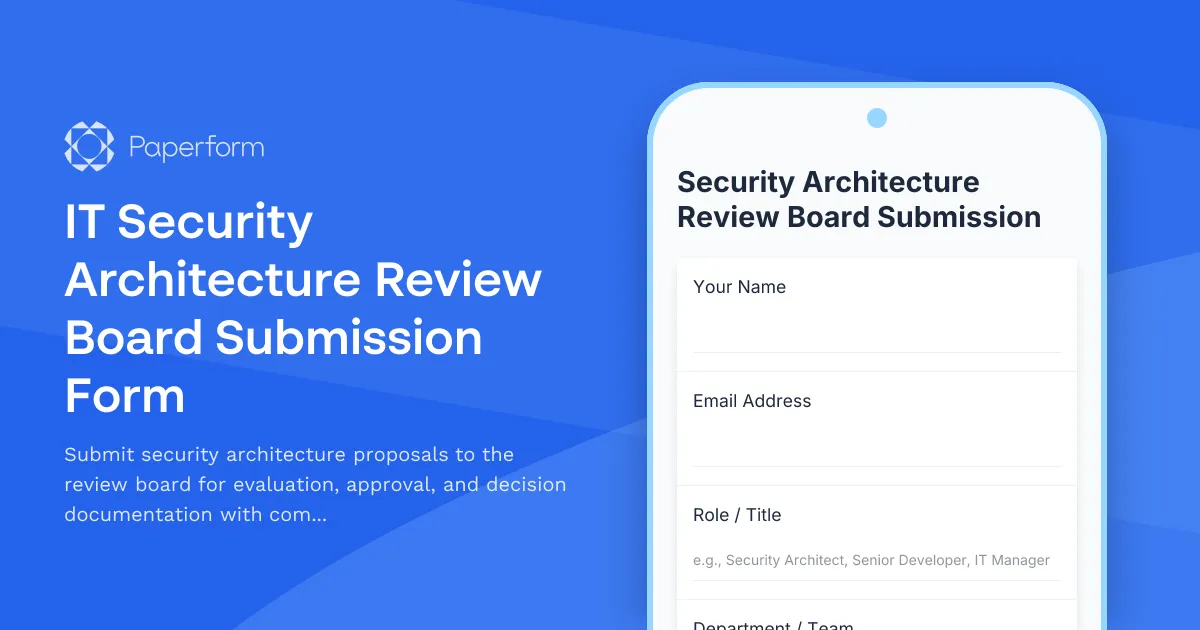
IT Security Architecture Review Board Submission Form
Submit security architecture proposals to the review board for evaluation, approval, and decision documentation with comprehensive risk assessments and compliance considerations.
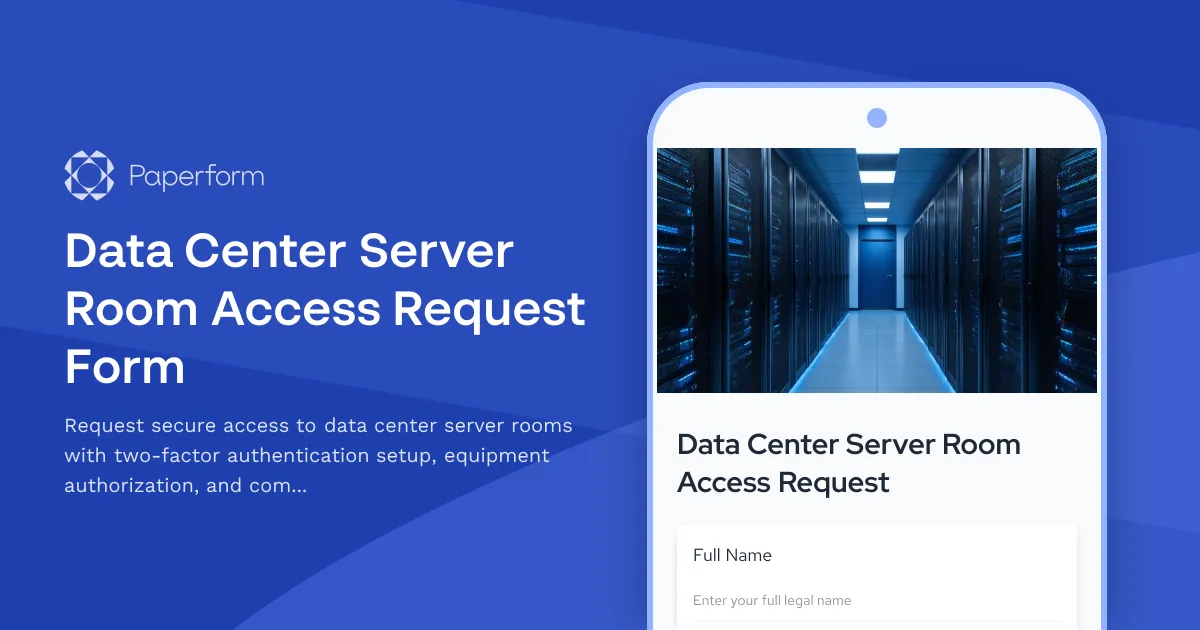
Data Center Server Room Access Request Form
Request secure access to data center server rooms with two-factor authentication setup, equipment authorization, and compliance acknowledgment for IT professionals and technicians.
Disaster Recovery Platform Access Request
Request access to disaster recovery orchestration platforms with failover testing permissions, recovery plan execution rights, and RTO/RPO monitoring capabilities.
IT Compliance Audit Remediation Change Request Form
A comprehensive form for requesting and tracking IT compliance audit remediation changes, including finding resolution, evidence collection, and verification procedures for compliance teams.
IT Network Segmentation Change Request Form
Submit network segmentation change requests including VLAN configuration, security zones, and access control list modifications with technical details and approval workflow.
IT Security Architecture Decision Record (ADR) Change Request
Document security architecture decisions, technical choices, and rationale with structured approval workflows for IT change management and governance.
IT Security Architecture Exception Approval Form
Request and approve security architecture exceptions with technical justifications, alternative approaches, risk assessments, and time-bound permissions for IT change management.
IT Security Architecture Roadmap Update Change Request
Submit and track IT security architecture roadmap changes, strategic initiatives, technology adoption plans, and investment requests for approval.
Network DDoS Mitigation Request Form
Submit a request to activate DDoS protection services, configure traffic scrubbing parameters, set detection thresholds, and whitelist legitimate traffic sources for your network infrastructure.
Privileged Access Management Change Request Form
Streamline privileged access requests with automated approval workflows, audit trails, and time-based access controls for enhanced security compliance.
Quantum-Safe Cryptography Readiness Assessment
Evaluate your organization's preparedness for post-quantum cryptography threats with a comprehensive assessment of current cryptographic algorithms, migration planning, and implementation roadmap.
Server Confidential Computing Enablement Request Form
Request and configure confidential computing environments with trusted execution environment (TEE) setup, enclave configuration, remote attestation, and secure key management for sensitive workloads.