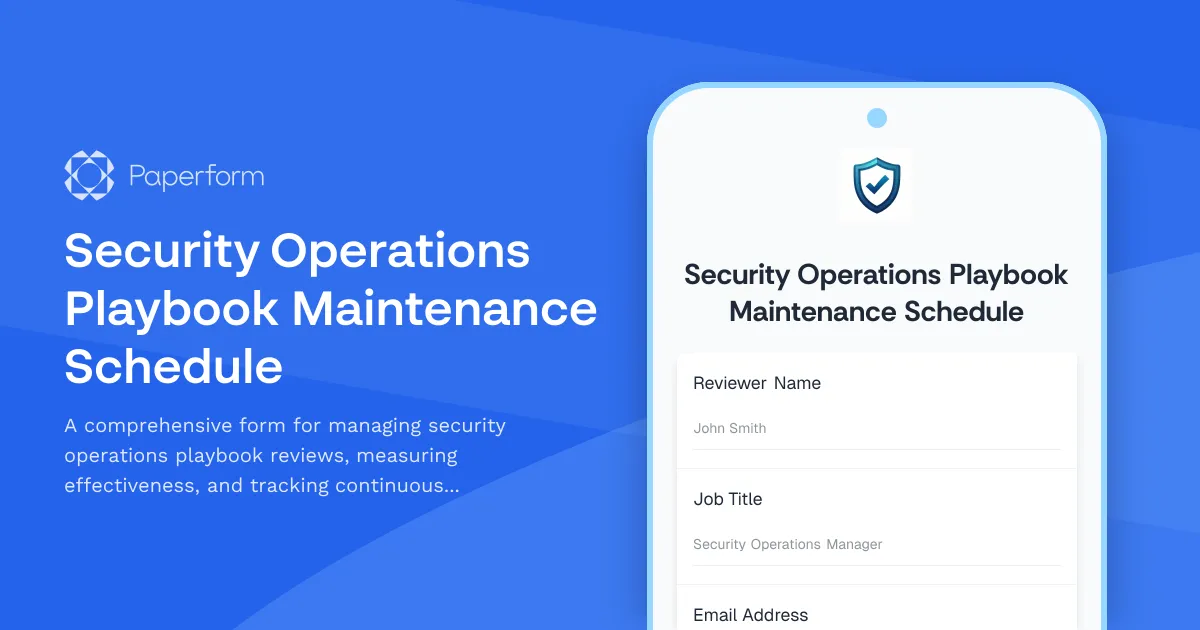
Streamline Your Security Operations Playbook Management
Maintaining up-to-date security operations playbooks is critical for IT teams managing incidents, audits, and threat responses. This Security Operations Playbook Maintenance Schedule template helps security operations centers (SOCs), IT security teams, and compliance officers establish a systematic review process that ensures playbooks remain effective, relevant, and aligned with evolving threats.
Why Use This Template?
Security playbooks become outdated quickly as threat landscapes shift, technologies evolve, and organizational priorities change. This template provides a structured approach to quarterly playbook reviews, effectiveness measurement, and continuous improvement tracking—all in one centralized form that integrates seamlessly with your security operations workflow.
With Paperform, you can customize this template to match your organization's specific playbook categories, review cycles, and improvement metrics. The form captures essential details about playbook performance, identifies gaps, and documents action items for future enhancements.
Automate Your Security Workflow
Take your security operations to the next level by connecting this form to Stepper (stepper.io), Paperform's AI-native workflow automation platform. Automatically route completed reviews to security team leads, update your playbook repository, notify stakeholders of critical findings, and create tracked improvement tasks in your project management system—all without writing a single line of code. Stepper ensures that every playbook review translates into actionable improvements that strengthen your security posture.
Built for Security Professionals
Whether you're managing incident response playbooks, compliance audit procedures, or threat mitigation strategies, this template adapts to your needs. IT security managers, SOC analysts, compliance officers, and security consultants trust Paperform to deliver professional, secure forms that integrate with their existing security stack while maintaining SOC 2 Type II compliance standards.
Get started today and build a proactive security operations culture where playbooks are living documents that continuously evolve to meet emerging challenges.

More templates like this
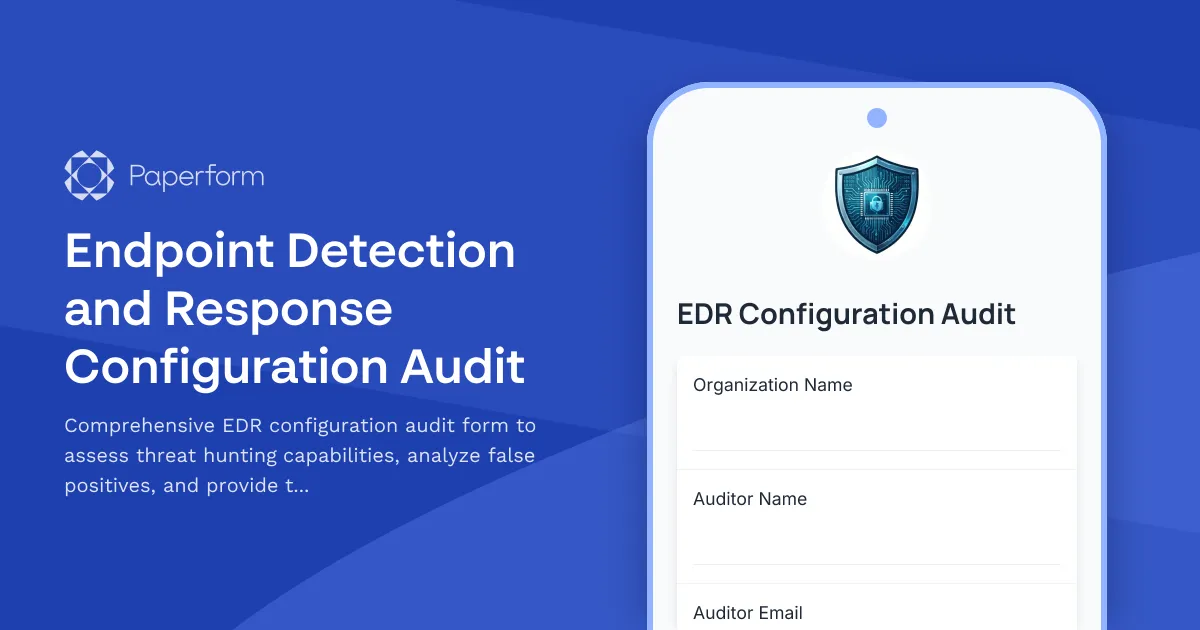
Endpoint Detection and Response Configuration Audit
Comprehensive EDR configuration audit form to assess threat hunting capabilities, analyze false positives, and provide tuning recommendations for optimal endpoint security performance.
ISO 27001 Internal Audit Checklist
A comprehensive ISO 27001 internal audit form for systematically testing information security controls, tracking non-conformities, and planning corrective actions across all Annex A domains.
Security Incident Severity Classification Form
A comprehensive form for classifying security incidents, assessing business impact, mapping data classifications, and defining escalation criteria to ensure rapid and appropriate incident response.
Cloud Workload Protection Platform Effectiveness Review
Comprehensive assessment form for evaluating cloud workload protection platform performance, including container runtime security, serverless coverage, and threat detection capabilities.
Cybersecurity Awareness Training Quiz
Test employee knowledge on phishing detection, password security, and data protection with this comprehensive cybersecurity awareness quiz designed for workplace training programs.
Cybersecurity Exception Approval Request Form
A comprehensive form for requesting cybersecurity policy exceptions with risk assessment, compensating controls, business justification, and remediation plans requiring CISO authorization.
Cybersecurity Incident Post-Mortem Report
Conduct thorough post-incident analysis with attack vector documentation, response timeline tracking, and security gap identification to strengthen your organization's cybersecurity posture.
Ethical Hacking Consultant NDA & Engagement Agreement
Comprehensive non-disclosure agreement for ethical hacking consultants covering security assessment confidentiality, penetration test results protection, and remediation consulting payment terms.
Firewall Rule Review and Cleanup Form
A comprehensive form for IT security teams to review firewall rules, identify unused or overly permissive access, and validate business justifications for rule retention or removal.
FISMA Compliance Annual Assessment Form
Comprehensive FISMA compliance assessment form for federal contractors to verify NIST 800-53 security controls and document continuous monitoring evidence for annual audits.
Identity and Access Management Quarterly Review Form
Conduct comprehensive IAM quarterly reviews with user provisioning audits, role-based access validation, and orphaned account identification to maintain security compliance and minimize access risks.
IT Air-Gapped System Change Request Form
Secure change request form for air-gapped systems with data transfer procedures, security controls, and multi-level approval workflow for high-security IT environments.