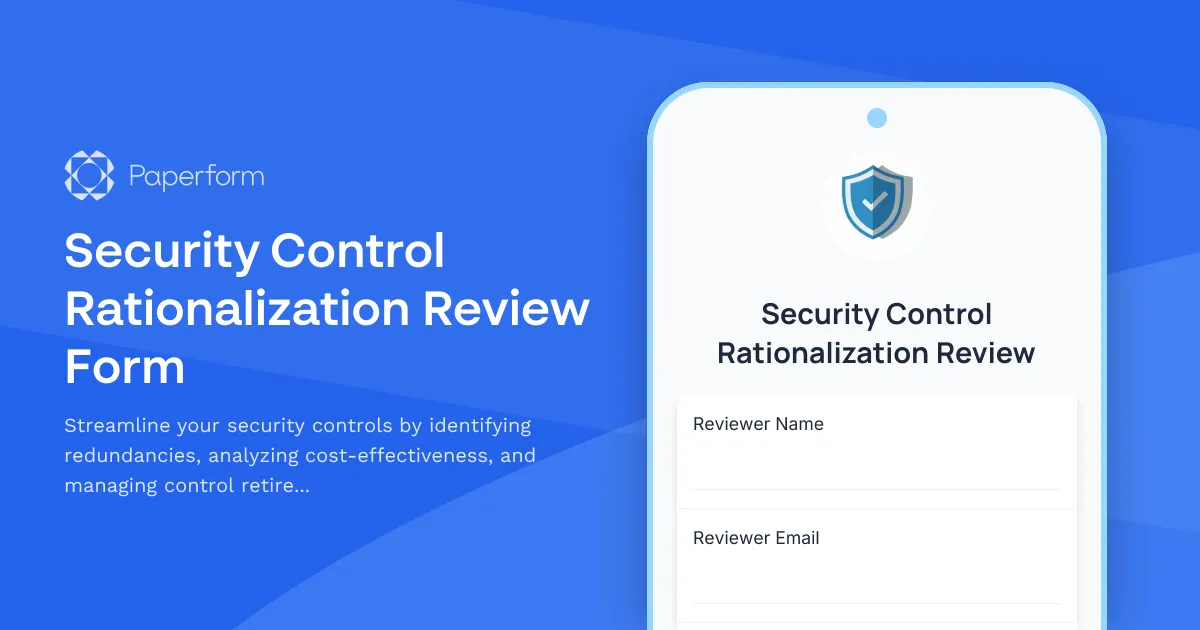
Optimize Your Security Posture with Smart Control Rationalization
In today's complex cybersecurity landscape, organizations often accumulate overlapping security controls over time—leading to bloated budgets, operational inefficiencies, and audit confusion. This Security Control Rationalization Review Form helps IT security teams, compliance officers, and CISOs systematically evaluate their security control environment to identify redundancies, assess cost-effectiveness, and make informed decisions about control retirement.
Why Security Control Rationalization Matters
As your organization grows and evolves, security controls can multiply without proper oversight. Multiple tools might monitor the same threats, legacy controls may overlap with newer solutions, and maintenance costs can spiral without delivering proportional value. Regular rationalization reviews help you maintain an efficient, effective security program that balances protection with practicality.
This form template provides a structured framework for evaluating each security control against key criteria including coverage overlap, operational costs, effectiveness metrics, and business impact—ensuring retirement decisions are data-driven and properly documented for audit purposes.
Built for Security and Compliance Teams
Whether you're a CISO managing enterprise security architecture, a security analyst conducting control assessments, an IT auditor reviewing compliance frameworks, or a GRC professional optimizing your security program, this template streamlines the entire rationalization process.
The form captures comprehensive details about each control under review, from technical specifications and framework mappings to cost data and stakeholder input. Conditional logic ensures reviewers only see relevant questions based on their responses, while built-in calculations help quantify redundancy levels and cost-benefit ratios.
Paperform Makes Complex Workflows Simple
With Paperform's document-style editor, you can customize this template to match your organization's specific control frameworks (NIST, ISO 27001, CIS Controls, etc.), add your branding, and embed it directly into your security portal or intranet. The form works beautifully whether accessed from a security operations center or remotely by distributed teams.
Integration with your existing security ecosystem is seamless. Connect submissions to your GRC platform, ticketing systems like ServiceNow or Jira, or collaboration tools like Slack and Microsoft Teams. Use Stepper to automate multi-stage approval workflows—routing control retirement requests through security architects, compliance teams, and executive stakeholders based on risk scores and cost thresholds, then automatically updating your CMDB or asset management systems once approved.
From Assessment to Action
Each submission generates a complete rationalization report with redundancy analysis, cost-benefit calculations, and recommended actions. Security teams can track all control reviews in one central location, maintain audit trails for compliance purposes, and ensure nothing slips through the cracks during the retirement process.
The form includes sections for identifying overlapping controls, calculating total cost of ownership, assessing risk impact if controls are retired, and capturing approval from relevant stakeholders. This structured approach ensures your team considers all angles before removing any security safeguard.
Professional Documentation and Audit Readiness
When auditors ask "How do you ensure your security controls remain relevant and cost-effective?", you'll have documented evidence of your rationalization process. The form creates a clear paper trail showing due diligence in control evaluation, stakeholder consultation, and risk-based decision making.
For organizations managing multiple control reviews simultaneously, Paperform's submission management features let you filter, sort, and analyze results across your entire control inventory—identifying patterns and prioritizing rationalization efforts where they'll deliver the most value.
Trusted by Security-Conscious Organizations
Paperform is SOC 2 Type II and GDPR compliant, ensuring your sensitive security control data is handled with appropriate safeguards. Role-based permissions let you control who can view, submit, or manage rationalization reviews, while data residency options ensure compliance with regional requirements.
Over 500,000 teams worldwide trust Paperform to handle their most important workflows. With 30,000+ templates and a flexible platform that grows with your needs, Paperform helps security teams work smarter—not harder.
Start rationalizing your security control environment today with this professional, ready-to-use template that brings structure to one of cybersecurity's most challenging optimization tasks.



More templates like this
Cybersecurity Incident Post-Mortem Report
Conduct thorough post-incident analysis with attack vector documentation, response timeline tracking, and security gap identification to strengthen your organization's cybersecurity posture.
IT Security Incident Response Communication Change Request Form
Request changes to security incident response communication protocols, including notification groups, escalation paths, and stakeholder contact information.
Cyber Crisis Communication Drill Evaluation Form
Evaluate crisis communication readiness with media simulation exercises, spokesperson performance reviews, and message consistency checks for cybersecurity incidents.
Cybersecurity Breach Incident Report
Report and document cybersecurity breaches, data exposures, and security incidents with comprehensive system impact assessment and executive notification workflow.
Data Breach Incident Report Form
Document and manage data breach incidents with comprehensive system impact analysis, user assessment, response tracking, and regulatory notification timelines.
IT Security Policy Version Control Change Request Form
Submit, track, and approve security policy changes with version control, approval workflow, and publication management for IT governance and compliance.
Security Incident Lessons Learned Report
Comprehensive post-incident analysis form for documenting security incident timelines, decision points, root causes, and process improvements to strengthen future incident response.
Security Investment Portfolio Review & Budget Allocation
A comprehensive security investment analysis form for evaluating budget allocation, identifying control coverage gaps, and prioritizing strategic security initiatives across your organization.
Cybersecurity Exception Approval Request Form
A comprehensive form for requesting cybersecurity policy exceptions with risk assessment, compensating controls, business justification, and remediation plans requiring CISO authorization.
Insider Threat Investigation Form
Investigate behavioral analytics alerts for potential insider threats with user baseline analysis, HR correlation, and structured escalation workflows for security teams.
IT Security Architecture Decision Record (ADR) Change Request
Document security architecture decisions, technical choices, and rationale with structured approval workflows for IT change management and governance.
IT Security Architecture Exception Approval Form
Request and approve security architecture exceptions with technical justifications, alternative approaches, risk assessments, and time-bound permissions for IT change management.