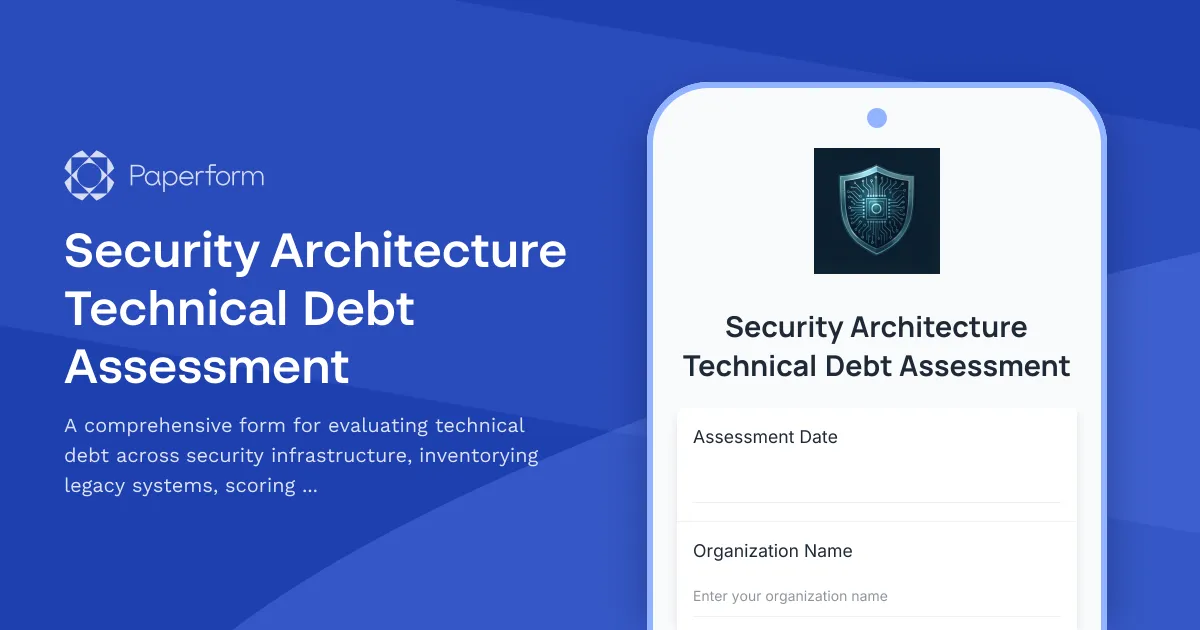
Assess and Modernize Your Security Architecture with Paperform
Technical debt in security architecture isn't just an IT headache—it's a business risk. Legacy systems, outdated protocols, and patchwork security measures create vulnerabilities that can expose your organization to breaches, compliance failures, and operational inefficiencies. This Security Architecture Technical Debt Assessment template helps IT teams, security professionals, and technology leaders systematically evaluate their security posture, identify modernization priorities, and build actionable remediation roadmaps.
Built for IT departments, managed service providers, security consultancies, and enterprise technology teams, this template replaces scattered spreadsheets and disconnected audit tools with a single, structured assessment form. Capture detailed legacy system inventories, score modernization urgency across multiple criteria, and document remediation strategies—all in one place.
Paperform's conditional logic ensures assessors only see questions relevant to their specific security stack, while calculation fields automatically score risk and priority levels based on factors like system age, vulnerability exposure, compliance requirements, and business impact. Once submitted, responses flow directly into your project management tools, ticketing systems, or security information platforms via Stepper, Paperform's AI-native workflow builder, triggering the right next steps for remediation planning and resource allocation.
Whether you're conducting quarterly security reviews, preparing for compliance audits, or building a multi-year modernization strategy, this template gives you the structured data you need to make informed decisions about where to invest your security budget and engineering resources. SOC 2 Type II compliance and enterprise-grade security controls mean your sensitive infrastructure assessments stay protected throughout the process.

More templates like this
Cybersecurity Implementation Scope of Work Form
Define project scope, assess risks, and establish security controls for cybersecurity implementation projects. Includes training plans, incident response protocols, and monitoring requirements.
Cybersecurity Incident Post-Mortem Report
Conduct thorough post-incident analysis with attack vector documentation, response timeline tracking, and security gap identification to strengthen your organization's cybersecurity posture.
Ethical Hacking Consultant NDA & Engagement Agreement
Comprehensive non-disclosure agreement for ethical hacking consultants covering security assessment confidentiality, penetration test results protection, and remediation consulting payment terms.
IT Security Architecture Decision Record (ADR) Change Request
Document security architecture decisions, technical choices, and rationale with structured approval workflows for IT change management and governance.
IT Supply Chain Security Change Request Form
Comprehensive IT change request form for supply chain security assessments, including vendor evaluations, software bill of materials (SBOM), and risk analysis for secure technology implementations.
Security Investment Portfolio Review & Budget Allocation
A comprehensive security investment analysis form for evaluating budget allocation, identifying control coverage gaps, and prioritizing strategic security initiatives across your organization.
Server Confidential Computing Enablement Request Form
Request and configure confidential computing environments with trusted execution environment (TEE) setup, enclave configuration, remote attestation, and secure key management for sensitive workloads.
SOAR Playbook Effectiveness Review
Evaluate your security orchestration, automation, and response playbooks with comprehensive metrics tracking, MTTR analysis, and actionable workflow optimization recommendations.
Cloud Workload Protection Platform Effectiveness Review
Comprehensive assessment form for evaluating cloud workload protection platform performance, including container runtime security, serverless coverage, and threat detection capabilities.
Cybersecurity Consulting Business Banking Application
A comprehensive business banking account application designed specifically for cybersecurity consulting firms handling penetration testing payments, compliance audits, incident response retainers, and training revenue streams.
Cybersecurity Exception Approval Request Form
A comprehensive form for requesting cybersecurity policy exceptions with risk assessment, compensating controls, business justification, and remediation plans requiring CISO authorization.
Cybersecurity Vulnerability Assessment Quiz
Evaluate your organization's cybersecurity posture, identify threat exposures, assess compliance gaps, and prioritize risk mitigation strategies with this comprehensive vulnerability assessment.