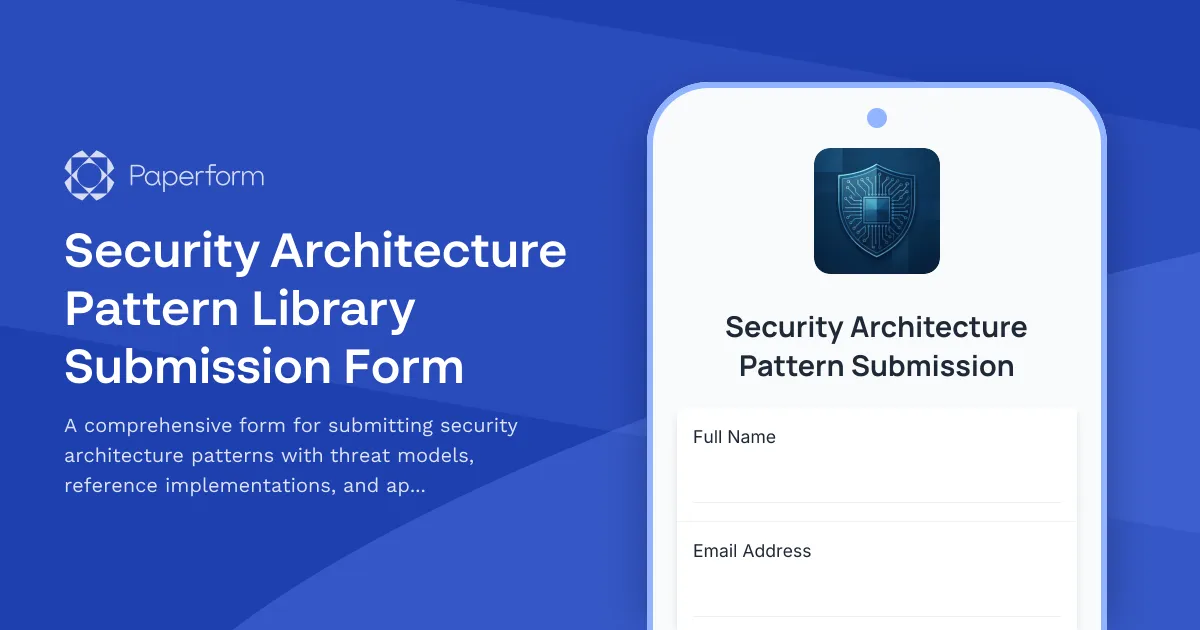
Build a Robust Security Architecture Pattern Library
Security architecture patterns are the foundation of consistent, scalable security across your organization. This Security Architecture Pattern Library Submission Form streamlines the process of documenting, reviewing, and approving new patterns for your enterprise architecture team.
Whether you're an IT security architect, DevSecOps engineer, or infrastructure lead, this template helps you capture every critical detail—from threat models and attack vectors to reference implementations and approved technology stacks—in a structured, standardized format.
What You Can Do With This Template
- Document security patterns systematically with clear descriptions, use cases, and security objectives
- Capture comprehensive threat models including STRIDE analysis, attack vectors, and mitigation strategies
- Link reference implementations with code repositories, diagrams, and deployment guides
- Track approved technology stacks and component dependencies for consistent tooling
- Enable security review workflows that route submissions to the right stakeholders
- Maintain compliance requirements and regulatory mappings for each pattern
Perfect for IT Security Teams
This form is designed for organizations that take security architecture seriously. IT security teams, cloud architects, and DevSecOps professionals can use it to build a centralized pattern library that promotes reusable security solutions, reduces risk, and accelerates secure development.
Paperform's conditional logic lets you show or hide fields based on pattern type, sensitivity level, or compliance requirements. Embed the form on your internal wiki, share it with your architecture review board, or integrate it directly into your governance workflows.
Automate Your Security Workflow
Connect this form to your existing tools using Stepper, Paperform's AI-native workflow builder. Automatically route submissions to security architects for review, create tickets in Jira or ServiceNow, update your architecture repository in Confluence or Notion, and notify stakeholders when patterns are approved—all without writing a single line of code.
With Paperform's SOC 2 Type II compliance, SSO support, and role-based permissions, you can confidently manage sensitive security documentation while maintaining audit trails and access controls your enterprise requires.
More templates like this
Privileged Access Management Change Request Form
Streamline privileged access requests with automated approval workflows, audit trails, and time-based access controls for enhanced security compliance.
Blockchain Smart Contract Security Audit Form
Comprehensive security audit form for blockchain smart contracts covering reentrancy vulnerabilities, access control, gas optimization, and code analysis with detailed findings documentation.
Cybersecurity Incident Report Form
Report and document cybersecurity incidents with threat classification, affected systems tracking, and automatic escalation to security leadership.
Identity Management System Change Request Form
A comprehensive IT form for requesting identity management changes, including SSO integration, MFA setup, user provisioning, and access modifications with approval workflows.
IT Security Compliance Attestation Workflow Change Request
A comprehensive form for managing IT security compliance change requests, enabling control owners to submit attestations, review evidence, and track certification deadlines throughout the approval workflow.
Security Incident Communication & Stakeholder Notification Form
Streamline security incident reporting, stakeholder notifications, and regulatory compliance with this comprehensive communication template designed for IT security teams.
Security Policy Exception Request & Approval Form
A comprehensive form for requesting exceptions to security policies, including risk assessment, compensating controls, and approval workflow with annual recertification tracking.
Security Tool Consolidation Assessment Form
A comprehensive form for evaluating security tool redundancy, scoring vendor capabilities, and planning migration strategies to optimize your security stack and reduce costs.
Security Training Needs Assessment Form
Evaluate security training requirements across your organization with role-based assessments, skill gap analysis, and certification tracking to build a comprehensive security awareness program.
SOC Runbook Creation Form
A comprehensive form for security teams to document incident scenarios, response procedures, and escalation criteria for Security Operations Center (SOC) runbooks.
Vulnerability Coordination Case Management Form
Professional vulnerability disclosure coordination form for security researchers and vendors. Track vulnerability reports, manage researcher communications, coordinate vendor notifications, and schedule responsible public disclosures.
API Integration Support Ticket Form
A comprehensive support ticket form for developers experiencing API integration issues, including endpoint documentation, authentication problems, rate limiting, and error code troubleshooting.