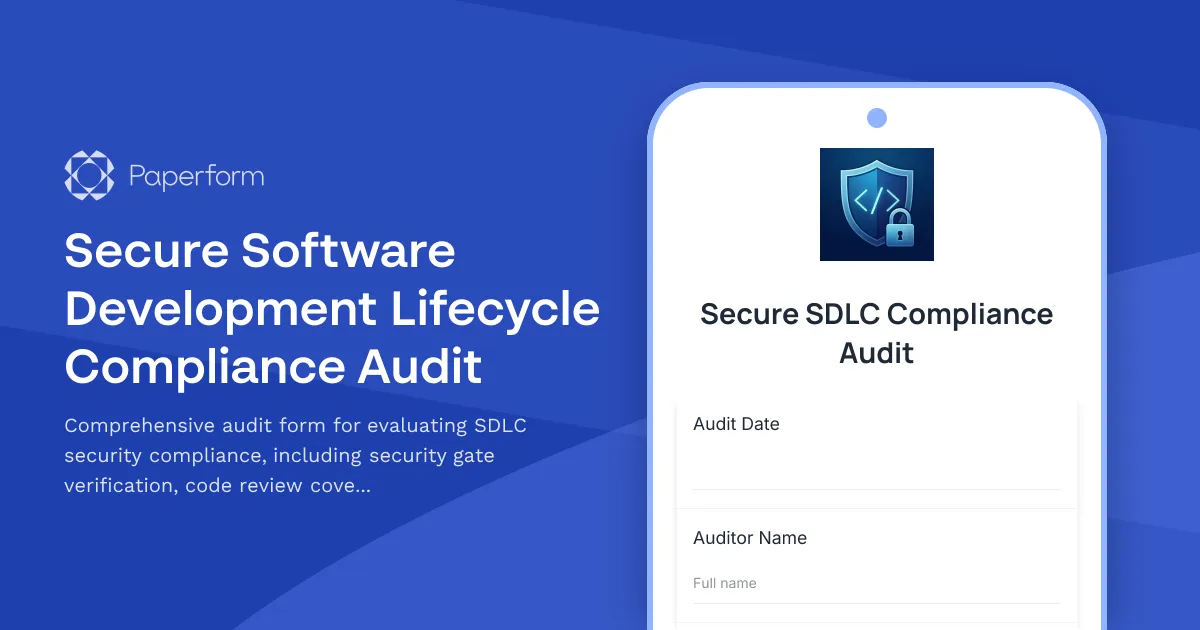
Secure Your Software Development with Comprehensive SDLC Compliance Audits
In today's threat landscape, embedding security into every phase of the software development lifecycle isn't optional—it's critical. This Secure SDLC Compliance Audit template helps IT security teams, DevSecOps engineers, and compliance officers systematically evaluate security controls, gate verifications, and testing integration across your development pipeline.
Whether you're preparing for SOC 2 compliance, ISO 27001 certification, or implementing internal security standards, this template provides a structured framework to assess code review coverage, security testing practices, vulnerability management, and access controls throughout your SDLC.
Built for Security and Development Teams
This audit form is designed for organizations that need to:
- Verify security gate compliance at each SDLC phase (requirements, design, development, testing, deployment)
- Assess code review coverage and secure coding practices
- Evaluate security testing integration including SAST, DAST, SCA, and penetration testing
- Document security controls for compliance and audit purposes
- Identify gaps in your secure development practices
Streamline Your Security Audit Workflow
Using Paperform's conditional logic, this template adapts based on audit findings—flagging critical issues and requesting additional documentation only when needed. You can embed calculations to automatically score compliance levels and use AI Insights to identify patterns across multiple audits.
Connect your audit workflow to your existing tools using Stepper to automatically create tickets in Jira, notify security teams in Slack, update compliance tracking in Airtable, or trigger remediation workflows based on audit severity. This keeps your security team focused on fixing issues rather than managing spreadsheets.
For organizations requiring digital sign-off on audit findings and remediation plans, integrate Papersign to capture secure eSignatures from development leads, security officers, and compliance stakeholders—maintaining a complete audit trail.
Trusted by Security-Conscious Organizations
This template supports IT security teams, DevSecOps engineers, compliance officers, CISOs, and security consultants working in software development, SaaS, fintech, healthcare tech, and any organization building secure applications. With Paperform's SOC 2 Type II compliance and enterprise-grade security, your audit data stays protected while remaining accessible to authorized stakeholders.
More templates like this
Cybersecurity Exception Approval Request Form
A comprehensive form for requesting cybersecurity policy exceptions with risk assessment, compensating controls, business justification, and remediation plans requiring CISO authorization.
Data Breach Incident Report Form
Document and manage data breach incidents with comprehensive system impact analysis, user assessment, response tracking, and regulatory notification timelines.
Ethical Hacking Consultant NDA & Engagement Agreement
Comprehensive non-disclosure agreement for ethical hacking consultants covering security assessment confidentiality, penetration test results protection, and remediation consulting payment terms.
IT Cloud Security Posture Management Change Request Form
A comprehensive cloud security change request form with automated misconfiguration detection, compliance validation, and remediation workflow triggers for IT teams managing cloud infrastructure security.
IT Supply Chain Security Change Request Form
Comprehensive IT change request form for supply chain security assessments, including vendor evaluations, software bill of materials (SBOM), and risk analysis for secure technology implementations.
Privileged Access Management Change Request Form
Streamline privileged access requests with automated approval workflows, audit trails, and time-based access controls for enhanced security compliance.
Third-Party Vendor Data Sharing Access Request Form
A comprehensive form for managing third-party vendor data access requests, including data processing agreement requirements, security assessments, and purpose limitation controls for IT and compliance teams.
AI Model Deployment Approval Form
A comprehensive approval form for AI model deployments that evaluates training data, bias assessment, performance metrics, security controls, and ethical considerations before production release.
Bug Bounty Security Researcher Terms & Responsible Disclosure Agreement
Comprehensive bug bounty program terms for security researchers, including responsible disclosure guidelines, payout criteria, scope definitions, and legal safe harbor provisions to protect ethical hackers.
Cybersecurity Breach Incident Report
Report and document cybersecurity breaches, data exposures, and security incidents with comprehensive system impact assessment and executive notification workflow.
Identity and Access Management Quarterly Review Form
Conduct comprehensive IAM quarterly reviews with user provisioning audits, role-based access validation, and orphaned account identification to maintain security compliance and minimize access risks.
ISO 27001 Internal Audit Checklist
A comprehensive ISO 27001 internal audit form for systematically testing information security controls, tracking non-conformities, and planning corrective actions across all Annex A domains.