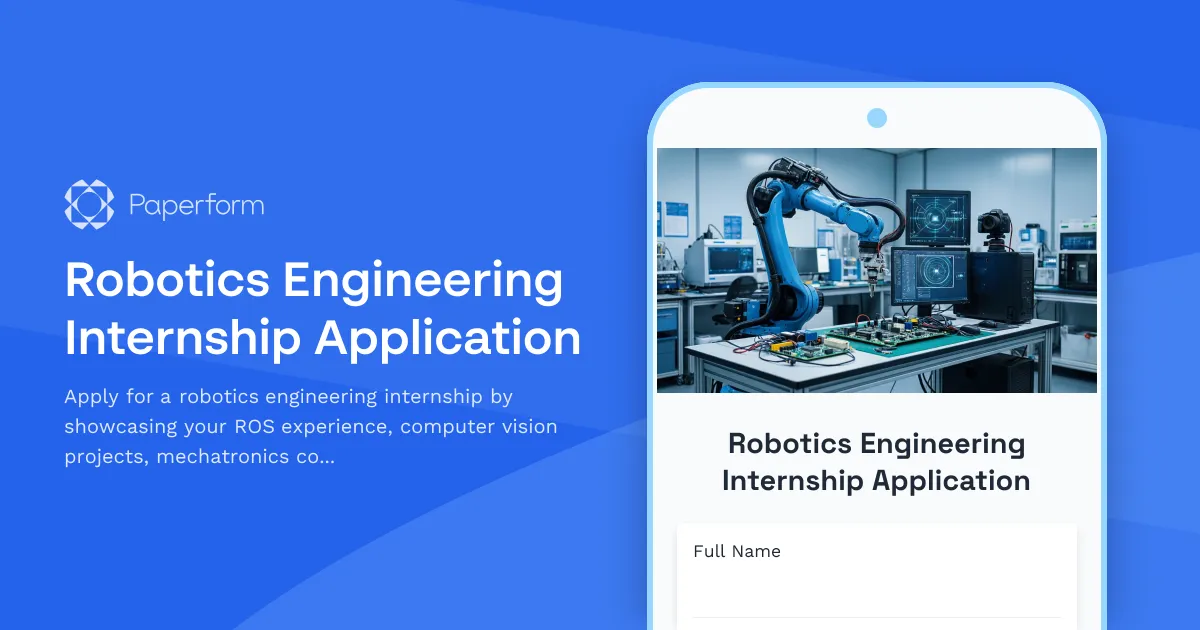
Robotics Engineering Internship Application Form
Finding the right robotics engineering intern requires more than just reviewing résumés—you need to understand their hands-on experience with ROS (Robot Operating System), their computer vision project portfolio, their mechatronics foundation, and where their passion for automation lies. This Robotics Engineering Internship Application form is designed specifically for companies in the robotics, automation, and advanced manufacturing sectors looking to identify talented students and early-career engineers who can contribute to cutting-edge projects.
Why Use This Form for Your Robotics Internship Program?
Traditional application processes often miss the technical depth needed to evaluate robotics candidates. This template goes beyond basic qualifications to capture:
- ROS proficiency and practical experience with specific distributions, packages, and real-world implementations
- Computer vision project portfolios including frameworks used, problem domains tackled, and measurable outcomes
- Mechatronics coursework and competencies across mechanical design, electronics, control systems, and programming
- Industry and application area preferences to match candidates with the right teams and projects
- Project links and code repositories so you can assess actual work, not just descriptions
For robotics companies, automation consultancies, research labs, and manufacturing innovators, this form streamlines technical screening while creating a candidate experience that signals you understand the field.
What Makes This Robotics Application Form Different?
This isn't a generic internship application adapted for engineering—it's purpose-built for the robotics domain:
Technical Depth: Questions probe ROS navigation stacks, computer vision pipelines, sensor integration, and control theory understanding, helping you identify candidates who can contribute from day one rather than requiring months of onboarding.
Portfolio-First Approach: By collecting GitHub repositories, project videos, and technical write-ups inline, hiring managers and technical leads can review actual implementations during initial screening, dramatically improving hiring quality.
Industry Alignment: Candidates indicate interest in specific automation sectors (manufacturing, logistics, agriculture, healthcare robotics, etc.), making it easy to route applications to the right teams or identify overlaps with current R&D priorities.
Academic-to-Industry Bridge: The form balances academic coursework with practical project experience, helping you evaluate both theoretical foundation and hands-on problem-solving ability—critical for internships that need to deliver value in 12–16 weeks.
Who Should Use This Form?
This template is ideal for:
- Robotics companies building autonomous systems, collaborative robots, or intelligent automation solutions
- Research labs and innovation centers working on computer vision, motion planning, or human-robot interaction
- Manufacturing and logistics firms deploying industrial automation, warehouse robotics, or smart factory initiatives
- Startups in agtech, construction robotics, or service robotics seeking engineering talent with multidisciplinary skills
- Engineering consultancies that need interns who can jump into client projects involving sensors, actuators, and embedded systems
Streamline Technical Screening and Hiring Workflows
Paperform makes it easy to turn this application into a complete hiring pipeline. Use conditional logic to show follow-up questions based on experience level (e.g., ask PhD candidates about publications, ask undergrads about coursework). Customize confirmation emails to set clear expectations about timeline and next steps, and integrate with your ATS or Notion database to keep all candidate information organized.
For teams that want to move fast, you can use Stepper (stepper.io) to automate what happens after submit: route robotics applications to technical leads, send assessment tasks to qualified candidates, schedule video interviews, and keep everyone updated via Slack—all without manual copying and pasting.
If your internship requires signed agreements (NDAs, IP assignment, or remote work policies), you can pair this form with Papersign (papersign.com) to send contracts for eSignature as soon as a candidate is selected, keeping the entire process in one connected system.
Customize for Your Robotics Program
Every robotics internship is different. You might be focused on soft robotics and bio-inspired design, industrial pick-and-place optimization, autonomous navigation in GPS-denied environments, or human-robot collaboration in healthcare settings. This template gives you a strong foundation, and Paperform's doc-style editor makes it simple to add domain-specific questions, embed explainer videos about your lab or product, or link to open-source projects you contribute to.
Adjust the required fields, change the visual theme to match your brand, and use Paperform's calculation and scoring features if you want to auto-rank candidates based on weighted criteria (e.g., ROS experience + vision projects + relevant coursework).
Why Paperform for Robotics and Engineering Hiring?
Paperform is trusted by innovative engineering teams because it combines beautiful, on-brand forms with powerful backend features. You get a hiring experience that feels modern and thoughtful—important for attracting top talent—while maintaining the technical depth and data structure you need for rigorous evaluation.
With SOC 2 Type II compliance, robust integrations with tools like Google Sheets, Airtable, HubSpot, and Slack, and advanced features like conditional workflows and calculated fields, Paperform scales from startup internship programs to enterprise co-op rotations at global robotics companies.
Start attracting exceptional robotics engineering interns today with a form that understands the field as well as you do.
More templates like this
Digital Twin Simulation Internship Application
Apply for an internship focused on digital twin technology, IoT sensor integration, predictive maintenance algorithms, industrial metaverse, and real-time data visualization.
Electrochromic Smart Glass Technology Internship Application
Apply for an internship focused on electrochromic smart glass, chromogenic materials, building automation, and dynamic glazing control systems.
Satellite Communications Internship Application
Apply for a satellite communications internship position with this comprehensive form covering RF engineering background, ground station experience, and space industry expertise.
AI & Machine Learning Internship Application
A comprehensive application form for AI and machine learning internship positions, collecting technical skills, project experience, research implementations, and ethical considerations.
Autonomous Vehicle Testing Internship Application
Apply for an autonomous vehicle testing internship. Share your sensor fusion knowledge, simulation experience, safety certifications, and ethical decision-making skills.
Electromagnetic Launcher Systems Internship Application
Apply for an internship in electromagnetic launcher technology, including railgun physics, hypervelocity projectiles, naval weapons systems, and space launch applications.
Reversible Adhesive Technology Internship Application
Apply for an internship in reversible adhesive technology, working with gecko-inspired materials, pressure-sensitive adhesives, and biomimetic engineering solutions.
Smart Dust Sensor Networks Internship Application
Apply for an internship focused on smart dust sensor networks, MEMS technology, wireless power transmission, and IoT edge computing. Join our team working on cutting-edge environmental monitoring systems.
Stratospheric Solar Power Internship Application
Apply for an internship in stratospheric solar power technology, focusing on high-altitude platforms, wireless power transmission, and renewable energy systems.
Vertical Takeoff Aircraft Development Internship Application
Apply for an internship in advanced vertical takeoff aircraft development. Showcase your aerodynamics expertise, eVTOL simulation experience, and commitment to the future of urban air mobility.
Voice Assistant AI Internship Application
Apply for a voice assistant AI internship position. Submit your conversational design portfolio, NLP projects, and accessibility experience.
Aerospace Engineering Internship Application
Apply for aerospace engineering internships with specialized questions on CAD proficiency, propulsion systems knowledge, security clearance status, and ITAR compliance.