Radiation Safety Officer Training Needs Analysis Form
Maintaining compliance with radiation safety regulations requires continuous professional development and skills assessment. This Radiation Safety Officer Training Needs Analysis form template helps healthcare facilities, research institutions, industrial operations, and nuclear facilities identify critical skill gaps and prioritize training investments for their radiation safety personnel.
Whether you're managing a hospital radiology department, research laboratory, or industrial radiography operation, this comprehensive assessment tool evaluates competency across five essential domains: regulatory compliance, dosimetry monitoring, safety protocols, equipment calibration, and incident response procedures.
Why Use Paperform for Radiation Safety Training Assessment?
Paperform gives radiation safety managers and compliance officers a professional, ALARA-principle-aligned platform to conduct thorough training needs assessments without requiring technical skills. The conditional logic engine adapts questions based on facility type and current certification levels, ensuring each RSO receives a personalized assessment relevant to their specific regulatory environment.
With Paperform's calculation capabilities, you can automatically score competency levels across different domains, prioritize training gaps, and generate immediate recommendations. Integration with Stepper allows you to automatically route high-priority training needs to department heads, schedule required courses, update training management systems, and maintain compliance documentation—all triggered automatically when an assessment is submitted.
This template is ideal for:
- Healthcare facilities conducting annual competency assessments for radiation safety staff
- Research institutions evaluating skills across multiple radiation modalities
- Industrial operations assessing radiography and gauge operator competencies
- Nuclear facilities maintaining regulatory training requirements
- Compliance officers documenting continuous professional development programs
The form's professional design reflects the serious nature of radiation safety while remaining approachable for busy RSOs to complete. Built-in validation ensures complete responses across all critical competency areas, giving you reliable data for training budget planning and regulatory documentation.
Trusted by over 500K teams worldwide and SOC2 Type II compliant, Paperform provides the security and reliability required for managing sensitive safety and compliance documentation.



More templates like this
Environmental Compliance Officer Hazardous Materials Training Request
Request specialized training in hazardous materials management, RCRA certification, emergency response procedures, and environmental regulatory compliance for compliance officers and safety personnel.
Safety Coordinator Training Needs Evaluation
Comprehensive training needs assessment for safety coordinators covering OSHA regulations, hazard assessment, incident investigation, and compliance monitoring to identify skills gaps and development opportunities.
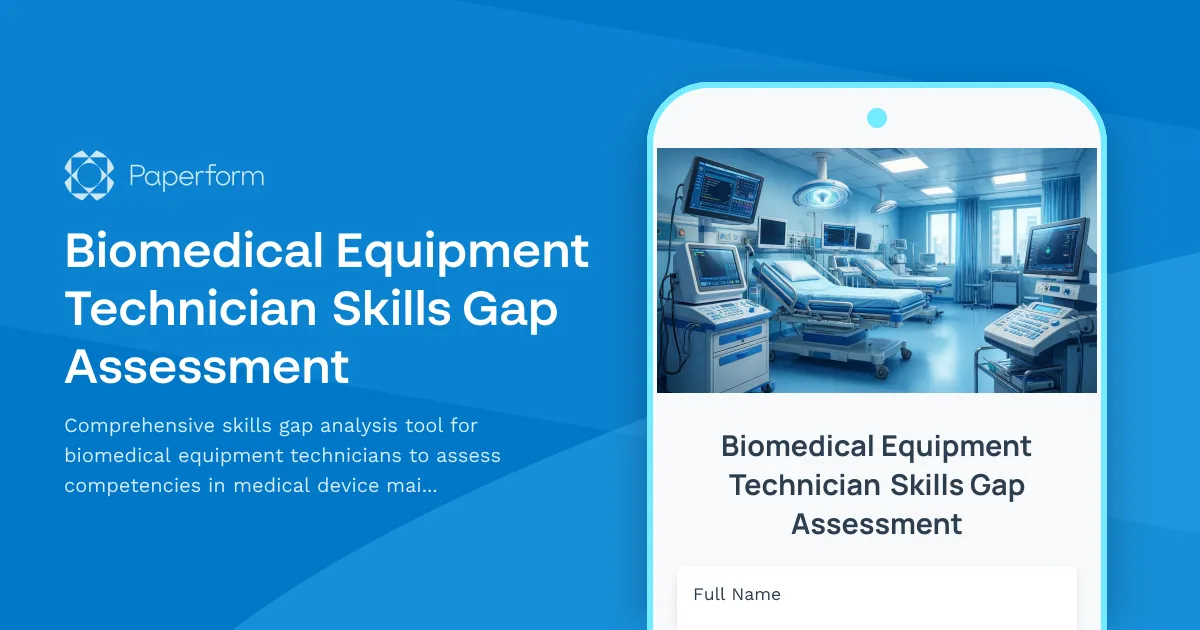
Biomedical Equipment Technician Skills Gap Assessment
Comprehensive skills gap analysis tool for biomedical equipment technicians to assess competencies in medical device maintenance, safety testing, troubleshooting, documentation, and regulatory compliance.

Biotechnology Lab Technician Training Needs Assessment
Comprehensive skills gap analysis for biotech lab technicians covering laboratory equipment, research protocols, data management, safety compliance, and analytical techniques.
Clinical Research Coordinator Continuing Education & Certification Tracking Form
Track ACRP certification credits, GCP training, and professional development hours for clinical research coordinators with automated CEU documentation and compliance monitoring.
Environmental Health and Safety Training Completion Form
A comprehensive EHS training completion form that verifies EPA compliance, hazardous materials handling certification, and facility-specific protocol acknowledgment for workplace safety records.
Industrial Hygiene Training Instructor Assessment Form
Evaluate industrial hygiene training instructors on exposure monitoring, ventilation systems, PPE selection, and sampling techniques. Comprehensive feedback form for workplace health and safety training programs.
Industrial Hygienist Certification Renewal Application
A comprehensive certification renewal form for industrial hygienists to document professional development hours, continuing education, ethics training, and specialty area credentials.
Industrial Hygienist Certification Training Request
Request form for industrial hygiene certification training programs covering OSHA compliance, air quality monitoring, and workplace safety assessments.
Medical Laboratory Technician Skills Gap Analysis
Assess competency levels across specimen processing, equipment operation, quality control, documentation, and safety protocols to identify training needs for medical laboratory technicians.
Nuclear Medicine Technologist Competency Evaluation
Comprehensive skills assessment for nuclear medicine technologists covering radiopharmaceuticals, imaging equipment, safety protocols, quality control, and patient preparation competencies.

Optometric Technician Skills Gap Analysis & Training Needs Evaluation
Identify training needs and skill gaps for optometric technicians across pretesting procedures, equipment operation, insurance verification, patient education, and practice management systems.