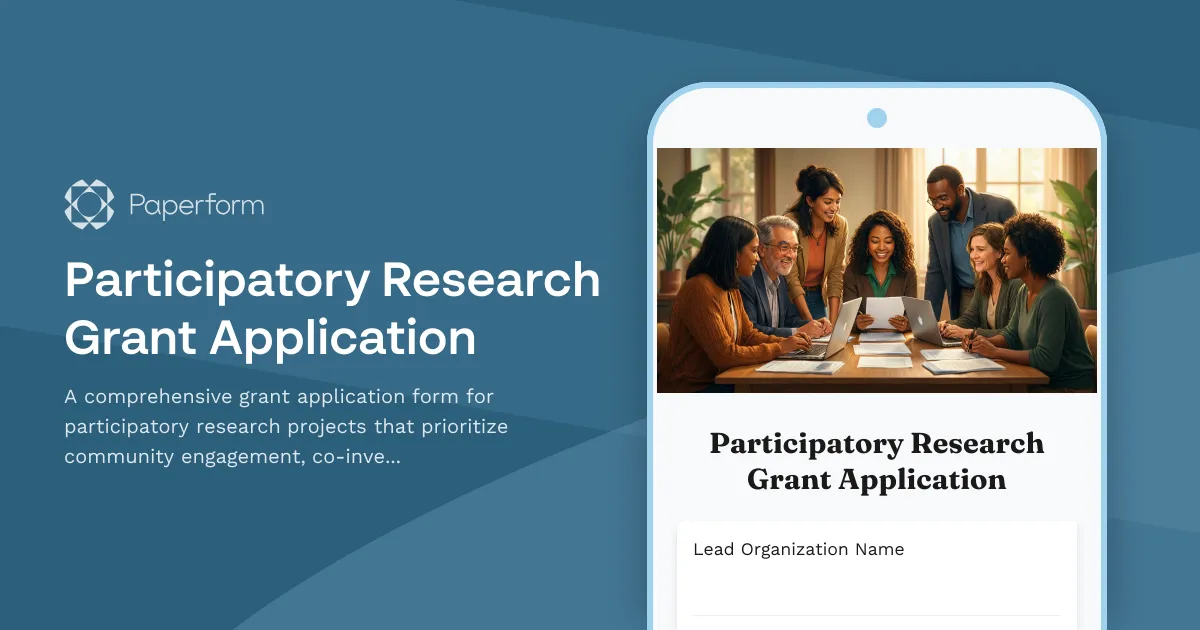
Advance Equity-Driven Research with Participatory Grant Applications
Participatory research transforms traditional academic inquiry by centering community voices, ensuring data sovereignty, and creating equitable benefit-sharing agreements. This Participatory Research Grant Application template helps research institutions, community organizations, nonprofits, and academic researchers collect detailed proposals that demonstrate genuine partnership, ethical data practices, and meaningful community impact.
Why participatory research funding matters
Traditional research models often extract knowledge from communities without meaningful involvement or benefit-sharing. Participatory research flips this model by positioning community members as co-investigators, ensuring data remains under community control, and requiring clear plans for how knowledge will be translated back into community benefit.
Funding bodies increasingly recognize that the most impactful research happens when communities are partners from design through dissemination. This application template captures the essential elements funders need to assess genuine participatory commitment: co-investigator training plans, data governance protocols, knowledge translation strategies, and community benefit agreements.
What this template captures
This form is structured to collect comprehensive information across all dimensions of participatory research:
Project fundamentals: Research team composition, institutional affiliations, community partner details, project timeline, and budget requirements ensure funders understand the basic scope and structure.
Community partnership details: Questions about how community members will be involved as co-investigators, what training and capacity-building will be provided, and how decision-making authority will be shared demonstrate authentic partnership rather than extractive consultation.
Data sovereignty protections: Specific sections on data ownership, storage, access protocols, and community authority over data use reflect growing understanding that communities should control information about themselves.
Knowledge translation plans: Details on how research findings will be shared back with communities in accessible formats, what actions will result from the research, and how community priorities will shape dissemination.
Community benefit agreements: Clear articulation of what communities will gain from participation beyond abstract "contribution to knowledge"—including capacity building, resource access, employment, and tangible improvements.
Ethical review and consent: Information about ethics approval processes that center community values, not just institutional requirements, and consent protocols designed with and for community participants.
Who uses participatory research grant applications
Research institutions and universities use these applications to secure funding for community-engaged scholarship that meets emerging standards for ethical, equitable research partnerships.
Community-based organizations and nonprofits apply for funding to lead or partner on research that addresses their priorities while building organizational research capacity.
Indigenous organizations and First Nations communities seek grants for research conducted under principles of Indigenous data sovereignty and self-determination.
Public health researchers pursue funding for community-based participatory research (CBPR) that addresses health inequities through partnership.
Social scientists and anthropologists apply for grants requiring meaningful community involvement and benefit-sharing in research design and execution.
Environmental justice organizations secure funding for community-led research on environmental health, climate impacts, and resource management.
Education researchers partner with schools and community groups to study and improve educational outcomes through collaborative inquiry.
How Paperform elevates participatory research applications
Traditional grant applications often reduce complex partnership commitments to checkbox exercises. Paperform lets you create an application experience that reflects the values of participatory research itself—transparent, accessible, and centered on relationship-building.
The doc-style editor allows you to weave narrative context throughout the application, helping applicants understand why each section matters and how their responses will be evaluated. You can include examples of strong data sovereignty protocols or effective benefit agreements directly in the form, modeling the kind of detail and thoughtfulness funders seek.
Conditional logic adapts the application based on project type, community context, and research methodology. If an applicant indicates work with Indigenous communities, the form can surface specific questions about OCAP® principles (Ownership, Control, Access, Possession) and culturally appropriate protocols. If the research involves vulnerable populations, additional safeguarding questions appear automatically.
File upload fields collect letters of support from community partners, draft benefit agreements, ethics approvals, and CVs for both academic and community co-investigators—keeping all application materials in one organized submission.
Calculation fields can help applicants ensure budget allocations meet funder requirements for community compensation, training, and knowledge translation, displaying totals and percentages as they build their budget.
For review committees, Papersign (papersign.com) streamlines the process of obtaining signatures on funding agreements and community benefit agreements once applications are approved, ensuring all parties formally commit to participatory principles before work begins.
Once applications are submitted, Stepper (stepper.io) can automate the review workflow—routing applications to appropriate reviewers, sending community partners confirmation that their partnership is documented, updating grant management systems, and triggering conditional follow-up based on review outcomes. This means your team spends less time on administrative coordination and more time supporting meaningful research partnerships.
AI Insights helps review committees identify themes across applications—which communities are being centered, what training models are most common, how data sovereignty is being approached—informing both funding decisions and future program design.
Building trust through better application processes
The quality of your application process signals your commitment to participatory values. A well-designed form demonstrates that you understand participatory research isn't just methodology—it's an ethical stance on power, knowledge, and community rights.
By making your expectations transparent, providing clear guidance, and collecting the right details about partnership structures and benefit-sharing, you help applicants submit stronger proposals and set the foundation for genuinely collaborative research that serves community priorities.
Whether you're a foundation shifting toward equity-driven grantmaking, a university research office supporting community-engaged scholars, or a community organization building research capacity, this Paperform template helps you collect the information that matters while treating applicants with the respect participatory research demands.
Trusted by over 500,000 teams worldwide and SOC 2 Type II compliant, Paperform provides the security and reliability research institutions require. Start with this template and customize it to reflect your specific funding priorities, community contexts, and participatory principles.
More templates like this
Traditional Medicine Grant Application Form
Apply for funding to support traditional medicine research, practitioner training, quality control initiatives, and integration with conventional healthcare systems.
Community-Based Participatory Research Grant Nomination Form
A comprehensive nomination form for community-based participatory research grants featuring community partner support documentation, mutual benefit assessment, and service-learning integration evaluation.
Language Revitalization Grant Application
Apply for funding to support endangered language preservation through immersion schools, master-apprentice programs, digital resources, and intergenerational transmission initiatives.
Animal Testing Alternatives Research Grant Proposal
Submit a comprehensive research grant proposal for animal testing alternatives including project summary, methodology, budget justification, timeline, and IRB approval documentation.
Community Knowledge Grant Application
Application form for community-led research grants supporting knowledge justice, participatory action research, and grassroots intellectual production through community-university partnerships.
Decolonization Grant Application Form
Apply for funding to support decolonization initiatives including curriculum transformation, Indigenous knowledge systems integration, land acknowledgment implementation, and institutional policy reform.
Indigenous Data Sovereignty Grant Application
A comprehensive grant application form for Indigenous communities seeking funding for data sovereignty initiatives, including tribal data governance, culturally appropriate research protocols, community data centers, and digital repatriation projects.
Indigenous Futures Grant Application
A comprehensive grant application for Indigenous-led cultural futurism projects, youth visioning initiatives, traditional innovation, and seventh generation planning programs.
Indigenous Studies Graduate Scholarship Application
Apply for a graduate scholarship supporting Indigenous students pursuing advanced studies in cultural preservation, language revitalization, land rights, and sovereignty with active tribal community involvement.
Media Literacy Grant Application Form
Apply for funding to develop and implement media literacy programs with curriculum frameworks, educator training, misinformation detection tools, and digital citizenship components.
Oral History Project Grant Application
Apply for funding to document and preserve community stories through oral history interviews with professional archival standards and public access platforms.
Public Health Grant Application
Comprehensive grant application for public health initiatives focused on disease prevention, health equity, community health worker programs, and data-driven interventions.