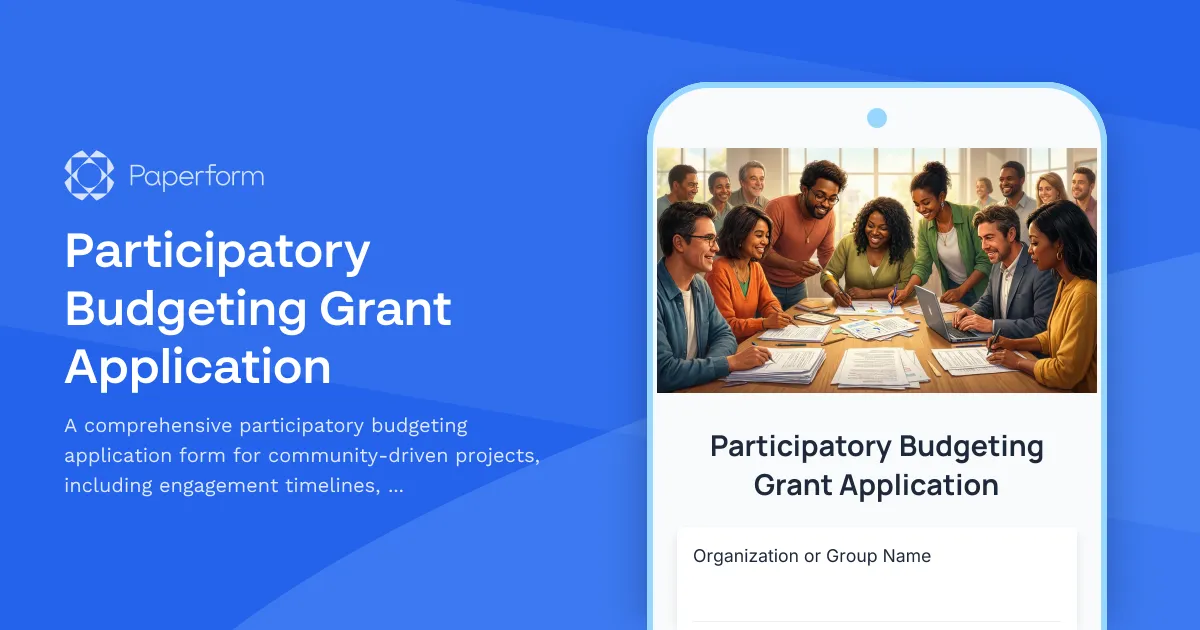
Empower Your Community with Participatory Budgeting
Participatory budgeting puts decision-making power directly into the hands of community members, allowing them to decide how public funds are spent on local projects. Whether you're a nonprofit organization, municipal government, community foundation, or civic group, this Participatory Budgeting Grant Application template helps you collect comprehensive project proposals that include engagement strategies, voting mechanisms, and accountability measures.
Why Use This Participatory Budgeting Application Template?
Traditional grant applications often miss the collaborative spirit of participatory budgeting. This template goes beyond basic project descriptions to capture:
- Community engagement timelines that show how you'll involve residents at every stage
- Voting infrastructure details to ensure transparent, accessible democratic processes
- Clear project selection criteria aligned with community priorities
- Implementation oversight plans that build trust through accountability
Built with Paperform, this template offers a professional, user-friendly experience that encourages thoughtful applications while streamlining your review process.
Perfect for Civic Organizations and Community Groups
This form template is ideal for:
- Municipal governments launching participatory budgeting initiatives in neighborhoods or districts
- Community foundations distributing funds through democratic processes
- Nonprofit organizations running community-directed grant programs
- Neighborhood associations managing shared resources and improvement projects
- Urban planning departments engaging residents in public space improvements
- Youth councils empowering young people to allocate funding for youth programs
- Housing authorities involving residents in amenity and improvement decisions
What's Included in This Template
The participatory budgeting application collects everything you need to evaluate community-driven proposals:
Project Basics: Organization details, project title, funding amount requested, and project category (infrastructure, arts & culture, environment, youth programs, public safety, etc.)
Community Engagement Plan: Detailed timeline showing how you'll inform, consult, and involve community members before, during, and after the voting process. This section helps ensure proposals genuinely reflect community needs.
Voting Infrastructure: Information about your proposed voting mechanisms—whether in-person, online, or hybrid—along with accessibility measures, language support, voter eligibility criteria, and plans to reach underserved populations.
Project Details: Comprehensive description, specific location, timeline, community need being addressed, expected beneficiaries, and measurable outcomes.
Selection Criteria Alignment: How your project meets established criteria such as community impact, feasibility, equity, sustainability, and cost-effectiveness.
Implementation Plan: Project phases, key milestones, team members and their roles, community oversight structure, and risk mitigation strategies.
Budget Breakdown: Itemized costs, in-kind contributions, matching funds, and budget justification.
Accountability Measures: Reporting schedule, success metrics, community feedback mechanisms, and transparency commitments.
How Paperform Makes Participatory Budgeting Applications Better
With Paperform's intuitive document-style editor, you can customize this template to match your specific participatory budgeting program guidelines and community priorities. Add your organization's branding, adjust questions to reflect local context, and include images or videos that inspire applicants.
Conditional logic ensures applicants only see questions relevant to their project type—infrastructure projects might need construction permits, while arts programs need performance venue details. This keeps forms focused and completion rates high.
File upload fields let applicants attach supporting documents like site plans, letters of support, partnership agreements, or community petition signatures—all organized in one place for easy review.
Calculation fields can automatically tally budget items, helping applicants ensure their totals match requested amounts and reviewers quickly assess cost breakdowns.
For organizations managing multiple participatory budgeting cycles or districts, Paperform makes it simple to duplicate and customize forms for each round, maintaining consistency while adapting to local needs.
Streamline the Entire Grant Cycle with Automation
Paperform isn't just about collecting applications—it's about creating smooth workflows that save your team time:
Instant confirmation emails reassure applicants their proposal was received and outline next steps in your participatory budgeting timeline.
Stepper workflows (stepper.io) can automatically route new applications to the right review committee members, create tasks in your project management tool, and send reminder notifications as voting deadlines approach. When a project is approved, Stepper can trigger your financial systems to prepare funding, notify the applicant, and schedule milestone check-ins—all without manual copy-pasting between tools.
Integration with your existing tools means applications can flow directly into Airtable or Google Sheets for collaborative scoring, sync with Slack for team notifications, or connect to your CRM to track applicant relationships over multiple funding cycles.
Build Trust Through Transparency and Accessibility
Participatory budgeting succeeds when communities trust the process. This template helps you demonstrate that commitment:
- Clear, jargon-free questions that welcome first-time applicants
- Required fields for engagement and accountability that set expectations
- Options to describe projects in multiple formats (text, video, images)
- Mobile-friendly design so community members can apply from any device
Paperform's clean, accessible interface ensures your application process lives up to the inclusive values of participatory budgeting.
Who Benefits from This Template
Community organizations and grassroots groups get a clear roadmap for what funders expect, reducing anxiety and increasing application quality.
Grant administrators and civic staff receive complete, comparable applications that make evaluation faster and fairer.
Review committees can assess proposals against consistent criteria, with all information organized logically.
Community members gain transparency into how decisions are made and how their voices shape outcomes.
Paperform for Mission-Driven Organizations
Paperform is trusted by over 500,000 teams worldwide, including nonprofits, government agencies, and community organizations. Our platform is SOC 2 Type II compliant and GDPR-ready, with data residency controls and security features that meet public sector standards.
Whether you're running your first participatory budgeting pilot or managing an established citywide program, this template gives you a professional, effective tool for engaging communities in democratic resource allocation.
Start with this template, customize it to your community's unique needs, and create a grant application process that truly embodies participatory values.
More templates like this
Community Development Grant Application
A comprehensive grant application form for community development projects, capturing neighborhood demographics, stakeholder engagement, impact planning, and partnership documentation.
Arts Organization Community Grant Application
Apply for arts and culture community program grants with detailed project information, artist demographics, accessibility plans, work samples, and letters of support.
Cash Transfer Program Grant Application
A comprehensive application form for unconditional cash transfer programs, designed to collect applicant information, verify eligibility criteria, and establish payment preferences for direct financial assistance.
Civic Engagement Grant Application
Apply for funding to support civic engagement initiatives including voter registration, community organizing, civic education, and language access programs in your community.
Climate Adaptation Grant Application
Apply for climate adaptation funding with comprehensive vulnerability assessment, resilience strategies, stakeholder consultation records, and monitoring framework documentation.
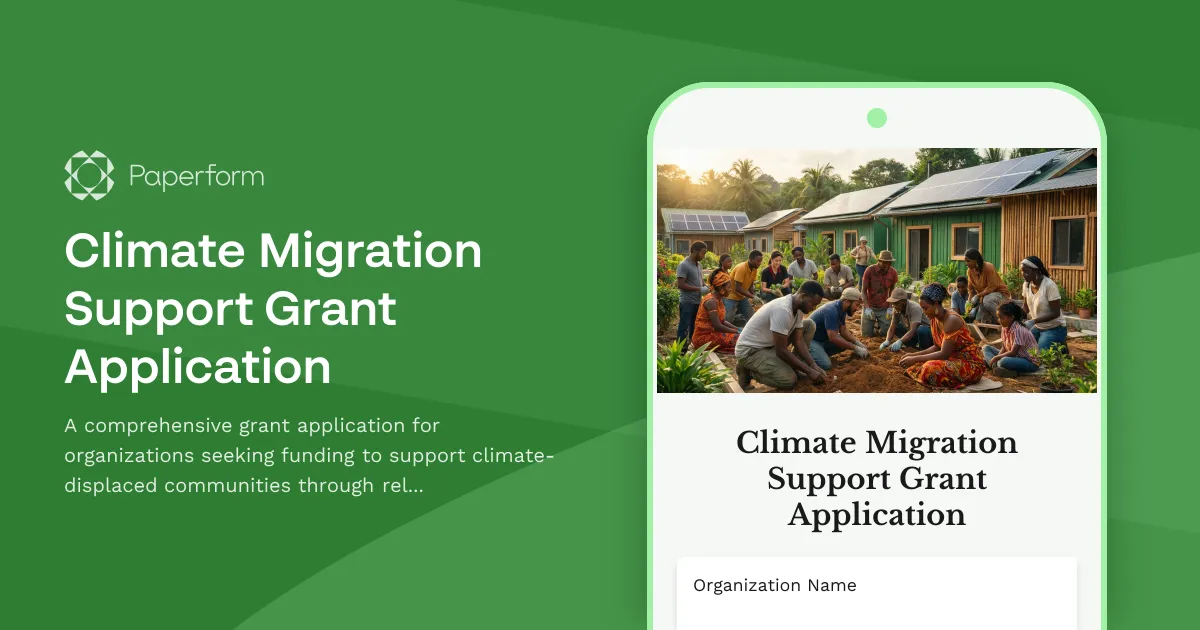
Climate Migration Support Grant Application
A comprehensive grant application for organizations seeking funding to support climate-displaced communities through relocation assistance, cultural preservation, community reception planning, and trauma-informed services.
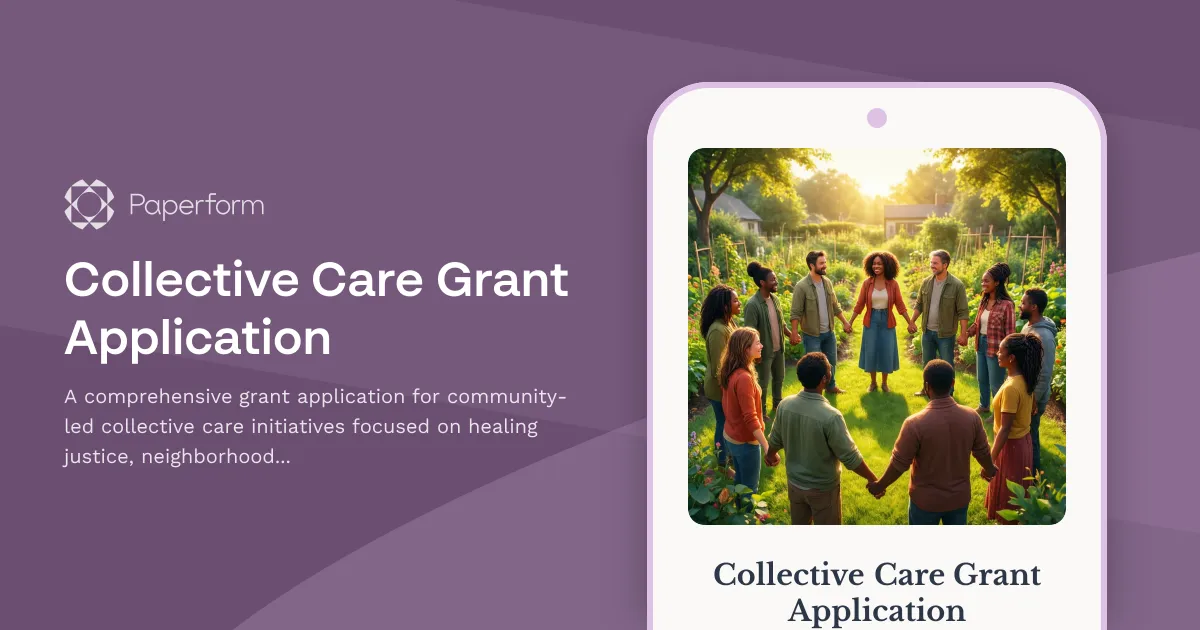
Collective Care Grant Application
A comprehensive grant application for community-led collective care initiatives focused on healing justice, neighborhood wellness, and disability justice integration.
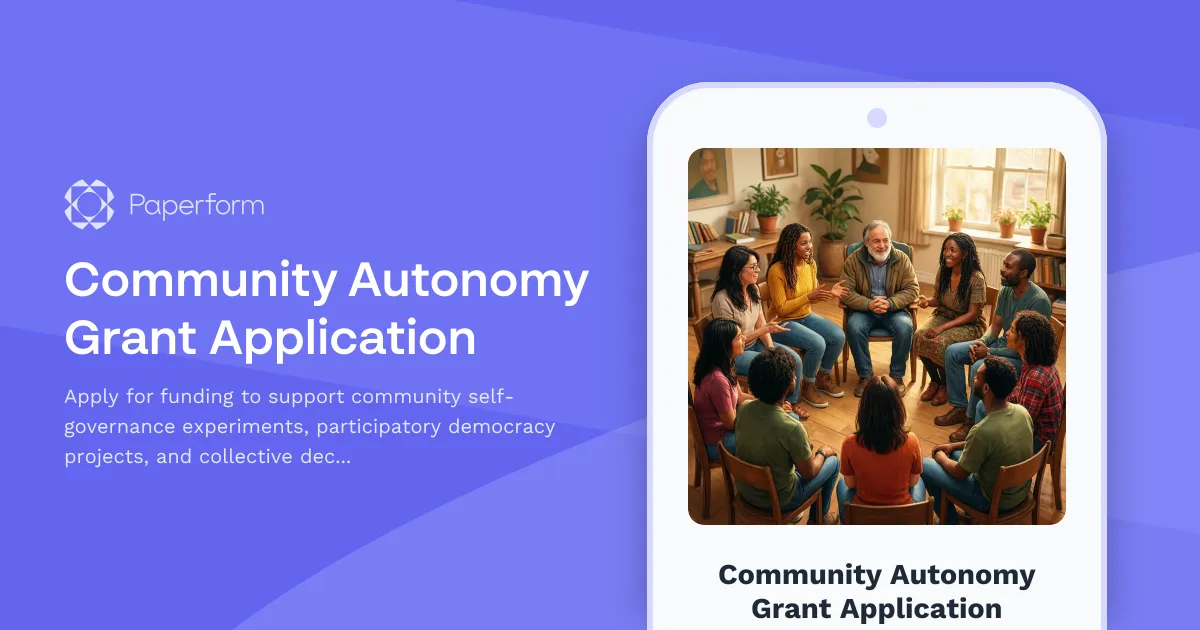
Community Autonomy Grant Application
Apply for funding to support community self-governance experiments, participatory democracy projects, and collective decision-making infrastructure that builds community power and autonomy.
Community Composting Grant Application
Apply for grant funding to establish or expand community composting programs. Includes project scope, collection logistics, composting methodology, distribution plans, and sustainability measures.
Community Economics Grant Application
A comprehensive grant application form for community-led economic initiatives including alternative currencies, local exchange systems, community development financial institutions, and cooperative finance projects.
Community Health Worker Grant Application
A comprehensive grant application for community health worker programs focused on health equity, care coordination, and addressing social determinants of health.
Community Land Trust Grant Application
A comprehensive grant application for community land trusts seeking funding for property acquisition, affordability mechanisms, resident governance, and anti-displacement initiatives.