Comprehensive Skills Assessment for Optometric Practices
Running a successful optometry practice depends on having well-trained technicians who can confidently handle everything from pretesting procedures to insurance verification. This Optometric Technician Skills Gap Analysis template helps you systematically evaluate your team's capabilities and identify exactly where additional training is needed.
Built for Growing Eye Care Practices
Whether you're onboarding new optometric technicians, preparing for annual reviews, or rolling out new equipment, this skills assessment covers the core competencies that matter most in modern optometry practices:
- Pretesting procedures: Autorefraction, lensometry, tonometry, visual acuity testing, and preliminary assessments
- Equipment operation: Comfort and proficiency with diagnostic instruments and technology
- Insurance verification: Understanding coverage, pre-authorization, and billing accuracy
- Patient education: Communication skills for explaining procedures, contact lens care, and eyewear options
- Practice management software: Proficiency with scheduling, charting, and documentation systems
Close the Gap Between Current Skills and Practice Needs
This form doesn't just identify weaknesses—it creates a clear action plan. By assessing both current competency levels and training priorities, you'll know exactly which skills to develop first and can track improvement over time. Use conditional logic to customize follow-up questions based on experience level, and gather specific feedback on training preferences and scheduling constraints.
Streamline with Stepper and Keep Records with Papersign
Once you've identified skills gaps, use Stepper to automatically route training requests to the appropriate department heads, create personalized learning plans, and send calendar invites for upcoming sessions. If your training program requires acknowledgment of completion or certification agreements, Papersign lets you turn form responses into legally binding eSignature documents—perfect for maintaining compliance records.
Paperform makes it easy to create professional, branded skills assessments that your team will actually want to complete. With AI-powered insights, you can quickly spot trends across multiple submissions and make data-driven decisions about your training budget and priorities.


More templates like this
Biomedical Equipment Technician Skills Gap Assessment
Comprehensive skills gap analysis tool for biomedical equipment technicians to assess competencies in medical device maintenance, safety testing, troubleshooting, documentation, and regulatory compliance.
Medical Laboratory Technician Skills Gap Analysis
Assess competency levels across specimen processing, equipment operation, quality control, documentation, and safety protocols to identify training needs for medical laboratory technicians.
Nuclear Medicine Technologist Competency Evaluation
Comprehensive skills assessment for nuclear medicine technologists covering radiopharmaceuticals, imaging equipment, safety protocols, quality control, and patient preparation competencies.
Cardiac Catheterization Lab Technologist Competency Evaluation
A comprehensive skills assessment form for evaluating cardiac cath lab technologists across sterile technique, hemodynamic monitoring, emergency protocols, and procedure documentation.
Dialysis Technician Competency Matrix
Assess dialysis technician skills across treatment procedures, machine operation, patient assessment, vascular access care, and documentation to identify training needs and competency gaps.
Emergency Medical Technician Skills Competency Assessment
Comprehensive EMT competency evaluation form covering patient assessment, trauma care, cardiac emergencies, and protocol compliance for certification and skills validation.
Emergency Medical Technician Training Needs Analysis
Comprehensive skills gap assessment for EMTs covering patient assessment, treatment protocols, equipment operation, documentation systems, and communication procedures to identify training priorities.
Interventional Radiology Technologist Competency Assessment
Comprehensive skills evaluation for interventional radiology technologists covering sterile technique, contrast administration, patient monitoring, and emergency protocols.
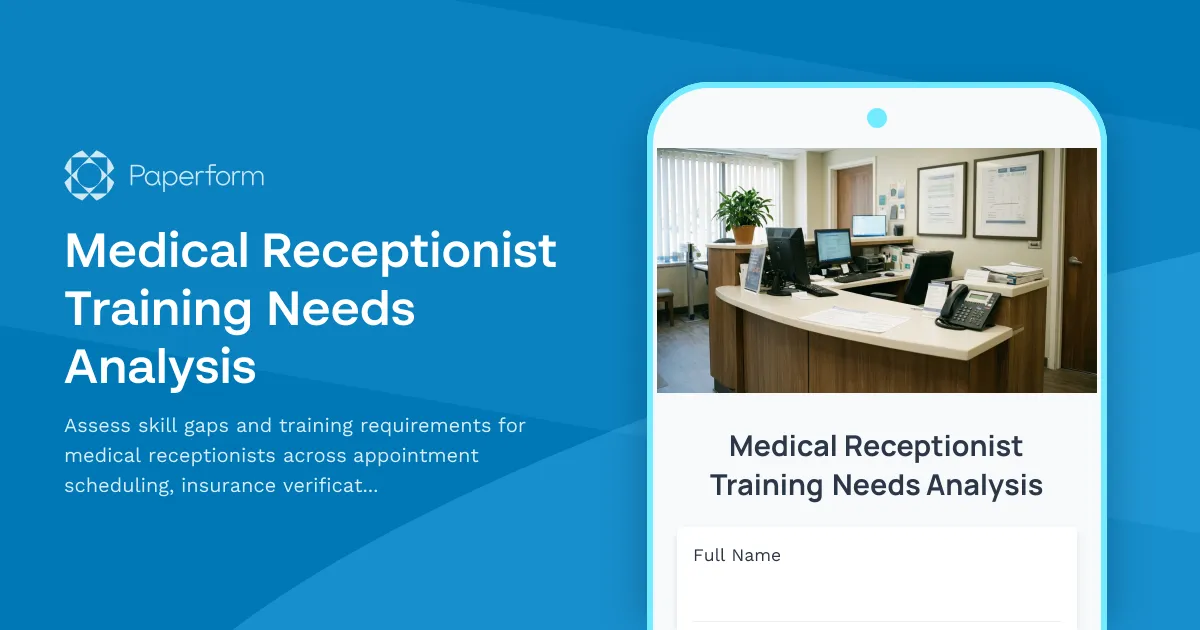
Medical Receptionist Training Needs Analysis
Assess skill gaps and training requirements for medical receptionists across appointment scheduling, insurance verification, patient registration, phone systems, and customer service.
MRI Technologist Certification Practice Test
A comprehensive practice test for MRI technologists covering MRI physics, safety protocols, contrast administration, and artifact recognition to prepare for certification exams.
Occupational Therapist Assistant Competency Evaluation
Comprehensive skills assessment for occupational therapist assistants covering treatment techniques, documentation systems, equipment proficiency, patient education capabilities, and outcome tracking competencies.
Patient Care Technician Skills Assessment
A comprehensive skills gap analysis form for evaluating patient care technician competencies across vital signs monitoring, patient hygiene, mobility assistance, documentation systems, and communication skills.