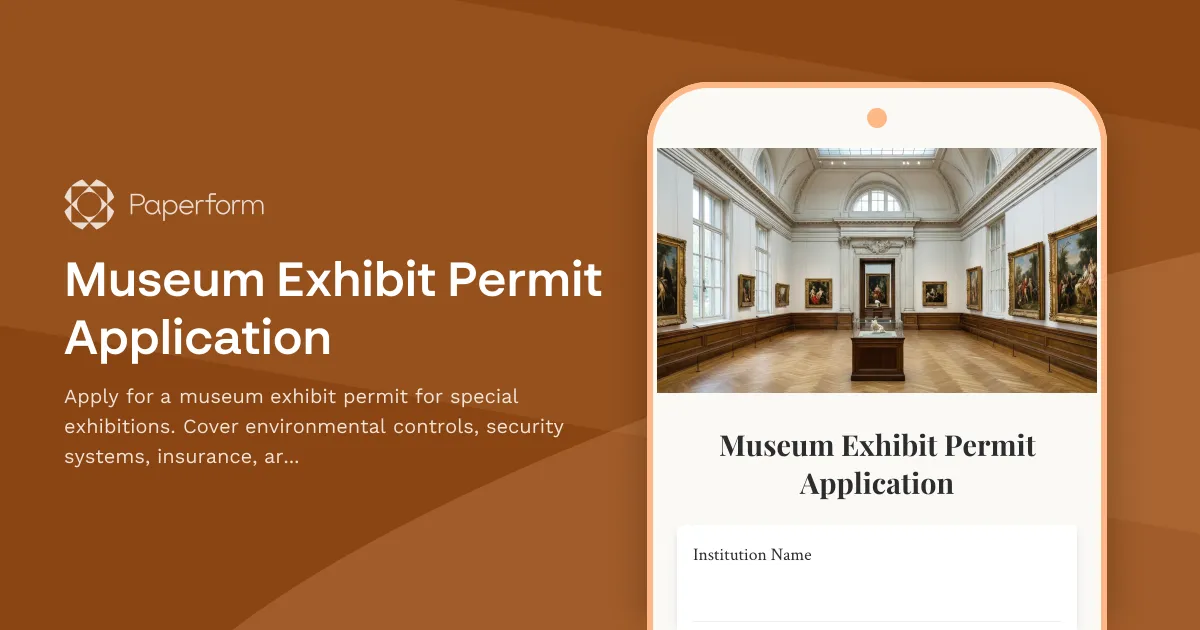
Museum Exhibit Permit Application Form Template
Planning a special exhibition at your museum? Whether you're hosting traveling exhibits, loaning precious artifacts, or creating temporary installations, securing the proper permits and documenting safety protocols is essential. This Museum Exhibit Permit Application template from Paperform streamlines the entire permitting process, helping museums, galleries, cultural institutions, and exhibition organizers meet regulatory requirements while ensuring the protection of valuable artifacts.
Why museums and cultural institutions choose Paperform
Museums and galleries operate at the intersection of public education, artifact preservation, and complex regulatory compliance. Traditional paper-based permit applications create unnecessary delays, risk incomplete submissions, and make it difficult to track approvals across departments. This template transforms the permit application process into a smooth, digital workflow that captures all necessary information—from environmental control specifications to insurance coverage—in one organized submission.
With Paperform's document-style editor, you can customize every section to match your institution's specific requirements, branding guidelines, and permitting criteria. Add your museum's logo, adjust field labels to reflect your terminology, and modify conditional logic to show only relevant questions based on exhibition type. The result is a professional permit application that looks like it belongs to your institution, not a generic form tool.
What this museum exhibit permit template covers
This comprehensive template is designed specifically for special exhibition permit applications and includes sections for:
Applicant and Exhibition Information: Capture essential details about the organizing institution, exhibition curator, contact information, and proposed exhibition scope. Clear identification fields ensure your permits department knows exactly who is applying and what exhibition is being proposed.
Environmental Control Requirements: Document detailed specifications for temperature, humidity, lighting levels, and air quality monitoring. These fields are critical for preservation and help your facilities team prepare appropriate climate-controlled spaces for sensitive artifacts.
Security Systems and Protocols: Collect information about required security measures, including surveillance systems, access controls, guard schedules, and emergency response procedures. This ensures valuable artifacts are protected throughout the exhibition period.
Insurance Coverage: Gather comprehensive insurance information including coverage amounts, policy numbers, liability details, and proof of documentation. This protects both the lending institution and your museum against loss, damage, or theft.
Artifact Handling Protocols: Document proper handling procedures, transportation methods, installation requirements, and condition reporting processes. This section ensures artifacts are treated with appropriate care by qualified professionals.
Educational Programming: Detail the public engagement components of the exhibition, including guided tours, lectures, workshops, school programs, and accessibility accommodations. This demonstrates the educational value and community impact of the proposed exhibition.
Designed for museums, galleries, and cultural institutions
This template serves multiple roles within the museum ecosystem:
- Museum directors and curators applying for permits to host traveling exhibitions or special installations
- Exhibition designers submitting proposals for temporary exhibits requiring environmental or structural modifications
- Lending institutions documenting requirements when loaning artifacts to other museums
- Museum permits offices standardizing the intake process for exhibition applications
- Cultural heritage organizations managing applications for sensitive or historically significant displays
- University galleries processing faculty and student exhibition proposals
- Historic sites evaluating applications for temporary interpretive displays
Streamline workflows with Stepper automation
Once an exhibit permit application is submitted, the real work begins—routing for departmental review, facilities assessment, insurance verification, and final approval. Instead of managing this process through email chains and spreadsheet tracking, connect your Paperform submissions to Stepper (stepper.io), Paperform's AI-native workflow automation platform.
With Stepper, you can:
- Automatically route applications to the appropriate reviewers based on exhibition type or artifact value
- Trigger notifications to facilities, security, and insurance teams for parallel review
- Create approval workflows that require sign-off from multiple departments before final permit issuance
- Update your project management tools (Asana, Monday, Notion) with new permit applications
- Send automated status updates to applicants at each stage of the review process
- Flag applications that require additional documentation or special considerations
This automation eliminates manual handoffs, reduces approval timelines, and creates a transparent process for applicants who want to track their permit status.
Accept deposits and permit fees seamlessly
Many museums charge application fees, permit fees, or require deposits for special exhibitions. With Paperform's built-in payment integrations (Stripe, PayPal, Square), you can collect these fees directly within the application form. Use calculation fields to automatically determine fees based on exhibition size, duration, or number of artifacts, giving applicants immediate visibility into costs.
For complex pricing scenarios—such as tiered permit fees, insurance surcharges, or educational program add-ons—Paperform's calculation engine handles the math in real-time, updating the total as applicants complete the form. This eliminates billing confusion and ensures your museum receives proper payment upfront.
Secure, compliant, and audit-ready
Museums handle sensitive information about valuable artifacts, security systems, and insurance coverage. This template is built on Paperform's SOC 2 Type II certified platform, ensuring your permit applications are collected, stored, and transmitted securely. All submissions are encrypted, and you maintain full control over who has access to application data.
For institutions requiring formal agreements or approvals, integrate Papersign (papersign.com) to automatically generate permit agreements from submitted applications and send them for electronic signature. This creates a complete audit trail from application through final approval, with all documentation linked in one system.
Perfect for regulatory compliance and grant reporting
Special exhibitions often require documentation for insurance purposes, grant compliance, or regulatory reporting. With Paperform, every submission is automatically organized, searchable, and exportable. Generate reports showing all active exhibition permits, filter by exhibition type or date range, and export data to Excel or Google Sheets for grant reports or board presentations.
The AI Insights feature can analyze multiple permit applications to identify trends, common requirements, or areas where additional guidance might help applicants submit more complete initial applications—reducing back-and-forth and speeding up approval times.
Customizable for any exhibition type
While this template is designed for comprehensive special exhibition permits, Paperform's flexible editor makes it easy to adapt for specific use cases:
- Traveling exhibition permits focusing on transportation logistics and courier requirements
- Contemporary art installations requiring structural modifications or outdoor spaces
- Living history demonstrations with performer safety and public interaction protocols
- Interactive exhibits with visitor safety and accessibility requirements
- Loan agreements emphasizing condition reporting and return procedures
Simply duplicate the template, adjust fields to match your specific requirements, and publish—no coding or technical expertise required.
Trusted by cultural institutions worldwide
Museums, galleries, and cultural heritage organizations choose Paperform because it combines professional design capabilities with robust functionality. Create permit applications that reflect the professionalism of your institution while capturing all the detailed information your facilities, security, and curatorial teams need to evaluate proposals effectively.
Ready to modernize your museum's permit application process? Start with this template and customize it to fit your institution's unique requirements. With Paperform's intuitive editor, generous usage limits, and predictable pricing, you can roll out professional permit forms across your organization without breaking the budget or waiting on IT support.



More templates like this

Cultural Heritage Preservation Grant Application
Apply for grant funding to preserve, digitize, and make accessible important cultural heritage materials and artifacts through professional conservation methods.
Oral History Project Grant Application
Apply for funding to document and preserve community stories through oral history interviews with professional archival standards and public access platforms.
Art Gallery Exhibition Permit Application
A comprehensive permit application for art galleries covering exhibition setup, artist agreements, insurance, and event planning requirements.
Artist Residency Application Form
A comprehensive application form for artist residency programs. Collect artist statements, project proposals, portfolio images, budget requirements, and timeline details for creative residencies and fellowship programs.
Museum Curation Internship Application Form
A comprehensive application form for museum curation internship programs. Collect information about art history education, exhibition experience, collection interests, and academic references from aspiring curators.
Museum Docent Application Form
A comprehensive application form for prospective museum docents to assess their art history knowledge, public speaking abilities, language skills, and availability for volunteer tour guide positions.
Art Exhibition Competition Entry Form
A professional entry form for art competitions and exhibitions. Collect artwork details, artist information, dimensions, pricing, installation requirements, and shipping logistics in one streamlined submission.
Art Gallery Internship Application Form
A comprehensive application form for art gallery internship positions, evaluating exhibition installation experience, artist liaison capabilities, art handling certification, and collection management software proficiency.
Community Archive Volunteer Application
A comprehensive application for volunteers interested in preserving community history through oral history recording, document preservation, and collective memory stewardship.
Dance Company Administrative Internship Application
Apply for an administrative internship with a professional dance company. Perfect for students pursuing arts management, nonprofit administration, or performing arts careers.
Museum Educator Application Form
A comprehensive application form for museum educator positions that captures teaching credentials, subject expertise, public speaking experience, and multilingual capabilities.
Museum Exhibition Grant Application
Apply for museum exhibition funding with details on curatorial vision, conservation needs, interactive elements, and accessibility features. Streamline your grant application process.