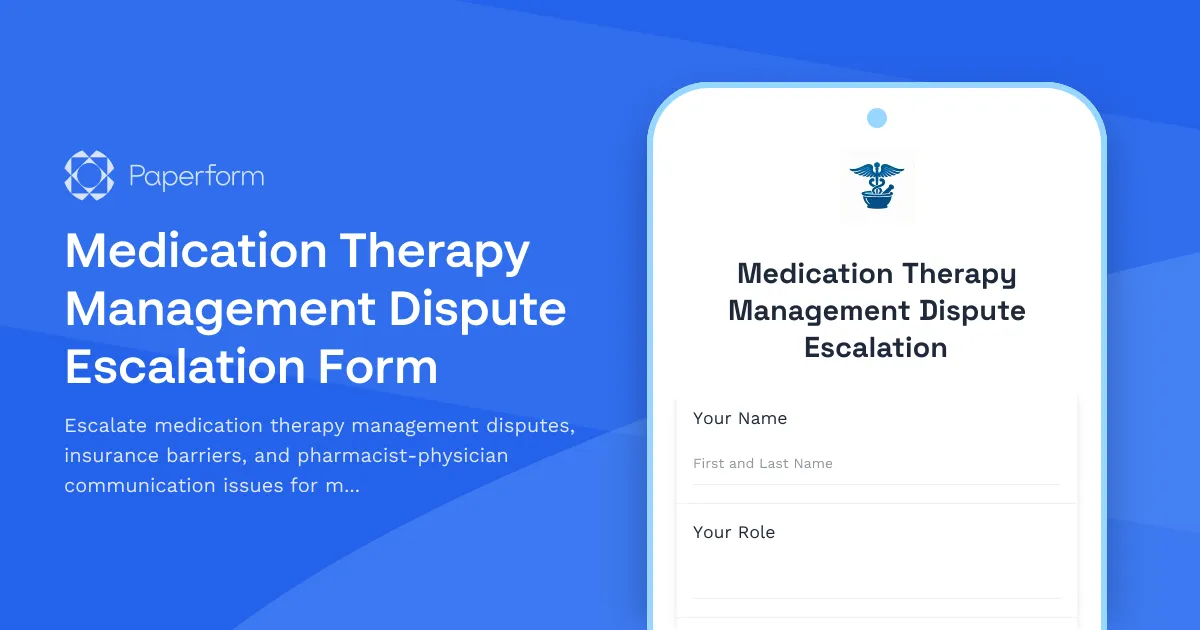
Streamline MTM Dispute Resolution with Professional Escalation Forms
Medication therapy management (MTM) services are essential for optimizing patient outcomes, but disputes involving insurance coverage, physician communication, and pharmacist recommendations can create significant barriers to quality care. When standard channels fail to resolve these conflicts, having a structured escalation process is critical for both patient safety and practice integrity.
This Medication Therapy Management Dispute Escalation Form provides healthcare organizations, pharmacy practices, and MTM providers with a comprehensive tool to document, track, and escalate complex disputes that require management review, insurance appeals, or accreditation compliance attention.
Why Healthcare Providers Need a Dedicated MTM Escalation Form
MTM disputes are unique in healthcare—they sit at the intersection of clinical judgment, insurance policy, regulatory compliance, and patient advocacy. Unlike general complaint forms, MTM escalations require detailed documentation of:
- Clinical recommendations made by pharmacists during comprehensive medication reviews
- Insurance coverage barriers preventing implementation of therapeutic interventions
- Physician communication failures that compromise collaborative care
- Accreditation and compliance concerns related to MTM program standards
Without a standardized escalation process, these disputes can languish in email threads, verbal conversations, and fragmented documentation—creating liability risks, delaying patient care, and threatening accreditation status.
What This MTM Dispute Escalation Form Captures
This template is designed specifically for the complexities of medication therapy management workflows. It gathers comprehensive information about:
Dispute Classification: Whether the issue involves insurance denial, prescriber non-response, clinical disagreement, patient safety concerns, or MTM accreditation standards.
Patient and Clinical Context: De-identified patient information (when appropriate), medication regimen details, chronic conditions, and clinical urgency level—all essential for management to assess priority and risk.
Insurance Coverage Barriers: Specific details about denials, prior authorization failures, formulary restrictions, step therapy requirements, and coverage gaps that prevent recommended interventions.
Pharmacist Recommendations: Documentation of the MTM pharmacist's clinical assessment, therapeutic recommendations, expected outcomes, and evidence-based rationale.
Physician Communication Issues: Timeline of communication attempts, nature of disagreement or non-response, and impact on patient care coordination.
Accreditation Concerns: Any elements of the dispute that relate to MTM accreditation standards, quality measures, or regulatory compliance requirements.
Previous Resolution Attempts: What steps have already been taken, who was involved, and why standard channels proved insufficient.
How Paperform Enhances MTM Dispute Management
Traditional paper-based or email escalation processes create documentation gaps, slow response times, and make it difficult to track patterns across multiple disputes. Paperform transforms MTM dispute escalation into a streamlined, trackable, and compliant process.
Conditional Logic for Relevant Detail Capture: The form adapts based on dispute type. If the issue involves insurance barriers, additional fields appear for coverage details. If it's a physician communication failure, the form prompts for documentation of outreach attempts. This ensures you gather exactly the right information without overwhelming submitters with irrelevant questions.
Secure, HIPAA-Aware Data Handling: While Paperform itself is not HIPAA compliant, it's designed with healthcare workflows in mind. You can use de-identified patient data, secure submission channels, and integrate with compliant systems via Stepper to ensure protected health information is handled appropriately throughout your escalation workflow.
Instant Routing to the Right Stakeholders: Using Paperform's notification logic, disputes can automatically route to clinical leadership, insurance specialists, quality assurance teams, or legal counsel based on the nature and severity of the issue—ensuring the right eyes see urgent matters immediately.
Integration with Healthcare Systems: Connect escalation submissions to your pharmacy management system, electronic health records, quality tracking databases, or case management tools through Stepper (stepper.io), Paperform's AI-native workflow builder. This eliminates manual data entry and creates a complete audit trail from initial escalation through final resolution.
Who Benefits from This Template
Community Pharmacies with MTM Programs: Independent and chain pharmacies offering comprehensive medication reviews need clear escalation paths when payers deny coverage for recommended interventions or prescribers fail to respond to critical safety recommendations.
Health Systems and Integrated Care Organizations: Large healthcare organizations with dedicated MTM services require standardized processes to track disputes, identify systemic issues with specific insurers or physician groups, and maintain accreditation compliance.
MTM Service Providers: Third-party MTM companies managing services across multiple pharmacies or health plans need consistent documentation to support appeals, demonstrate value to payers, and maintain quality standards.
Managed Care Organizations: Payers offering MTM benefits can use escalation data to identify coverage policy issues, improve pharmacist-physician collaboration, and demonstrate quality improvement efforts.
Quality and Compliance Teams: Organizations seeking or maintaining MTM accreditation (such as through URAC or ACHC) need documentation systems that demonstrate effective dispute resolution and continuous quality improvement.
Automate Follow-Through with Stepper Workflows
The real power of digital escalation forms comes when submission triggers appropriate action. With Stepper (stepper.io), you can build intelligent workflows that:
- Create case tickets in your quality management or customer service systems with all dispute details pre-populated
- Notify stakeholders based on dispute severity—immediate alerts for patient safety issues, standard routing for administrative concerns
- Trigger appeal preparation by auto-generating insurance appeal templates with clinical details and pharmacist recommendations
- Schedule follow-up tasks to ensure disputes don't fall through the cracks, with automated reminders to responsible parties
- Generate compliance reports showing dispute trends, resolution times, and accreditation-relevant metrics
- Update tracking dashboards in real-time so leadership can monitor MTM program performance and identify systemic barriers
These automations ensure every escalation receives appropriate attention and creates the documentation trail necessary for both clinical accountability and regulatory compliance.
The Business Case for Structured MTM Escalation
Beyond patient safety and quality care, effective dispute escalation protects your organization's financial and reputational interests:
Faster Insurance Appeals: Well-documented escalations with complete clinical rationale and evidence streamline the appeals process, increasing approval rates and reducing revenue loss from denied services.
Reduced Liability Risk: When pharmacist recommendations are documented and escalated through official channels, you create defensible records demonstrating clinical due diligence even when external barriers prevent implementation.
Accreditation Readiness: Surveyors reviewing MTM programs look for evidence of quality monitoring, dispute resolution processes, and continuous improvement. This form creates exactly the documentation they expect to see.
Data-Driven Quality Improvement: Aggregated escalation data reveals patterns—specific insurers with problematic policies, physician groups with communication gaps, or recurring medication safety issues—that inform targeted improvement initiatives.
Team Empowerment: Pharmacists providing MTM services need to know their clinical concerns will be heard and acted upon. A clear escalation process demonstrates organizational support for their professional judgment and patient advocacy.
Getting Started with Your MTM Escalation Process
This template is ready to deploy immediately, but most healthcare organizations will want to customize it to match their specific workflows:
- Add your organization's branding to reinforce that escalations are taken seriously and handled through official channels
- Customize routing logic to match your internal stakeholders—perhaps clinical disputes go to the pharmacy director while insurance issues route to your payer relations team
- Integrate with existing systems using Stepper to connect with your case management, EHR, or quality tracking platforms
- Create follow-up workflows that ensure every escalation receives status updates and documented resolution
- Build reporting dashboards to monitor trends and demonstrate program effectiveness to leadership and accreditation bodies
With Paperform's intuitive editor, healthcare administrators and pharmacy leaders can make these adjustments without IT support, maintaining control over the escalation process as organizational needs evolve.
Trust and Security for Healthcare Workflows
While handling sensitive healthcare disputes, security and reliability are non-negotiable. Paperform is SOC 2 Type II compliant and offers enterprise-grade security features including SSL encryption, role-based access controls, and detailed audit logs. For organizations requiring additional compliance layers, Paperform integrates seamlessly with HIPAA-compliant storage and workflow systems through Stepper and other healthcare-focused platforms.
Healthcare organizations worldwide trust Paperform to handle sensitive workflows because it combines the flexibility needed for complex clinical processes with the security and reliability standards healthcare demands.
Get started today: Set up your MTM dispute escalation process in minutes, empower your pharmacy team to advocate effectively for patients, and create the documentation infrastructure that supports both quality care and accreditation excellence.



More templates like this
Anticoagulation Safety Checklist & Bleeding Risk Assessment
A comprehensive pre-visit assessment for patients on anticoagulation therapy to evaluate bleeding risk, fall frequency, medication compliance, and dietary vitamin K intake.
Low-Income Patient Medication Refill & Assistance Application
A compassionate medication refill form that connects low-income patients with pharmaceutical assistance programs, generic alternatives, and social work support services.
Medication Adherence Patient Barrier Survey
A comprehensive survey to identify barriers affecting medication adherence, including cost, dosing complexity, side effects, and pharmacy services, helping healthcare providers improve patient care and outcomes.
Medication Refill Request with Adherence Analysis
A comprehensive prescription refill form that tracks medication adherence patterns, identifies potential barriers, and enables proactive care team interventions to improve patient outcomes.
Medication Therapy Management Annual Review Form
Comprehensive annual MTM review form for documenting medication therapy management sessions, medication-related problems, action plans, and patient outcomes.
Medication Therapy Management & Pharmacy Benefit Review
Comprehensive medication therapy management form for virtual healthcare visits. Includes pharmacy benefit review, drug interaction screening, adherence assessment, and personalized cost optimization recommendations.
Pharmacy Benefits Manager Complaint Escalation Form
Formal escalation form for pharmacy benefits management issues including prior authorization delays, formulary access concerns, contract compliance, and employer notifications.
Pharmacy Service Accommodation Request Form
A comprehensive form for patients to request accommodations for pharmacy services, including prescription format preferences, consultation privacy options, and medication counseling modifications to ensure accessible healthcare.
Point-of-Care Testing Patient Consent Form
A professional consent form for point-of-care rapid testing that explains test types, accuracy limitations, follow-up requirements, and result turnaround times to patients.
Telemedicine Prescription Refill Request Form
A comprehensive telemedicine form for patients to request prescription refills, update their medication list, report symptom control and side effects, and provide pharmacy preferences for seamless remote healthcare.

Travel Medicine Pre-Departure Consultation Form
Comprehensive pre-travel health assessment form for telehealth consultations, covering destination-specific vaccine requirements, malaria prophylaxis, preventive medications, and travel insurance verification.
Anemia Medication Refill Request Form
Request anemia medication refills with iron panel results, transfusion history, and hematology specialist approval for ongoing anemia treatment management.