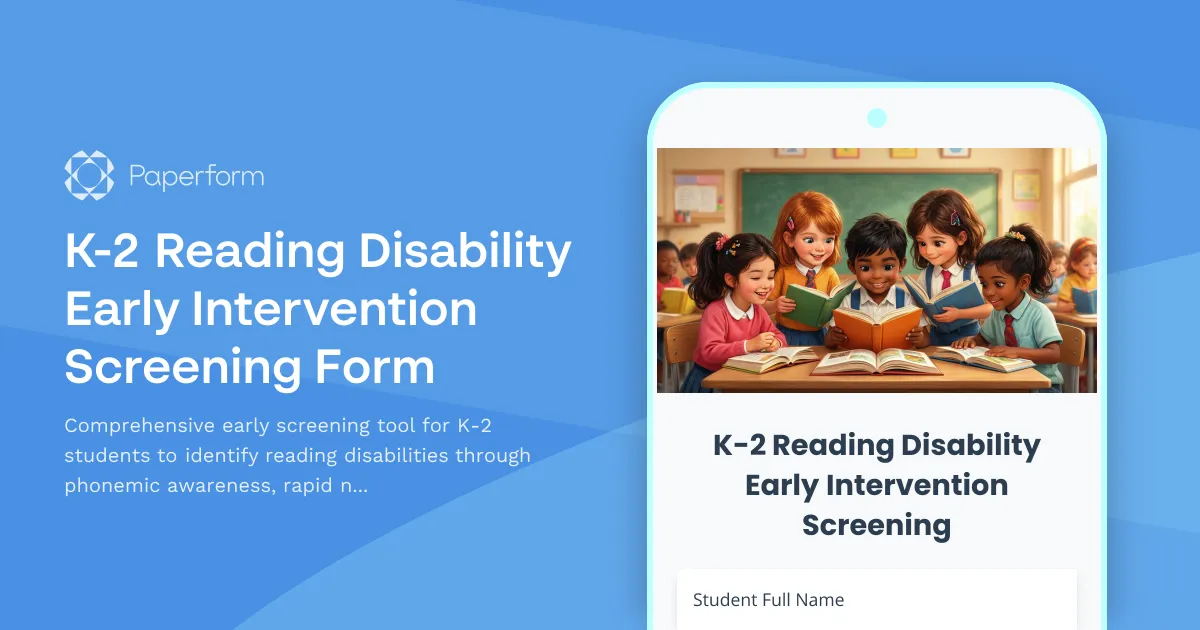
Support Early Literacy Success with Targeted Reading Disability Screening
Early identification of reading difficulties is crucial for K-2 student success. This reading disability early intervention screening form provides educators with a structured, evidence-based assessment tool to identify students who may benefit from additional literacy support.
Comprehensive Assessment Areas
This template evaluates key literacy indicators including phonemic awareness, rapid naming ability, letter knowledge, and sound-letter correspondence—all critical predictors of reading success. By capturing detailed observations across multiple domains, educators can identify specific areas of difficulty and match students with appropriate intervention strategies.
Designed for Elementary Education Professionals
Whether you're a special education coordinator, reading specialist, classroom teacher, or school psychologist, this form streamlines the screening process while maintaining thorough documentation. The structured format ensures consistency across evaluators and creates a clear record for IEP meetings, parent conferences, and intervention planning.
Tiered Support Recommendations Built In
Based on assessment results, the form automatically guides educators toward appropriate tiered intervention recommendations—from universal classroom strategies to intensive individual support. This alignment with RTI (Response to Intervention) frameworks helps schools allocate resources effectively and ensures students receive the right level of support at the right time.
Seamless Integration with Your Workflow
With Paperform's conditional logic, you can show relevant follow-up questions based on initial screening results. Connect submissions to Google Sheets for easy tracking across grade levels, or use Stepper to automatically notify intervention specialists when students score below benchmark levels, schedule follow-up assessments, or generate parent communication letters.
Perfect for elementary schools implementing early literacy screening programs, special education departments conducting universal screenings, and reading specialists tracking student progress throughout the year. Make data-driven intervention decisions with confidence using this professional screening tool.
More templates like this
Functional Behavioral Assessment Parent Questionnaire
A comprehensive parent questionnaire for functional behavioral assessments (FBA) that helps educators understand student behavior patterns, environmental triggers, reinforcement factors, and communication methods to develop effective behavioral intervention plans.
Learning Disability Assessment Form
A comprehensive pre-assessment form for identifying learning difficulties, academic challenges, processing speed concerns, and accommodation needs for students and individuals seeking evaluation.
Adapted Physical Education Evaluation Request Form
A comprehensive evaluation request form for adapted physical education programs, assessing gross motor skills, fitness levels, adaptive equipment needs, and inclusive sports participation opportunities for students with diverse abilities.
Assistive Technology Evaluation Request Form
Request an assistive technology evaluation for students with learning barriers. Assess current technology use, identify needs, and connect with AT specialists for personalized support.
Autism Spectrum Disorder Diagnostic Observation Consent Form
A comprehensive consent and information form for ASD diagnostic observation including ADOS-2 assessment, parent interview, school observation, and multidisciplinary team evaluation.
Autism Spectrum Support Services Intake Form
A comprehensive intake form for autism spectrum support services that captures sensory profiles, communication preferences, social skills assessments, and behavior patterns to create personalized support plans.
Dyslexia Screening Quiz
A comprehensive dyslexia screening tool for educators and specialists to identify reading difficulties, assess phonological awareness, and determine if formal diagnostic testing is recommended.
Emotional Disturbance Eligibility Evaluation Form
Comprehensive assessment form for evaluating students for emotional disturbance eligibility under special education programs, documenting behavioral incidents, mental health diagnoses, educational impact, and therapeutic recommendations.
Individual Counseling Services Request for Students with Emotional Disturbance
A comprehensive form for requesting and documenting intensive individual counseling services for students with emotional disturbance, including treatment planning, evidence-based interventions, crisis prevention strategies, and outcome measurement.
Learning Disability Screening Quiz
A comprehensive screening tool for educational psychologists to assess potential learning disabilities through academic performance indicators, behavioral observations, and cognitive patterns.
Occupational Therapy Evaluation Request Form
Request an occupational therapy evaluation for school-aged children with sensory processing concerns, fine motor skills challenges, or adaptive equipment needs.
Other Health Impairment (OHI) Eligibility Form
Comprehensive eligibility assessment form for students with chronic health conditions seeking special education support under Other Health Impairment classification, including medical documentation and educational impact evaluation.