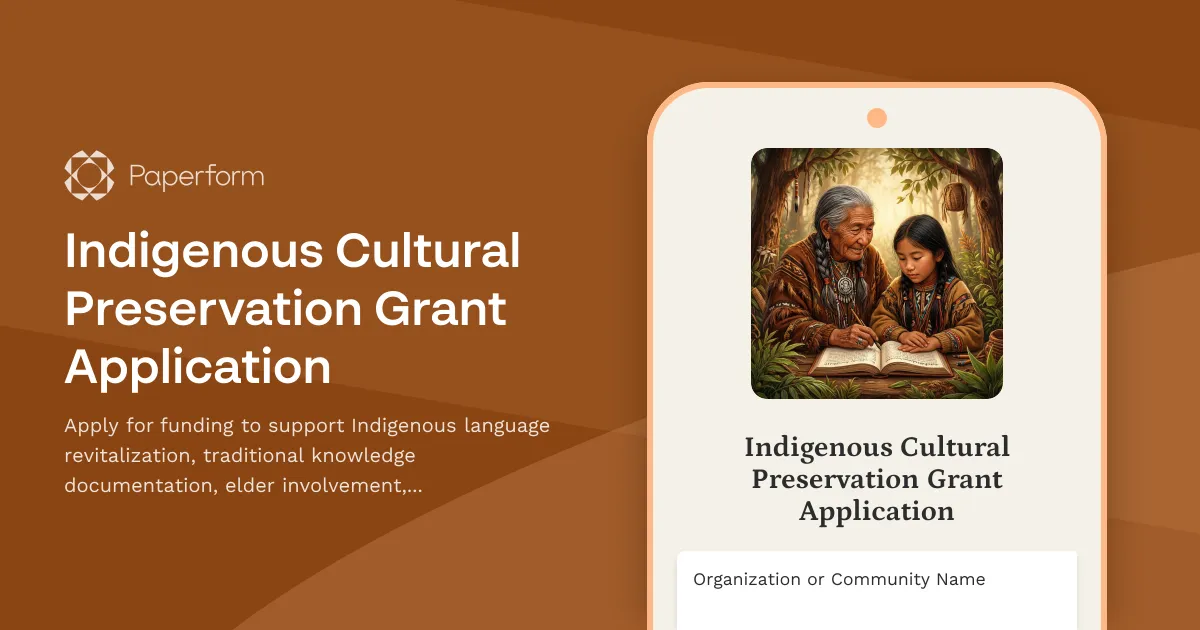
Preserve Indigenous Culture and Language with Our Grant Application Template
Indigenous communities worldwide face the urgent challenge of preserving traditional languages, cultural practices, and ancestral knowledge as elder knowledge-keepers age and younger generations become more disconnected from their heritage. Cultural preservation grants provide vital funding to support language revitalization programs, traditional knowledge documentation, and intergenerational cultural transmission—but the application process can be complex and time-consuming.
Our Indigenous Cultural Preservation Grant Application template streamlines the entire process, making it easier for Indigenous communities, cultural organizations, tribal councils, and educational institutions to apply for funding that supports language revitalization, traditional knowledge preservation, elder engagement, and youth cultural programs.
Why Indigenous Cultural Preservation Grants Matter
Language loss is occurring at an alarming rate globally, with many Indigenous languages now spoken by only a handful of elders. When a language disappears, it takes with it centuries of cultural knowledge, traditional ecological wisdom, spiritual practices, and unique ways of understanding the world.
Cultural preservation grants fund critical initiatives including:
- Language revitalization programs that document endangered languages, create teaching materials, and establish immersion programs
- Traditional knowledge documentation capturing elder wisdom about medicine, ecology, ceremonies, and cultural practices
- Intergenerational programs connecting elders with youth to transmit cultural knowledge and language skills
- Cultural education initiatives including language classes, traditional arts workshops, and ceremonial practice preservation
- Digital archiving projects recording oral histories, songs, stories, and language lessons for future generations
- Community cultural centers and gathering spaces where language and traditions can be practiced and shared
This template is designed specifically for Indigenous communities and organizations seeking funding to protect and revitalize their cultural heritage before critical knowledge is lost forever.
Who This Template Is For
This grant application form is ideal for:
- Indigenous communities and tribal nations seeking funding for cultural preservation initiatives
- Cultural preservation organizations focused on Indigenous language and knowledge protection
- Educational institutions developing Indigenous language programs and cultural curricula
- Community cultural centers offering language classes and traditional knowledge workshops
- Non-profit organizations supporting Indigenous cultural revitalization efforts
- Tribal councils and Indigenous governments implementing cultural preservation strategies
- Language revitalization teams working to document and teach endangered Indigenous languages
- Elder and youth program coordinators facilitating intergenerational cultural transmission
What Makes This Template Effective
Unlike generic grant applications, this template addresses the unique aspects of Indigenous cultural preservation work:
Community-Centered Approach: The form recognizes that effective cultural preservation must be community-led and elder-guided, with questions designed to demonstrate community involvement, traditional governance consultation, and culturally appropriate methodologies.
Comprehensive Program Documentation: Applicants can detail their specific language revitalization methods (immersion programs, master-apprentice models, digital resources), traditional knowledge documentation approaches (oral history recording, traditional ecological knowledge mapping), elder involvement strategies, and youth engagement plans.
Cultural Sensitivity: Questions are framed with respect for Indigenous knowledge systems, acknowledging that some traditional knowledge may be sacred or restricted, and allowing applicants to describe appropriate protocols for documentation and sharing.
Measurable Impact Assessment: The form helps organizations articulate both quantitative metrics (number of language learners, hours of elder recordings, youth participants) and qualitative outcomes (cultural identity strengthening, intergenerational relationship building, traditional practice continuation).
Sustainability Planning: Sections focused on long-term sustainability ensure that preservation efforts will continue beyond the grant period, building community capacity and creating lasting cultural infrastructure.
Streamline Your Grant Application Process with Paperform
Managing cultural preservation grant applications requires careful documentation, community consultation, and thorough project planning. Paperform makes this complex process manageable with an elegant, easy-to-use form builder that creates professional, culturally respectful application forms.
The document-style editor lets you customize every aspect of the form to reflect your granting organization's priorities and your community's cultural values. Add traditional artwork, incorporate community language elements, and create a welcoming application experience that honors Indigenous applicants' cultural perspectives.
With conditional logic, you can tailor questions based on project type—showing specialized questions for language immersion programs, traditional arts preservation, or knowledge documentation initiatives. This ensures applicants only see relevant questions while providing grant reviewers with the specific information needed for each project category.
File upload fields allow applicants to submit community support letters, elder endorsements, language sample recordings, traditional knowledge protocols, and supporting documentation all in one organized submission. Integration with Google Drive, Dropbox, or your document management system keeps everything accessible for review committees.
Automate Your Grant Review Workflow with Stepper
Once applications are submitted, Stepper (stepper.io) can automate your entire grant review and approval process. Create workflows that automatically:
- Send confirmation emails to applicants acknowledging receipt
- Route applications to appropriate review committee members based on project type or geographic region
- Notify community elders or cultural advisors for traditional knowledge review
- Track review progress and send reminders to committee members
- Compile reviewer scores and feedback into summary reports
- Send approval or decline notifications with detailed feedback
- Generate grant agreements for approved projects
- Schedule milestone check-ins and progress reporting
This automation ensures culturally important preservation projects move efficiently through the review process while maintaining the thoughtful consideration each application deserves.
Key Features for Cultural Preservation Grant Applications
Project Classification: Clearly categorize applications by focus area (language revitalization, traditional knowledge documentation, cultural arts, ceremonial practice, etc.) to match with appropriate funding streams and reviewers.
Community Engagement Documentation: Dedicated sections for describing community consultation processes, elder involvement, youth engagement strategies, and traditional governance approval ensure community-led approaches.
Cultural Protocol Recognition: Space for applicants to describe cultural protocols, traditional permissions obtained, and appropriate handling of sacred or restricted knowledge demonstrates respect for Indigenous knowledge systems.
Budget Planning Tools: Detailed budget sections help applicants outline costs for elder honorariums, language materials, recording equipment, youth program supplies, and community gathering expenses.
Impact Measurement: Questions designed to capture both Western evaluation metrics and Indigenous-centered measures of success, honoring different ways of knowing and measuring cultural vitality.
Integration with Your Existing Systems
Paperform connects seamlessly with the tools cultural organizations already use. Send applications to Airtable or Google Sheets for review tracking, notify your team via Slack when high-priority applications arrive, sync with your CRM to track applicant relationships, or push data to project management tools for grant administration.
For organizations managing multiple grant programs or serving various Indigenous communities, these integrations create a centralized hub where all applications, reviews, and grant management activities flow smoothly without manual data entry.
Supporting Indigenous Cultural Sovereignty and Self-Determination
Cultural preservation funding empowers Indigenous communities to reclaim their languages, protect traditional knowledge, and ensure cultural continuity for future generations. By making the grant application process more accessible and respectful of Indigenous ways of knowing, this template supports cultural sovereignty and self-determination.
Whether you're a tribal nation establishing a language nest for young children, a cultural center creating a digital archive of elder knowledge, an educational institution developing Indigenous curriculum, or a community organization connecting youth with traditional practices, this grant application template provides the structure needed to secure funding while maintaining cultural integrity.
Get Started Today
The Indigenous Cultural Preservation Grant Application template gives your organization or community a professional, culturally respectful foundation for securing funding to protect endangered languages, document traditional knowledge, honor elders, and engage youth in cultural learning.
With Paperform's intuitive editor, you can customize the template to reflect your specific granting priorities, add your organization's branding, and create an application experience that honors Indigenous applicants and their vital cultural preservation work. Start preserving languages, knowledge, and cultural heritage with a grant application process that's as respectful as it is efficient.
More templates like this
Cultural Exchange Grant Application Form
Comprehensive grant application for cultural exchange programs with program itinerary, participant selection, visa assistance, safety protocols, and reciprocal visit planning.
Language Revitalization Grant Application
Apply for funding to support endangered language preservation through immersion schools, master-apprentice programs, digital resources, and intergenerational transmission initiatives.
Oral History Project Grant Application
Apply for funding to document and preserve community stories through oral history interviews with professional archival standards and public access platforms.
Pollinator Habitat Grant Application
Apply for funding to establish or enhance pollinator habitats with native plant species, pesticide reduction plans, and community education components.
Abolition Education Grant Application
A comprehensive grant application for organizations and educators seeking funding to develop transformative abolition-focused curriculum, youth organizer training programs, political education initiatives, and movement-building capacity.
After-School Program Grant Application
Apply for funding to launch or expand an after-school program with comprehensive activity schedules, academic support, STEM enrichment, and student care services.
Aquaponics & Urban Farming Scholarship Application
A specialized scholarship application for students pursuing aquaponics, controlled environment agriculture, and urban farming initiatives with a focus on sustainable food systems.
Community Controlled Schools Grant Application
A comprehensive grant application for community controlled schools focused on parent and student governance, culturally sustaining pedagogy, community accountability, and liberatory education practices.
Community Knowledge Grant Application
Application form for community-led research grants supporting knowledge justice, participatory action research, and grassroots intellectual production through community-university partnerships.
Creative Writing Grant Application
A comprehensive grant application form for writers seeking funding for creative writing projects, including manuscript submission, publication history, and residency preferences.

Cultural Heritage Preservation Grant Application
Apply for grant funding to preserve, digitize, and make accessible important cultural heritage materials and artifacts through professional conservation methods.
Farm-to-School Grant Application
Apply for farm-to-school funding to support local food procurement, nutrition education programs, school gardens, and cafeteria infrastructure improvements.