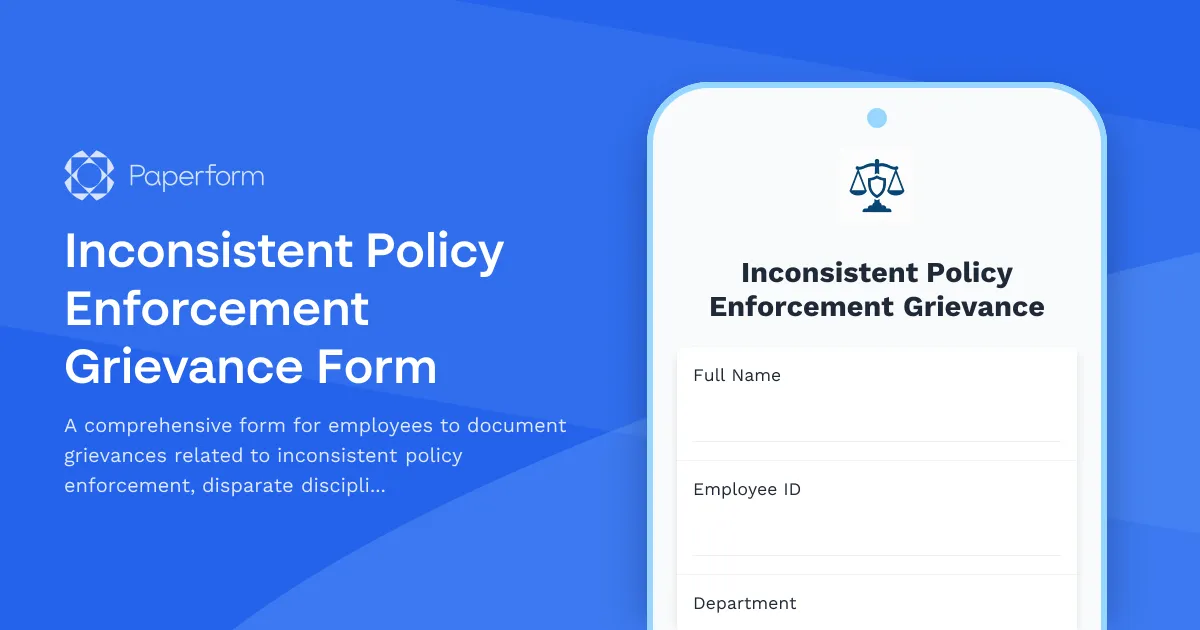
Fair Treatment Starts With Proper Documentation
When workplace policies aren't applied consistently, it erodes trust, damages morale, and can expose your organization to serious legal risks. This Inconsistent Policy Enforcement Grievance Form helps HR teams and employees create a clear, structured record of concerns related to unequal treatment, favoritism, and procedural fairness violations.
Built for HR professionals, managers, and employees who need to document and address workplace equity issues, this template captures all the critical details: specific incidents, comparative treatment, witnesses, supporting evidence, and the resolution being sought. Whether you're dealing with disparate disciplinary actions, preferential treatment, or selective policy application, this form ensures nothing falls through the cracks.
Why Paperform for HR Grievances?
Paperform makes it simple to collect sensitive workplace concerns securely and professionally. The form uses conditional logic to adapt questions based on the type of grievance, ensuring you gather relevant details without overwhelming the submitter. Responses are encrypted, stored securely (SOC 2 Type II compliant), and can trigger automated workflows via Stepper to route grievances to the appropriate HR personnel, create case files in your HRIS, or send acknowledgment emails automatically.
With Paperform's document-style editor, you can customize this template to match your organization's specific policies, add your employee handbook references, incorporate your company branding, and adjust the language to fit your workplace culture. The form works beautifully on any device, so employees can submit grievances confidentially from anywhere.
For HR teams managing multiple cases, Paperform's reporting dashboard and AI Insights help you identify patterns across submissions—spotting systemic issues before they become major problems. You can also use Papersign to route any resulting corrective action plans or resolution agreements for eSignature, keeping your entire grievance management process in one connected ecosystem.
This template is designed for organizations that take workplace equity seriously and need a professional, compliant way to document and address policy enforcement concerns before they escalate.
More templates like this
Compelled Speech & Belief Complaint Form
A professional HR form for employees to report concerns about compelled speech, belief mandates, DEI training objections, political coercion, and conscience protection requests in the workplace.
Constructive Discharge & Workplace Grievance Report Form
A confidential form for employees to document potential constructive discharge situations, unreasonable workload demands, and evidence of forced resignation strategies in the workplace.
Salary Inequity Grievance Form
A confidential form for employees to document and report concerns about salary inequity, wage gaps, and equal pay violations with comparative compensation data.
Socioeconomic Status Discrimination Report Form
A confidential form for reporting discrimination, harassment, or workplace barriers related to socioeconomic status, class background, or economic circumstances.
Workplace Gossip & Reputation Harm Complaint Form
A formal complaint form for employees to report workplace gossip, defamation, and reputation damage that impacts their professional standing and career.
Workplace Psychological Harassment Report Form
A confidential form for employees to report workplace psychological harassment, emotional abuse patterns, and hostile work environment concerns with documentation of mental health impact.
Appearance and Grooming Policy Discrimination Complaint Form
A confidential form for employees to report discrimination, bias, or denial of religious and cultural accommodations related to workplace appearance and grooming policies.
Caregiver Discrimination Grievance Form
A comprehensive form for employees to report caregiver discrimination, FMLA interference, family responsibility bias, schedule accommodation denials, and related Title VII violations in the workplace.
Company Data Privacy and GDPR Compliance Training Survey
Measure the effectiveness of your data privacy and GDPR compliance training. Assess employee confidence in data handling, understanding of compliance requirements, and identify knowledge gaps to strengthen your organisation's data protection culture.
Compelled Speech & Conscience Protection Complaint Form
A confidential form for employees to report concerns about compelled speech, belief requirements, training objections, or conscience protection issues in the workplace.
Employee Classification Grievance Form
A professional form for workers to submit formal grievances regarding potential misclassification as independent contractors instead of employees, including documentation of job duties, benefits denial, and DOL compliance concerns.
Employee Peer Review Bias Grievance Form
Submit formal complaints about bias, manipulation, or retaliation in peer review and 360 feedback processes. Confidential documentation of review integrity concerns.