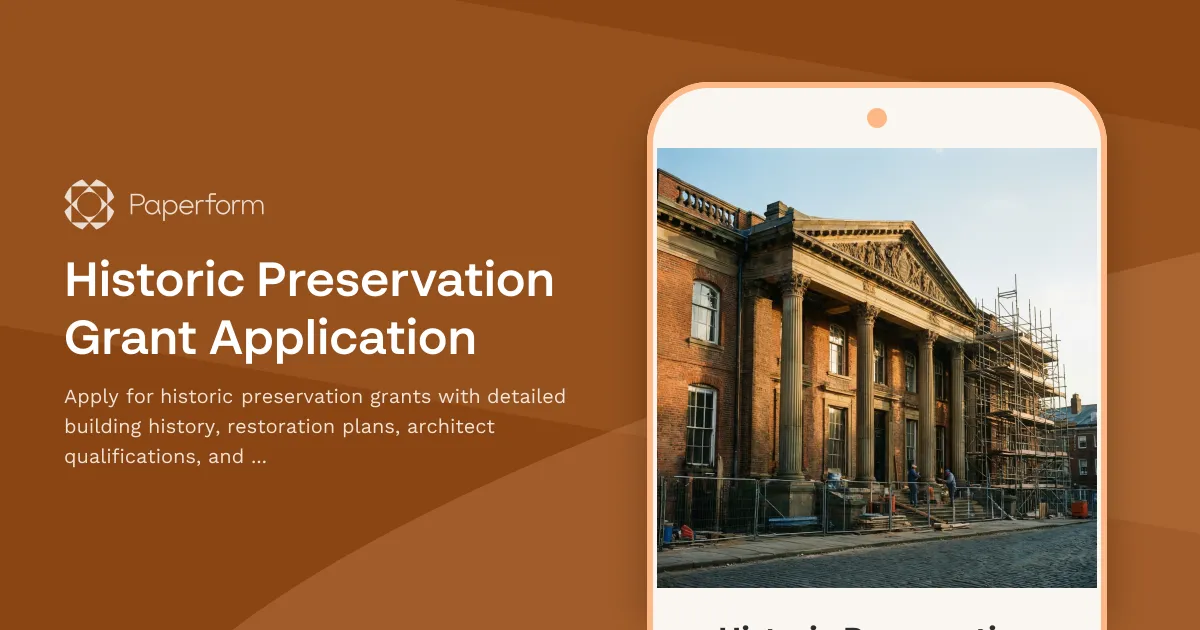
Historic Preservation Grant Application Form Template
Securing funding for historic preservation projects requires detailed documentation, careful planning, and a compelling case for why your building or site deserves protection and restoration. This Historic Preservation Grant Application form template streamlines the entire process, helping preservation societies, nonprofits, municipalities, property owners, and heritage organizations submit comprehensive grant applications that meet reviewer expectations.
Why Historic Preservation Grants Matter
Historic buildings are irreplaceable connections to our past—they tell stories of architectural evolution, community identity, and cultural heritage. Yet preservation work is expensive. From structural repairs and facade restoration to compliance with historic standards and National Register requirements, costs add up quickly. That's where preservation grants become essential, providing the financial support needed to restore, maintain, and protect these valuable assets for future generations.
Whether you're applying for state historic preservation office (SHPO) funding, National Park Service grants, local heritage commission support, or private foundation awards, this template ensures you capture every detail reviewers need to evaluate your project's merit, feasibility, and historic significance.
Built for Grant Reviewers and Applicants Alike
This form template is structured around the common requirements of historic preservation grant programs. It collects:
- Property and ownership details, including legal descriptions and site addresses
- Building history and significance, with space to document construction dates, architectural styles, original uses, and notable historical events or figures
- National Register status, whether already listed, eligible, or under consideration
- Detailed restoration plans, including scope of work, materials, timelines, and adherence to the Secretary of the Interior's Standards
- Architect and contractor qualifications, ensuring your team has the expertise required for preservation work
- Project budgets and funding requests, with line-item breakdowns and matching fund commitments
- Supporting documentation uploads, such as photographs, architectural drawings, historical research, letters of support, and previous condition assessments
With conditional logic built in, the form adapts based on answers—showing additional fields for National Register–listed properties, asking for architect credentials only when required, and collecting budget details proportional to the project scope.
Designed for Preservation Professionals and Community Advocates
This template serves a wide range of users:
- Historic preservation societies and trusts managing multiple properties and applying for recurring grant cycles
- Nonprofit organizations restoring community landmarks, theaters, schools, and houses of worship
- Municipal governments and planning departments seeking funds for public historic buildings and downtown revitalization
- Private property owners committed to preserving historic homes, estates, and commercial structures
- Architects and consultants working on behalf of clients to submit preservation grant applications
- Heritage commissions and cultural organizations advocating for sites with local, state, or national significance
No matter your role, Paperform's doc-style editor makes it easy to adapt the template to match specific grant guidelines, add your organization's branding, and include custom instructions or eligibility criteria.
How Paperform Elevates Historic Preservation Grant Applications
Applying for preservation grants shouldn't mean wrestling with clunky PDFs, email attachments, and scattered spreadsheets. Paperform replaces all of that with a single, beautifully designed form that works across devices and keeps everything organized.
Professional, branded experience: Use Paperform's theme controls to match your preservation organization's colors, fonts, and visual identity. Embed historical images, building photos, or heritage society logos directly into the form to create an application experience that reflects the care and craftsmanship your project deserves.
File uploads made simple: Applicants can attach floor plans, elevation drawings, historical photographs, letters of support from preservation officers, condition reports, and environmental assessments—all in one place. Paperform accepts multiple file types and keeps uploads linked to each submission for easy review.
Calculations for budget accuracy: Use on-form calculations to automatically total project costs, match fund percentages, and grant amounts requested. This ensures reviewers see accurate, professional budget summaries without manual math errors.
Conditional logic for smarter forms: Show follow-up questions only when relevant. For example, if a building is already on the National Register, request the listing date and reference number; if not, ask about eligibility and nomination plans. This keeps the form concise and reduces applicant frustration.
Data organized and searchable: All submissions land in a clean, sortable table where review committees can filter by project type, funding amount, National Register status, or submission date. Export to CSV or sync with Google Sheets or Airtable for grant review workflows.
Automate Grant Review Workflows with Stepper
Once applications are submitted, the real work begins: routing submissions to review committees, requesting additional documentation, scheduling site visits, and notifying applicants of decisions. Stepper (stepper.io), Paperform's AI-native workflow builder, automates these steps so your team can focus on evaluating projects rather than managing admin.
With Stepper, you can:
- Route applications to different reviewers based on project type, location, or funding tier
- Send automatic confirmation emails with submission summaries and next steps
- Request missing documents via follow-up emails triggered by incomplete fields
- Update project management tools like Airtable, Notion, or Monday.com with new applications
- Notify stakeholders when applications move from "Under Review" to "Approved" or "Requires Revision"
- Generate reports summarizing application volumes, funding requests, and approval rates
By connecting your grant application form to Stepper, you create a seamless pipeline from submission to decision, cutting review time and improving applicant communication.
Built for Security, Compliance, and Collaboration
Historic preservation grants often involve sensitive property information, financial details, and competitive applications. Paperform is SOC 2 Type II compliant, meaning your data is handled with enterprise-grade security. Role-based permissions let you control who can view, edit, or export applications, while audit logs track every action for accountability.
For organizations managing multiple grant programs or working across state and federal levels, Paperform's Agency+ plan makes it easy to create separate workspaces for different grant cycles, jurisdictions, or funding sources—all under one roof.
Who This Template Is For
This Historic Preservation Grant Application form is ideal for:
- State Historic Preservation Offices (SHPOs) administering state and federal grant programs
- Certified Local Governments (CLGs) distributing pass-through funds for local preservation projects
- Private foundations and trusts offering grants for heritage conservation and restoration
- National and regional preservation organizations running competitive grant cycles
- Municipalities and counties seeking to streamline preservation funding applications
- Property owners and developers applying for tax credits, easements, and restoration grants
Whether you're running a single grant program or managing dozens of applications per year, Paperform provides the structure, flexibility, and automation you need to make the process efficient and transparent.
How to Customize This Template
Every preservation grant has unique requirements. With Paperform's intuitive editor, you can:
- Add or remove fields to match specific grant guidelines (e.g., environmental impact statements, economic development benefits, community engagement plans)
- Adjust conditional logic to show questions based on applicant type (nonprofit, government, individual)
- Include custom scoring criteria or rubric fields for internal reviewers
- Embed instructional videos or links to grant guidelines, the Secretary of the Interior's Standards, or National Register criteria
- Set up email notifications to alert applicants of deadlines, missing materials, or status updates
You can also integrate Paperform with your existing tools—sync submissions to your CRM, push data to grant management software, or connect to Slack for real-time application alerts.
Start Streamlining Your Historic Preservation Grant Applications
Historic preservation is about honoring the past while planning for the future. This grant application template helps you do both—by making it easier for committed applicants to share their vision and simpler for funders to identify projects worth supporting.
With Paperform, you replace outdated paper forms and email chaos with a modern, mobile-friendly application process that reflects the professionalism and care historic preservation demands. And with tools like Stepper and Papersign (papersign.com) for contracts and agreements, you can manage the entire grant lifecycle—from application to award to project completion—in one connected platform.
Whether you're preserving a Victorian mansion, a mid-century modern landmark, a rural schoolhouse, or an entire historic district, this template gives you the foundation to make your case, secure funding, and ensure these irreplaceable places endure.



More templates like this
Affordable Housing Development Grant Application
Secure funding for affordable housing projects with a comprehensive grant application covering unit mix, income qualifications, construction timelines, and property management plans.
Green Infrastructure Grant Application
Apply for funding to implement green infrastructure projects including rain gardens, permeable pavement, bioswales, and stormwater management solutions.
Bike Infrastructure Grant Application
Apply for funding to build protected bike lanes and improve cycling infrastructure in your community. Complete application for bike path grants with safety assessment and connectivity planning.
Civic Technology Grant Application
Apply for funding to develop civic technology projects focused on open data platforms, resident engagement, language accessibility, and privacy protections.
Community Land Trust Grant Application
A comprehensive grant application for community land trusts seeking funding for property acquisition, affordability mechanisms, resident governance, and anti-displacement initiatives.
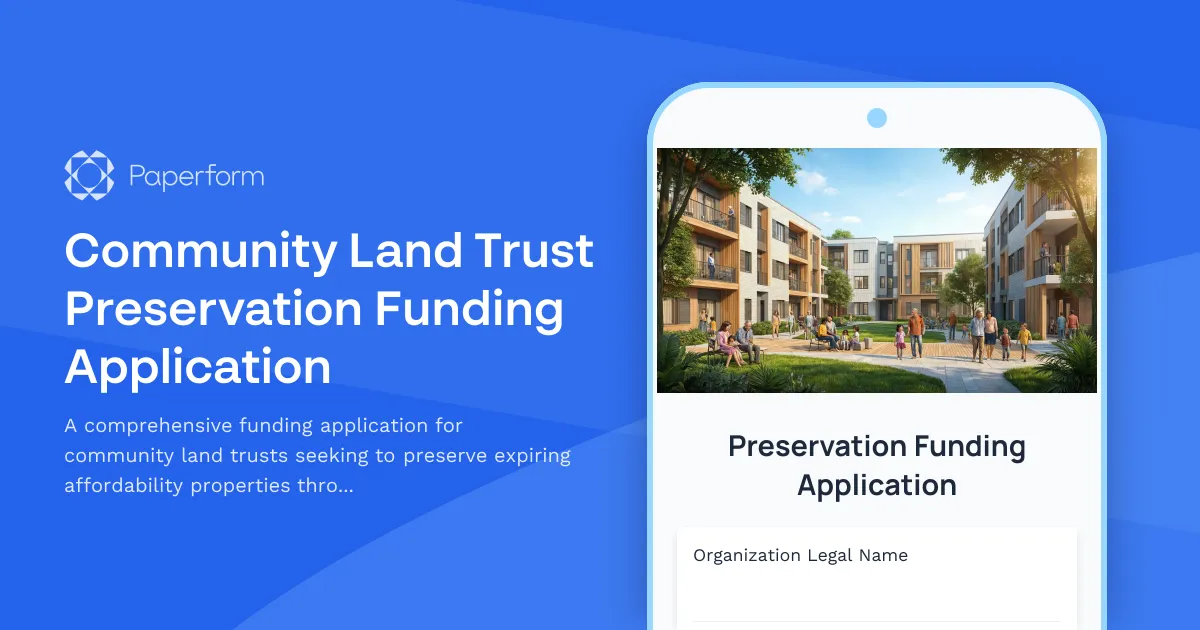
Community Land Trust Preservation Funding Application
A comprehensive funding application for community land trusts seeking to preserve expiring affordability properties through acquisition, capital improvements, and permanent affordability commitments.
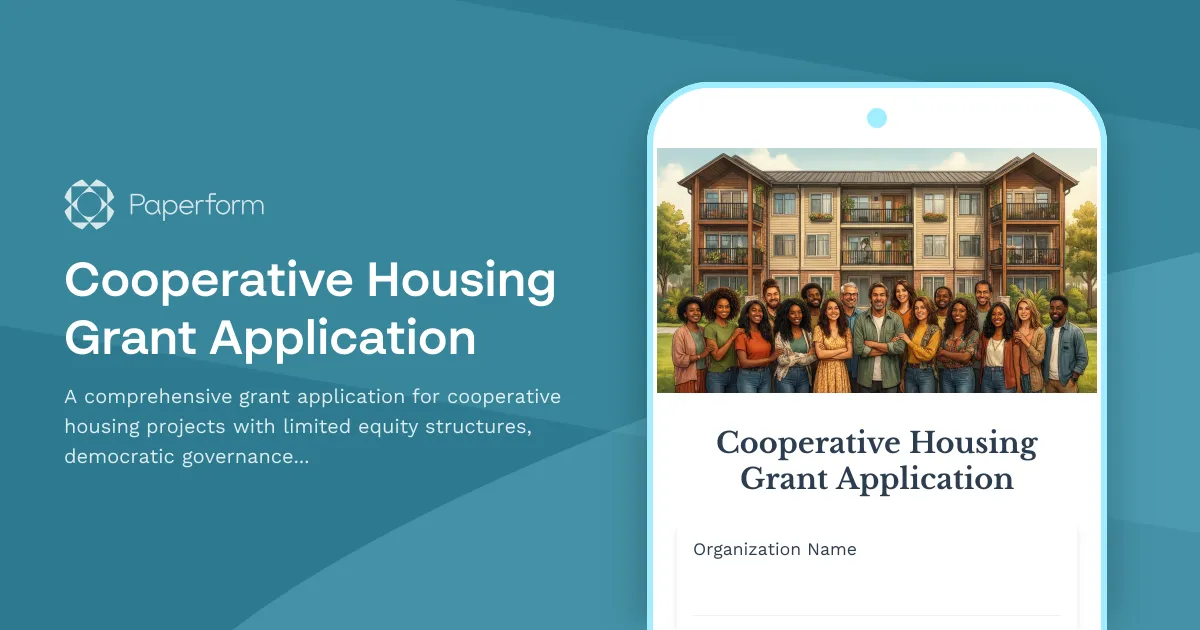
Cooperative Housing Grant Application
A comprehensive grant application for cooperative housing projects with limited equity structures, democratic governance models, and affordability preservation mechanisms.
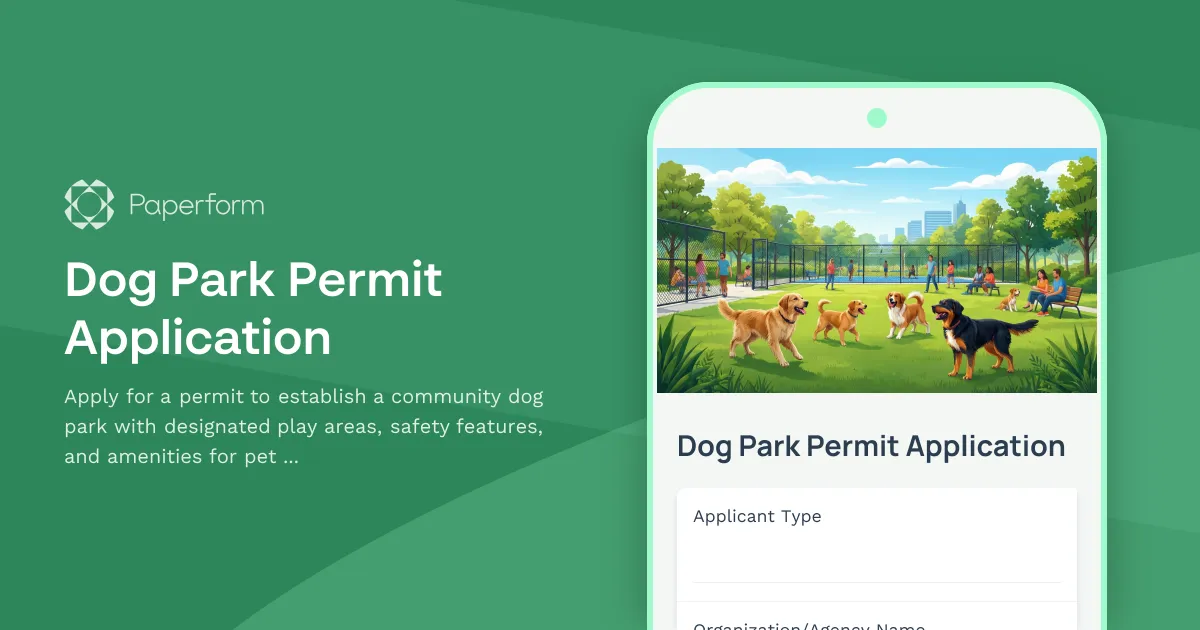
Dog Park Permit Application
Apply for a permit to establish a community dog park with designated play areas, safety features, and amenities for pet owners and their dogs.
Renewable Energy Grant Application
Comprehensive grant application for renewable energy projects including technical specifications, financial projections, environmental impact assessment, and contractor qualifications.
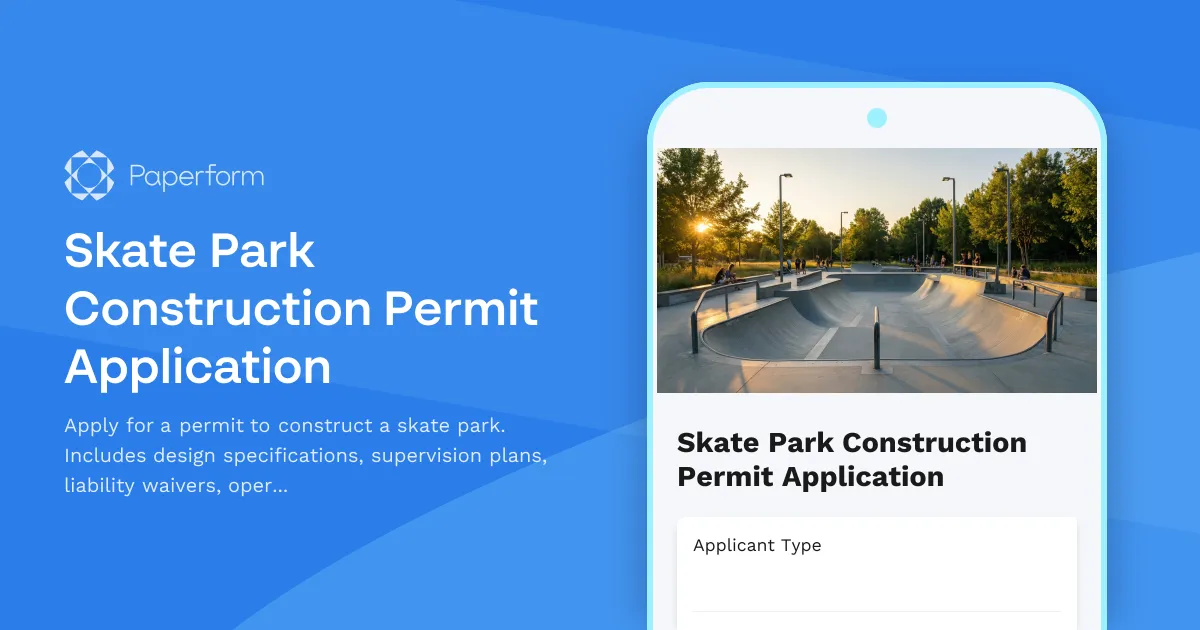
Skate Park Construction Permit Application
Apply for a permit to construct a skate park. Includes design specifications, supervision plans, liability waivers, operating hours, and maintenance schedules.
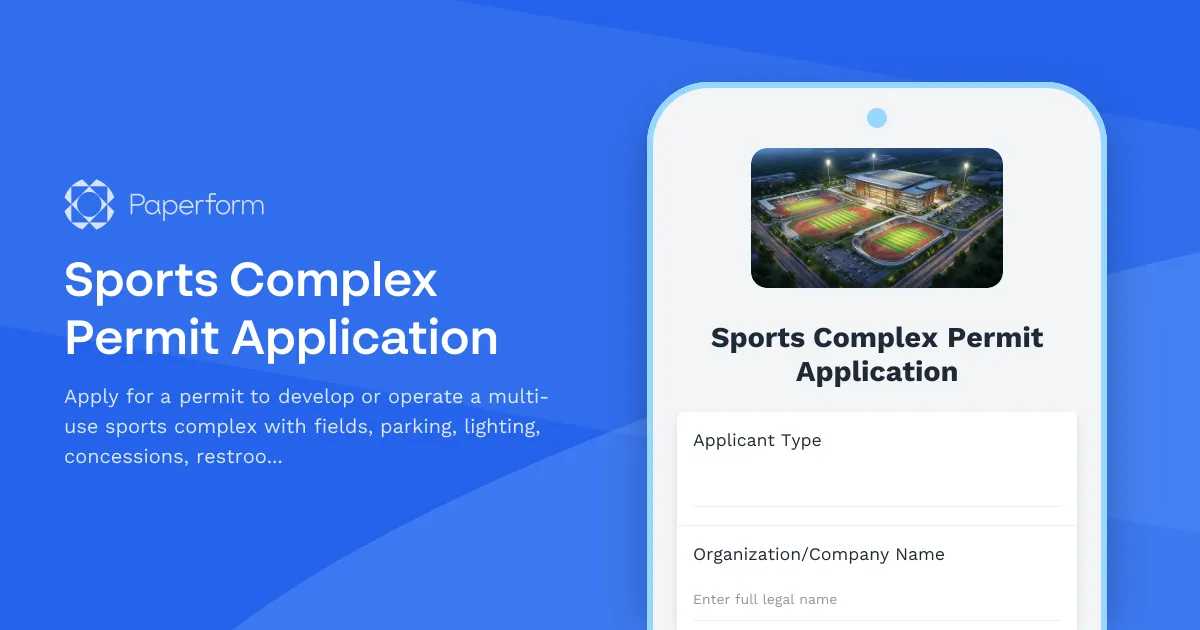
Sports Complex Permit Application
Apply for a permit to develop or operate a multi-use sports complex with fields, parking, lighting, concessions, restrooms, and tournament hosting capabilities.
Accessory Dwelling Unit (ADU) Permit Application
Apply for a permit to construct or convert an accessory dwelling unit (ADU) or backyard cottage on your property with size calculations, parking, utilities, and design review.