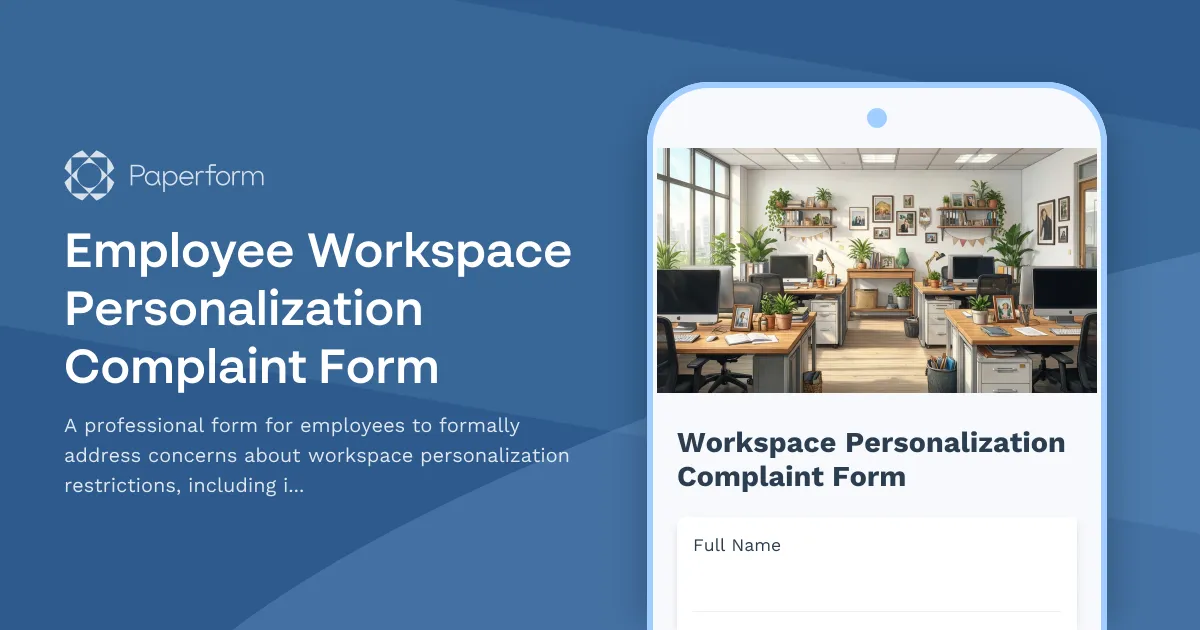
Submit Your Workspace Personalization Concern
Workplace environment matters. When employees feel their workspace reflects their personality and values, morale and productivity often improve. However, balancing personal expression with professional standards can be challenging—and when restrictions feel arbitrary or culturally insensitive, it's important to have a formal channel to voice those concerns.
This Employee Workspace Personalization Complaint Form is designed for HR teams, managers, and organizational leaders who need a structured way to capture, review, and respond to employee grievances about workspace personalization policies. Whether your team is navigating hybrid work setups, open office layouts, or shifting company culture, this template helps you document concerns about desk decoration limits, cultural expression policies, and morale impacts in a fair and consistent way.
Why Paperform for employee grievance forms?
Paperform makes it easy to create professional, on-brand HR forms that employees actually want to use. With conditional logic, you can tailor follow-up questions based on the type of restriction being challenged—whether it's about religious expression, personal photos, plants, or office decor standards. Because the form is built in a doc-style editor, you can add context, empathy and clear instructions that help employees feel heard from the moment they open the form.
Once submitted, responses can feed directly into your HRIS, Slack, or project management tools via Stepper—routing complaints to the right HR lead, triggering acknowledgment emails, and creating follow-up tasks automatically. That means no grievance gets lost in an inbox, and every employee knows their concern is being taken seriously.
For organizations committed to diversity, equity, and psychological safety, this template offers a starting point for documenting concerns, understanding patterns, and building more inclusive workspace policies. Trusted by HR teams worldwide, Paperform is SOC 2 Type II compliant and designed to keep employee data secure and confidential.



More templates like this
Company Communication Access Grievance Form
A formal grievance form for employees to report communication inequities, information access issues, remote worker exclusion, and concerns about decision-making transparency in the workplace.
Employee Committee Assignment Equity Grievance Form
Submit a formal grievance regarding committee assignment equity, visibility opportunities, leadership development access, and selection transparency in the workplace.
Employee Discipline Grievance Appeal Form
A comprehensive form for employees to formally appeal disciplinary actions, review progressive discipline procedures, report procedural violations, and request penalty reductions through a structured grievance process.
Employee Floating Holiday Denial Grievance Form
A formal grievance form for employees to appeal denied floating holiday requests, with special consideration for cultural, religious, and personal accommodations.
Employee Sick Leave Denial Grievance Form
File a formal grievance regarding denied sick leave, FMLA eligibility issues, or policy misapplication. Document your case with medical certification and request review of denied leave requests.
Hostile Supervisor Complaint Form
A confidential form for employees to report hostile supervisor behavior with detailed incident documentation, team impact assessment, and optional transfer requests.
Office Space Assignment Grievance Form
Submit a formal complaint regarding unfair office space allocation, workspace equity issues, or favoritism in desk assignments that affects your productivity and work environment.
Performance Evaluation Grievance Form
Submit a formal grievance regarding your performance evaluation, dispute ratings, provide evidence of achievements, and request a review of your assessment.
Professional Development Reimbursement Dispute Form
A structured form for employees to file disputes regarding professional development reimbursement denials or discrepancies, with policy references, documentation uploads, and HR mediation requests.
Workplace Guest Policy Grievance Form
Submit formal concerns about workplace guest policies, family visit restrictions, cultural accommodation needs, and request reasonable flexibility in visitor guidelines.
Workplace Parking Pass Denial Grievance Form
A formal grievance form for employees to contest parking pass denials, request reasonable accommodations, and address accessibility needs or seniority rights violations.
AI Monitoring & Bias Complaint Form
A comprehensive form for employees to report concerns about AI-powered monitoring systems, including facial recognition errors, algorithmic bias, and discriminatory surveillance practices.