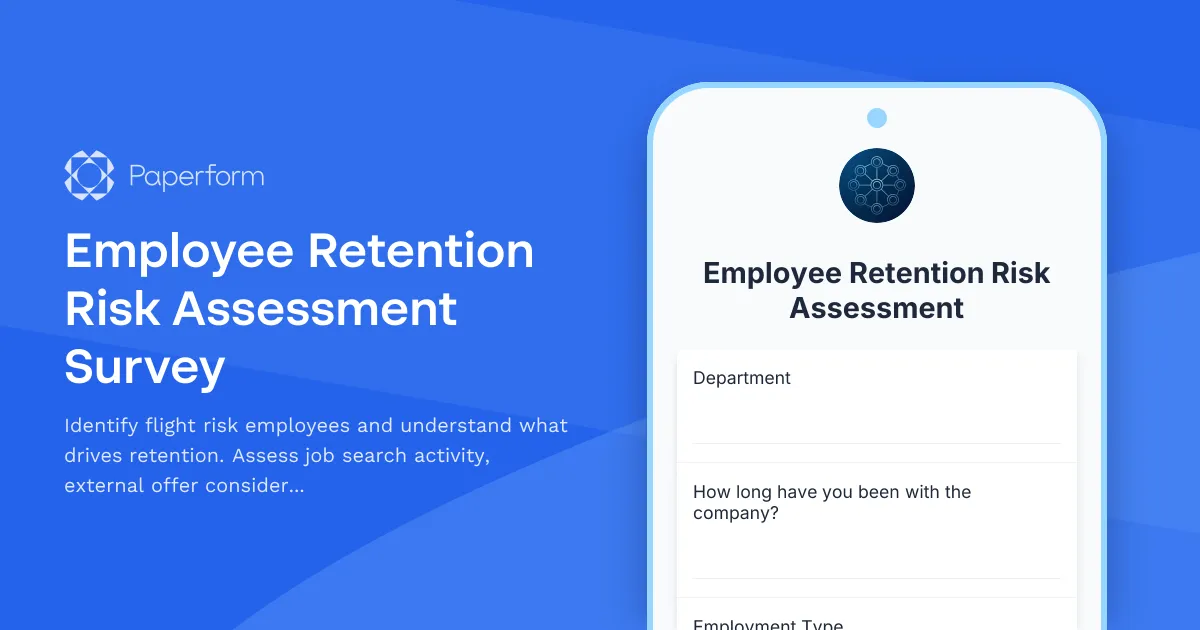
Why use an employee retention risk assessment survey?
Employee turnover is expensive—costing businesses anywhere from 50% to 200% of an employee's annual salary when you factor in recruitment, onboarding, lost productivity, and institutional knowledge. The best way to reduce turnover is to identify at-risk employees before they hand in their notice.
This Employee Retention Risk Assessment Survey helps HR teams and managers understand flight risk across their workforce by measuring job search activity, external offer consideration, and the factors that would convince employees to stay. Unlike traditional engagement surveys that focus on satisfaction scores, this template zeros in on retention-specific indicators that predict actual departure.
What makes this template valuable for HR teams
Built specifically for human resources professionals, people operations teams, and organisational development specialists, this survey cuts through surface-level feedback to reveal genuine retention risks. You'll identify which employees are actively interviewing, considering outside offers, or feeling disconnected—giving you the lead time needed to intervene with targeted retention strategies.
The survey assesses critical stay factors including compensation, career growth, work-life balance, leadership quality, recognition, and company culture. By understanding what matters most to at-risk employees, you can design personalised retention plans rather than blanket policies that miss the mark.
How Paperform makes retention surveys more effective
With Paperform's conditional logic, you can create dynamic pathways based on risk level. If someone indicates they're actively job searching, the survey can branch into deeper questions about their motivations and what it would take to keep them. Lower-risk employees might skip straight to stay factors, keeping the survey concise and respectful of their time.
The doc-style editor lets you frame sensitive questions with empathy and context, using headings and explanatory text to reassure employees that their honest feedback is valued and confidential. You can embed the survey directly into your intranet, send it via email, or share it through Slack—meeting employees where they already are.
Once responses come in, connect the survey to your HR tools via Stepper (stepper.io) to automatically flag high-risk responses, notify managers, create retention task lists in your project management system, or log insights in your HRIS. You can also use AI Insights to analyse open-ended responses at scale, surfacing common themes across departments or tenure groups without manually reading hundreds of comments.
For multi-location or multi-department organisations, Paperform's flexible design means you can deploy different versions of the survey with location-specific or role-specific questions while maintaining a consistent core assessment. Roll-up reporting gives leadership the big picture while protecting individual anonymity where appropriate.
Start reducing turnover today
Whether you're an HR manager at a growing startup, a People Ops lead at a mid-sized company, or part of a talent retention team at an enterprise, this template gives you the structure and insight needed to move from reactive exit interviews to proactive retention strategies. Deploy it quarterly, after major organisational changes, or as part of regular pulse check-ins to keep your finger on the pulse of employee commitment.
Trusted by HR teams worldwide and built on a SOC 2 Type II compliant platform, Paperform helps you gather sensitive retention data securely while automating the workflows that turn insights into action.
More templates like this
Employee Resource Group (ERG) Participation Survey
Gather employee feedback on ERG participation, affinity group interests, event attendance, and leadership opportunities to strengthen workplace diversity and inclusion initiatives.
Workplace Mental Health & Wellbeing Survey
A comprehensive survey to assess employee mental health, stress levels, wellbeing support needs, and gather feedback on existing counseling services and workplace mental health initiatives.
Company Succession Planning and Talent Pipeline Survey
Assess leadership readiness, identify high-potential talent, and evaluate career development opportunities. Gain insights into succession planning effectiveness and talent pipeline strength.
Employee Financial Transparency & Salary Policy Perception Survey
Gather employee feedback on salary transparency, pay equity, and compensation disclosure practices to build a fairer workplace.
Employee Gig Work & Side Hustle Policy Survey
Gather employee feedback on moonlighting policies, conflict of interest understanding, and the approval process for side work and gig economy participation.
Employee Pay Equity Audit Communication & Remediation Satisfaction Survey
A comprehensive survey to gather employee feedback on pay equity audit communications, adjustment transparency, retroactive corrections, and confidence in ongoing monitoring processes.
Employee Performance Goal Cascading Effectiveness Survey
Evaluate how effectively organizational goals cascade through departments to individual contributors. Assess clarity of company objectives, departmental priorities, and personal contribution visibility to improve goal alignment across your organization.
Employee Performance Review Cycle Timing Preference Survey
Gather employee feedback on performance review preferences, timing, and effectiveness. Understand team sentiment around annual vs continuous feedback approaches and development plan execution.
Employee Professional Association Membership Survey
A comprehensive survey to assess employee interest in professional associations, membership reimbursement awareness, perceived value, networking opportunities, and budget adequacy for professional development.
Manager Effectiveness 360-Degree Feedback Form
A comprehensive 360-degree feedback form to evaluate manager effectiveness across leadership competencies, communication skills, and team support. Gather anonymous, actionable insights to support professional development.
Performance Improvement Plan (PIP) Feedback Form
Gather confidential feedback on the PIP process to assess goal clarity, support adequacy, and fairness perception from employees and managers.
Professional Development Needs Assessment
A comprehensive survey to identify skill gaps, training preferences, and career development goals. Help your team grow with targeted professional development opportunities.