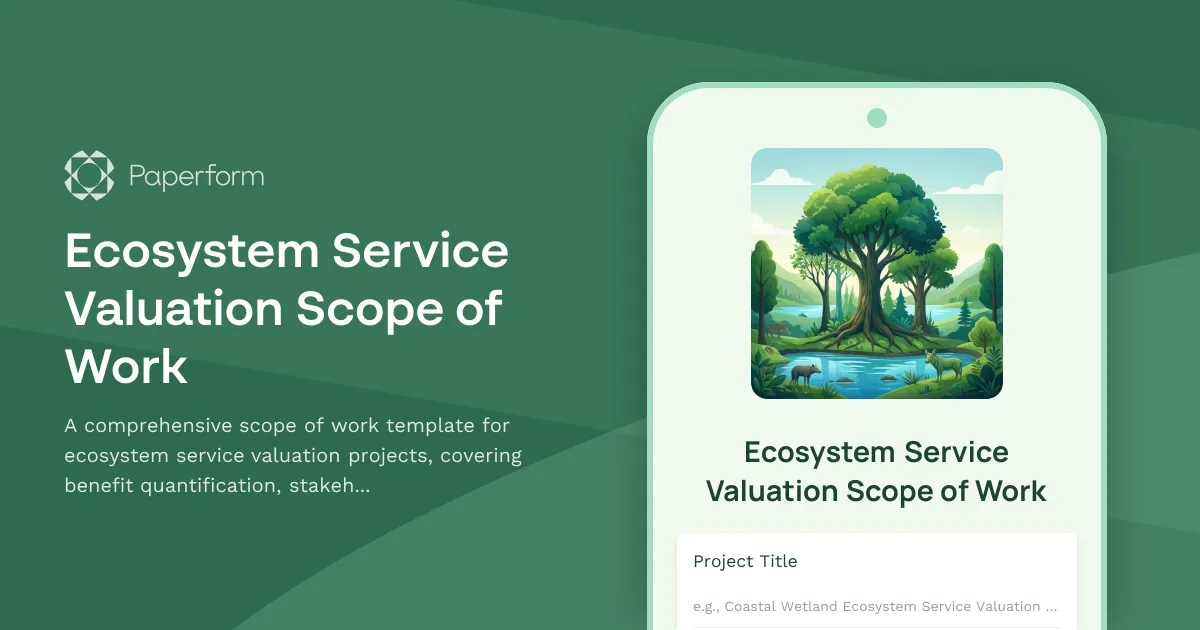
Professional Ecosystem Service Valuation Planning
Managing ecosystem service valuation projects requires a structured approach to defining scope, methodologies, and deliverables. This Ecosystem Service Valuation Scope of Work template provides environmental consultants, conservation organizations, government agencies, and sustainability professionals with a comprehensive framework for planning valuation projects that bridge ecological science and economic policy.
Whether you're assessing wetland benefits, designing payment for ecosystem services (PES) programs, or integrating natural capital into policy decisions, this template helps you capture all the critical elements—from benefit quantification methodologies and stakeholder mapping to monitoring frameworks and policy integration pathways.
Streamline Complex Environmental Projects
Ecosystem service valuation projects involve multiple disciplines, diverse stakeholders, and rigorous methodologies. This template helps you:
- Define valuation scope with clear objectives, ecosystem services to be assessed, and geographic boundaries
- Specify quantification approaches including biophysical modeling, economic valuation methods, and data requirements
- Map stakeholder landscapes to identify beneficiaries, rights holders, and decision-makers
- Design payment mechanisms that align incentives with conservation outcomes
- Establish monitoring frameworks for adaptive management and impact verification
- Plan policy integration to ensure valuation insights inform land use and resource management decisions
Built for Environmental and Sustainability Professionals
This scope of work template is designed for environmental consultants working on natural capital assessments, conservation NGOs developing PES schemes, government agencies integrating ecosystem services into planning, and research institutions conducting valuation studies. The form captures the technical rigor required for credible valuation while remaining accessible to cross-functional project teams.
Automate your workflow with Stepper: Once a scope of work is submitted, use Stepper to automatically generate project timelines, assign tasks to team members, create stakeholder communication schedules, and trigger milestone reviews. Connect your project management tools to keep ecosystem service valuation projects on track from scoping through delivery.
Secure approvals with Papersign: Turn approved scopes of work into formal agreements with Papersign. Send the finalized scope to clients, funding partners, or implementing agencies for eSignature, creating a clear contractual foundation for complex multi-stakeholder environmental projects.
Built with Paperform, this template combines professional structure with flexibility—customize valuation methodologies, add conditional logic for different project types, integrate with your existing environmental databases, and maintain SOC 2 Type II compliant records of all project scopes. Whether you're valuing coastal resilience benefits, forest carbon sequestration, or pollination services for agriculture, this template helps you define rigorous, actionable ecosystem service valuation projects.



More templates like this
Regenerative Agriculture Program Stakeholder Report
A comprehensive stakeholder report form for tracking regenerative agriculture program progress, including soil health metrics, carbon sequestration data, farmer participation, crop yields, and certification milestones.
Atmospheric Chemistry Modeling Scope of Work Form
Define project scope for atmospheric chemistry modeling projects including emission inventories, chemical mechanisms, meteorological coupling, validation campaigns, and policy scenario analysis.
Bioluminescent Lighting Scope of Work
A comprehensive scope of work template for bioluminescent lighting projects, covering organism selection, genetic optimization, emission control, lifecycle management, and architectural integration planning.
Carbon Credit Marketplace Affiliate Application for Small Farms
Apply to become an affiliate partner for our carbon credit marketplace, connecting small farms with carbon credit buyers and promoting regenerative agriculture practices.
Climate Adaptation Consulting Budget & Risk Assessment
Comprehensive budget planning form for climate adaptation consulting projects, including risk assessment modeling, stakeholder engagement, adaptation strategy development, implementation roadmapping, and grant funding identification for municipalities and businesses.
Climate Adaptation Finance Mechanism Application Form
Streamlined application form for organizations and communities seeking participation in climate adaptation finance pilot programs, capturing disaster risk data, community engagement processes, and resilience planning strategies.
Climate Adaptation Planning Professional Network Membership Application
Apply to join our professional network of climate adaptation practitioners. Connect with peers, share resources, and advance your expertise in climate resilience planning and implementation.
Ecosystem Restoration Scope of Work Template
A comprehensive scope of work form for ecosystem restoration projects, covering baseline assessment, species selection, planting strategies, monitoring protocols, and adaptive management plans.
Environmental Sustainability Initiative Post-Mortem Form
A comprehensive retrospective form for evaluating sustainability initiatives, measuring carbon reduction, cost savings, stakeholder engagement, and capturing lessons learned for future green projects.
Regenerative Agriculture Scope of Work Form
Define project scope for regenerative agriculture initiatives including soil testing, crop rotation, cover crops, water management, and carbon sequestration measurement planning.
Agricultural Carbon Sequestration & Emissions Assessment Form
A comprehensive form for agricultural operations to measure carbon sequestration potential and greenhouse gas emissions across crop production, livestock operations, and land management practices.
Aquarium Conservation Initiative Retrospective
A comprehensive retrospective form for aquarium conservation programs to evaluate species recovery outcomes, public engagement impact, and fundraising effectiveness.