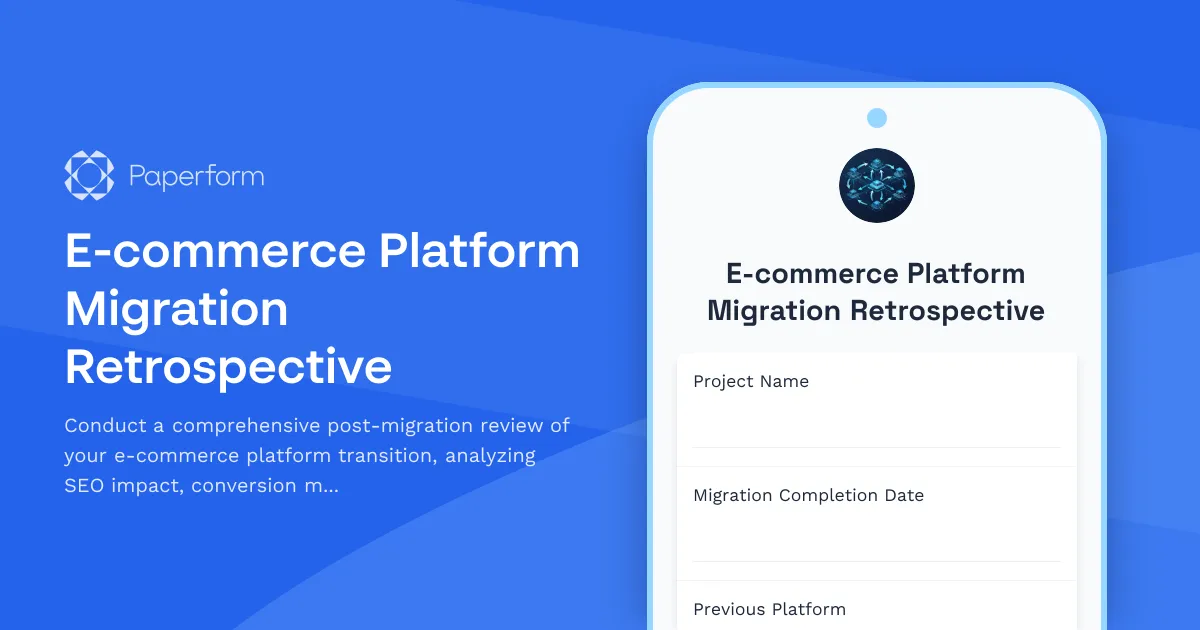
Moving your e-commerce store to a new platform is a major undertaking that affects every aspect of your online business—from technical infrastructure to customer experience and revenue performance. This E-commerce Platform Migration Retrospective template helps digital commerce teams, marketing managers, and technical leaders conduct a structured post-mortem to capture lessons learned, measure real impact, and turn migration insights into competitive advantages.
Whether you migrated from Magento to Shopify, WooCommerce to BigCommerce, or any other platform transition, this retrospective form guides your team through a comprehensive review of SEO impact, conversion rate changes, checkout abandonment patterns, and technical performance. Instead of letting valuable migration learnings fade into Slack threads and forgotten meeting notes, you'll document what worked, what didn't, and what you'd do differently next time.
Why Paperform for E-commerce Retrospectives?
Paperform's conditional logic adapts questions based on your migration outcomes, letting you dive deeper into problem areas while keeping the form relevant. Calculation fields help you quantify SEO ranking changes, conversion lifts or drops, and revenue impact in real time. When you're ready to turn insights into action, connect your retrospective submissions to Stepper workflows that automatically create follow-up tasks in Asana, notify stakeholders in Slack, or update your project documentation in Notion—ensuring lessons learned actually drive improvements.
For e-commerce agencies managing multiple client migrations or enterprise teams running regular platform updates, this template becomes your institutional memory. Capture technical debt decisions, vendor gotchas, and customer experience wins that inform your next migration with confidence. SOC 2 Type II compliance and flexible integrations mean your retrospective data stays secure and flows seamlessly into your existing project management stack.
Turn your platform migration from a one-time headache into a repeatable, optimized process that gets better with every iteration.
More templates like this
Partner Ecosystem Development Project Brief
A comprehensive project initiation form for planning and launching partner ecosystem development initiatives, covering value propositions, recruitment strategies, enablement, co-marketing, revenue sharing, and success metrics.
CMS Migration Stakeholder Interview Form
Gather comprehensive stakeholder feedback on CMS migration requirements, workflow needs, integration priorities, and training expectations from marketing, IT, content, and executive teams.
Customer Communication Preference Center Project Brief
A comprehensive project brief template for implementing a customer communication preference center, covering channel inventory, consent management, integration requirements, and governance framework.
Customer Data Platform Implementation Brief
A comprehensive project brief template for CDP implementation projects, covering data source mapping, unification strategy, segment definitions, activation channels, privacy compliance, and measurement frameworks.
Customer Data Platform Integration Sign-Off Form
A comprehensive milestone approval form for CDP integration projects, covering data ingestion verification, segmentation testing, activation channel review, and final authorization.
Digital Asset Management Sprint Planning Form
Plan your DAM sprint cycle with dedicated sections for content ingestion tasks, metadata tagging workflows, automation setup, and distribution channels to keep your digital asset projects on track.
E-commerce Checkout Optimization Project Post-Mortem
Comprehensive post-mortem form for e-commerce checkout optimization projects, evaluating cart abandonment reduction, mobile conversion improvements, and payment method expansion initiatives.
Martech Integration Architecture Meeting Request
Schedule a strategic meeting to discuss martech integration architecture, system dependencies, data flows, API availability, and processing requirements for your technology stack.
Agile Sprint Budget Planning Form
Plan and forecast sprint budgets with resource allocation, vendor costs, and financial tracking for agile teams managing project finances.
Agile Team Capacity Planning Form
Calculate sprint capacity based on team availability, skill sets, focus factors, and planned time off. Perfect for sprint planning and resource allocation in agile teams.
Agile Team Skills Matrix Form
Track team competencies, learning goals, and knowledge sharing opportunities to optimize sprint planning and resource allocation in agile teams.

Agile Vendor Coordination Form
Coordinate third-party vendors in agile sprints with clear deliverables, API requirements, SLA expectations, and contract milestones to keep external partners aligned with your development cycles.