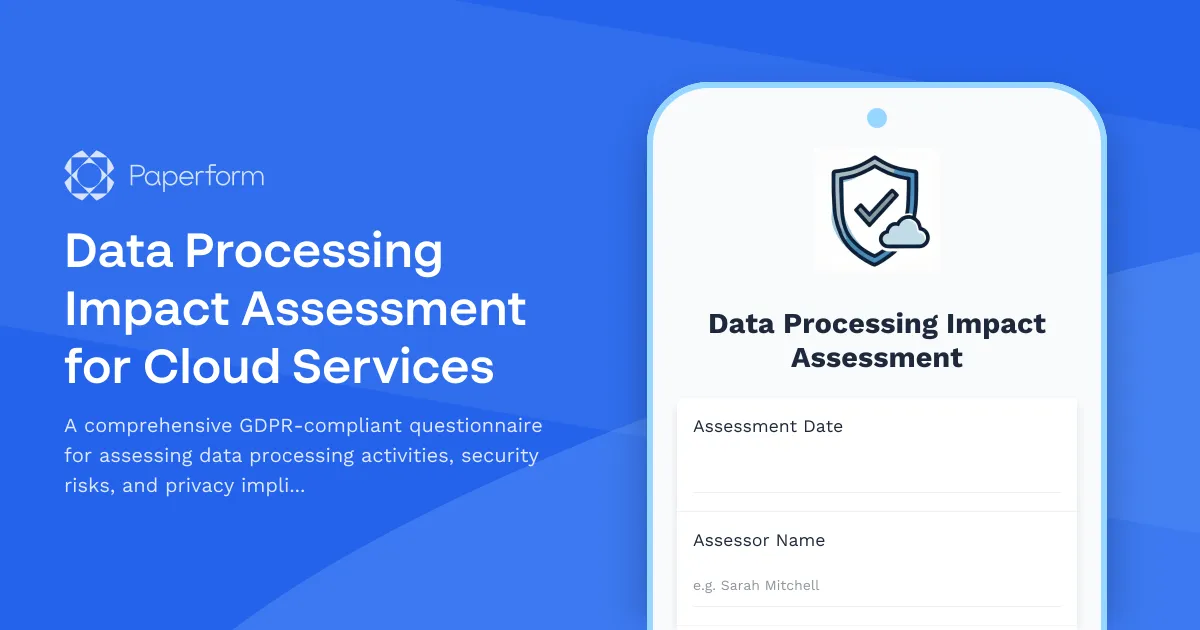
Streamline Your GDPR Compliance with Our Data Processing Impact Assessment Template
When adopting cloud services that handle personal data, EU-based organisations must conduct thorough Data Protection Impact Assessments (DPIAs) under GDPR Article 35. This comprehensive questionnaire template helps legal teams, data protection officers, compliance managers, and IT professionals systematically evaluate privacy and security risks before implementing new cloud solutions.
Built for EU GDPR Compliance
Our Data Processing Impact Assessment form guides you through the entire evaluation process—from identifying the nature and scope of data processing activities to assessing security measures, evaluating vendor compliance, and documenting risk mitigation strategies. The structured format ensures you capture all essential information required by data protection authorities while maintaining a clear audit trail.
Designed for Legal and Compliance Professionals
Whether you're a data protection officer conducting regular assessments, a legal counsel reviewing vendor contracts, or an IT manager implementing new cloud infrastructure, this template provides the framework you need. The questionnaire covers essential GDPR considerations including lawful basis for processing, data subject rights, cross-border transfers, security measures, and breach notification procedures.
Automate Your Compliance Workflow with Paperform and Stepper
Use Paperform's conditional logic to show relevant questions based on the type of processing activity, and connect your assessment directly into your compliance management system. Once submitted, you can use Stepper to automatically route high-risk assessments for additional review, notify stakeholders, update your processing register, and create follow-up tasks for your compliance team—turning each DPIA into a managed workflow rather than a one-off document.
With Paperform's SOC 2 Type II compliance, data residency controls, and enterprise-grade security, your sensitive compliance data remains protected throughout the assessment process. Create professional, auditable DPIAs that demonstrate your commitment to data protection and help you make informed decisions about cloud service adoption.



More templates like this
Data Breach Incident Report Form
Document and manage data breach incidents with comprehensive system impact analysis, user assessment, response tracking, and regulatory notification timelines.
GDPR Data Breach Assessment Form
Structured assessment form to evaluate data breaches and determine if notification to supervisory authority is required under GDPR Article 33 within 72 hours.
Corporate Data Breach Whistleblower Report
A secure, anonymous form for employees and stakeholders to report suspected data breaches and security incidents with full GDPR compliance and incident severity assessment.
Data Mapping Exercise Documentation Form
A comprehensive form for documenting personal data processing activities and data flows across systems to maintain Article 30 GDPR Records of Processing Activities (RoPA) compliance.
Privacy Impact Mitigation Plan Form
A comprehensive form for documenting risk reduction measures and mitigation strategies following high-risk findings from a Data Protection Impact Assessment (DPIA), ensuring GDPR compliance.
Third-Party Vendor Data Sharing Access Request Form
A comprehensive form for managing third-party vendor data access requests, including data processing agreement requirements, security assessments, and purpose limitation controls for IT and compliance teams.
Australian Notifiable Data Breach Report Form
Report a data breach to the Office of the Australian Information Commissioner (OAIC) under the Notifiable Data Breaches (NDB) scheme. Capture breach details, affected individuals, risk assessment, and remediation steps in one comprehensive form.
Compliance Reporting System Access Request
Request access to compliance reporting systems with role-based permissions, audit trail viewing capabilities, and regulatory report generation tools while maintaining strict confidentiality requirements.
Customer Data Access Request Form
A GDPR and CCPA compliant form for managing customer data access requests with verification, justification, and consent tracking.
Cybersecurity and Data Privacy Governance Report
A comprehensive ESG reporting form for documenting cybersecurity governance, data privacy measures, breach incidents, and security training compliance across your organization.
Cybersecurity Exception Approval Request Form
A comprehensive form for requesting cybersecurity policy exceptions with risk assessment, compensating controls, business justification, and remediation plans requiring CISO authorization.
Cybersecurity Services Data & Network Access Consent Form
Obtain client consent for managed cybersecurity services including network vulnerability scans, security monitoring, employee training tracking, and threat intelligence sharing.