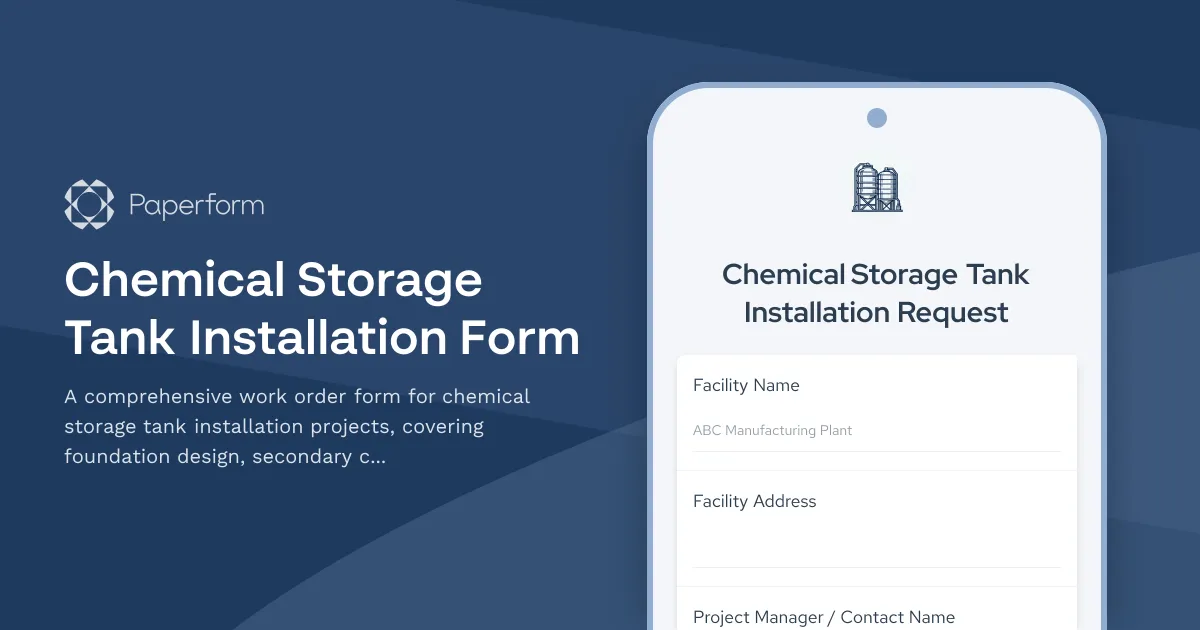
Streamline Your Chemical Storage Tank Installation Projects with Paperform
Chemical storage tank installations demand meticulous planning, regulatory compliance, and detailed documentation. Whether you're a contractor specializing in industrial facilities, a project manager overseeing hazardous material storage, or an engineering firm designing compliant containment systems, this Chemical Storage Tank Installation Form template gives you a professional, code-compliant starting point for capturing every critical specification.
Why Chemical Storage Tank Projects Need Better Forms
Traditional paper-based work orders and email chains create gaps in communication, missing specifications, and compliance headaches. Chemical storage installations involve multiple engineering disciplines—structural foundations, mechanical venting, electrical instrumentation, and environmental containment—each with specific codes and safety requirements. A single missed detail can lead to project delays, failed inspections, or worse, environmental incidents.
This Paperform template consolidates all essential information into one organized digital form: tank specifications, foundation requirements, secondary containment design, vent calculations, level monitoring systems, and leak detection setup. By capturing complete project details upfront, you reduce change orders, improve safety outcomes, and ensure regulatory compliance from day one.
Who Benefits from This Template
This form template is designed for:
- Construction contractors managing industrial and chemical facility projects
- Mechanical and process engineers specifying storage tank systems
- Project managers coordinating multi-discipline installations
- Environmental health and safety professionals ensuring compliance with EPA, OSHA, and local regulations
- Facility managers at manufacturing plants, refineries, and chemical processing sites
- General contractors subcontracting specialty tank installation work
Key Features Built into This Template
The form walks through every critical aspect of chemical storage tank installation:
Project & Client Information: Capture facility details, responsible parties, and project timeline expectations clearly from the start.
Tank Specifications: Document tank capacity, dimensions, materials of construction, chemical compatibility, pressure/temperature ratings, and API/ASME code requirements.
Foundation Design Requirements: Specify foundation type (concrete pad, ring wall, piers), soil bearing capacity, seismic considerations, grounding requirements, and anchor bolt specifications.
Secondary Containment System: Detail containment type (concrete dike, synthetic liner, double-wall tank), volume calculations meeting 110% capacity rules, drainage provisions, and material compatibility with stored chemicals.
Vent Sizing & Design: Calculate emergency relief requirements, normal breathing capacity, flame arrestor specifications, and compliance with NFPA codes for pressure/vacuum relief.
Level Indication Systems: Specify level monitoring technology (float, radar, ultrasonic, pressure transmitter), alarm setpoints, remote monitoring integration, and redundancy requirements.
Leak Detection Setup: Define detection method (visual inspection ports, interstitial monitoring, sensor cables), alarm integration, and response protocols.
Regulatory & Safety Compliance: Ensure documentation of applicable regulations (EPA SPCC, OSHA PSM, local fire codes), required certifications, inspection schedules, and safety equipment.
The conditional logic built into the form ensures you only see relevant questions based on your specific tank type, chemical classification, and installation environment—keeping the form efficient while capturing complete information.
How Paperform Elevates Your Chemical Installation Workflow
Professional, On-Brand Documentation: Present a polished, professional image to industrial clients with fully customizable forms that match your company branding. Add your logo, adjust colors, and modify field labels to match your engineering terminology and specifications.
Mobile-Friendly Site Documentation: Contractors and inspectors can complete forms on tablets or phones directly from the job site, with photo uploads for site conditions, existing infrastructure, and as-built verification.
Automated Calculations: Use Paperform's calculation fields to automatically compute secondary containment volumes, vent sizing based on tank dimensions, and compliance ratios—reducing manual errors and speeding up engineering reviews.
Seamless Project Management Integration: Connect submissions directly to your project management tools via Stepper (stepper.io), Paperform's AI-native workflow automation platform. Automatically create project folders, assign tasks to engineering teams, trigger design reviews, and update Gantt charts when new installation requests come in.
Client Approval & Sign-Off: After completing the technical specifications, use Papersign (papersign.com) to turn your form submission into a formal scope of work document that clients can review and eSign digitally. This creates a clear paper trail linking the original specifications to the approved contract.
Centralized Data & Reporting: All submissions flow into Paperform's submission dashboard, where you can track project pipelines, identify common design patterns, and generate reports on installation types, typical tank sizes, and regional compliance requirements.
Automation That Saves Time and Reduces Errors
With Stepper workflows connected to your form, you can:
- Route submissions to the appropriate engineering discipline based on chemical classification or tank size
- Trigger design checklists specific to the foundation type or containment system selected
- Generate preliminary quotes by pulling pricing from your database based on tank capacity and system complexity
- Schedule site surveys automatically when foundation design requires soil testing
- Update CRM records to track installation project lifecycle from inquiry to completion
- Create compliance folders in Google Drive or SharePoint with all regulatory documentation organized by project
Built for the Construction & Industrial Sector
Construction contractors and industrial project teams face unique challenges—tight timelines, strict safety requirements, and complex technical specifications. Paperform provides the flexibility to create forms that match your exact workflow while maintaining the professional standards your industrial clients expect.
Whether you're installing small day tanks at a laboratory or 50,000-gallon storage tanks at a chemical plant, this template adapts to projects of any scale. The modular question structure means you can easily add site-specific requirements, regional code variations, or client-specific specifications.
Security and Compliance You Can Trust
Industrial projects often involve proprietary process information and sensitive facility details. Paperform is SOC 2 Type II certified with enterprise-grade security, encrypted data transmission, and configurable data residency options. You can confidently collect technical specifications, site plans, and chemical inventories knowing your data—and your clients' data—is protected.
For larger engineering firms and contractors managing multiple projects, Paperform's Agency+ plan enables you to manage client projects in separate workspaces while maintaining centralized billing and administration.
Getting Started with This Template
This template is ready to use immediately but fully customizable to match your specific installation standards:
- Add your engineering specifications: Include your company's standard foundation details, preferred equipment manufacturers, or specific testing requirements
- Customize for regional codes: Adjust compliance questions to match state or local regulations in your operating areas
- Integrate your tools: Connect to your estimating software, project management platform, or ERP system
- Brand the experience: Apply your company colors, fonts, and logo to create a seamless client experience
The Paperform Advantage for Construction & Engineering
Trusted by over 500,000 teams worldwide, Paperform combines ease of use with powerful automation capabilities. You don't need a developer to create professional forms—just type, format, and publish. Yet behind that simplicity is a robust platform capable of complex calculations, conditional workflows, and enterprise integrations that scale with your business.
Start capturing complete, compliant chemical storage tank installation specifications with this template today. Reduce project rework, improve safety outcomes, and deliver installations that pass inspection the first time—all while presenting a modern, professional image that wins you more industrial projects.
For more advanced workflow automation connecting your forms to project management, scheduling, and client communication tools, explore how Stepper can eliminate manual handoffs between form submission and project kickoff. And when you need formal client approval on technical specifications, Papersign turns your detailed form responses into legally binding agreements with just a few clicks.



More templates like this

Industrial Grinding Booth Installation Request Form
A comprehensive installation form for industrial grinding booths including dust collection systems, explosion-proof fixtures, spark containment measures, and airflow specifications for safe metalworking operations.
Industrial Robot Cell Installation Form
A comprehensive form for planning and documenting industrial robot cell installations including safety guarding, e-stop locations, light curtains, safety mats, and lockout/tagout procedures.
Clean Room Construction Work Order Form
Professional work order form for clean room construction projects with filtration specs, pressure differential verification, particle count testing, and certification requirements.

Fire-Rated Partition Installation Form
Professional documentation form for fire-rated partition installations including UL assembly details, firestop locations, inspection requirements, and compliance tracking for construction projects.
Housekeeping and Waste Management Inspection Form
A comprehensive construction site housekeeping and waste management inspection form with debris removal tracking, material segregation verification, and dumpster placement safety checks.
Industrial Coating Removal Checklist
A comprehensive checklist for managing industrial coating removal projects, covering containment setup, removal methods, waste handling, surface preparation, and final cleanliness verification to ensure safe and compliant coating removal operations.
Industrial Parts Marking Station Installation Form
A comprehensive installation form for industrial parts marking stations, covering marking head alignment, controller programming, verification systems, fume extraction, and data integration requirements.
Material Handling Equipment Installation Form
A comprehensive installation form for material handling equipment that covers floor load verification, anchor placement, electrical requirements, safety features, and operator training documentation.
Material Silo and Bulk Storage Installation Checklist
A comprehensive checklist for documenting silo installation, foundation design, aeration systems, level indication, dust venting, and discharge rate verification for bulk material storage projects.
Ornamental Metal Railing Fabrication & Installation Form
A comprehensive work order form for ornamental metal railing projects, capturing design specifications, post spacing requirements, welding procedures, finish coatings, and load testing details for fabrication and installation.
Overhead Crane Installation Project Plan
A comprehensive project planning form for overhead crane installations, covering runway beam alignment, hoist specifications, electrical requirements, load testing protocols, and operator training coordination.
Pneumatic Tube System Installation Work Order
Professional work order form for pneumatic tube system installations, covering station locations, tube routing, blower specifications, control programming requirements, and carrier travel testing procedures.