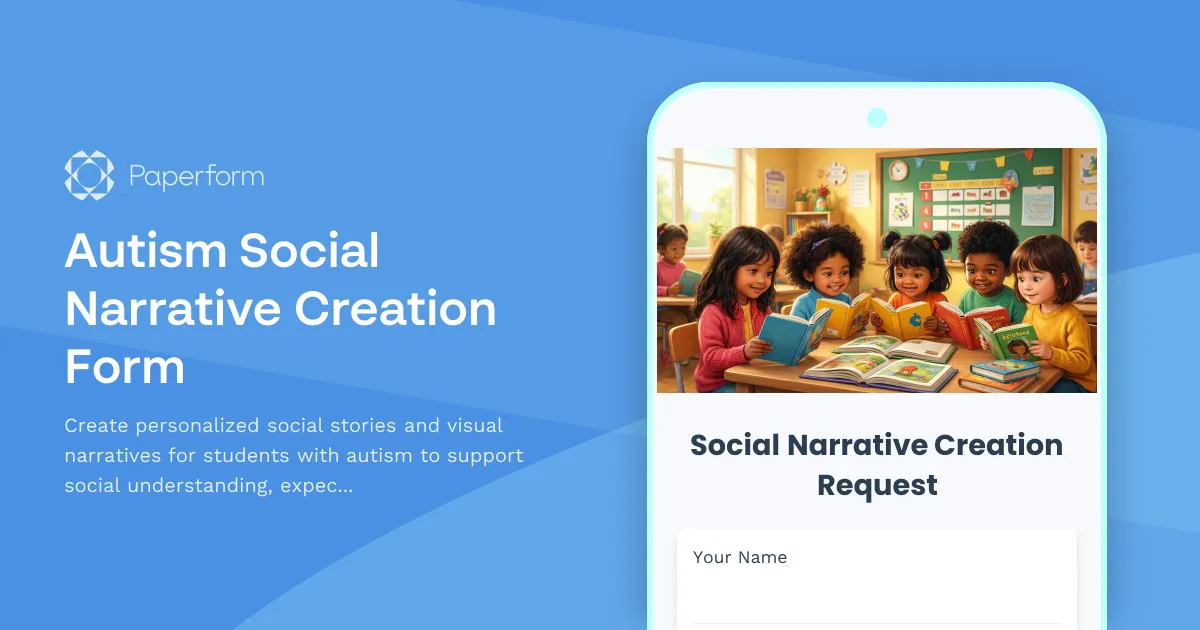
Create Effective Social Narratives for Students with Autism
Social narratives—also known as social stories—are a proven evidence-based strategy for helping students with autism understand social situations, learn expected behaviors, and build confidence across different settings. This Autism Social Narrative Creation Form makes it simple for special education teachers, behavior specialists, speech-language pathologists, and support staff to gather the specific information needed to craft personalized, effective social stories that truly resonate with each student.
Why Social Narratives Matter in Special Education
Students on the autism spectrum often benefit from explicit, concrete explanations of social expectations that neurotypical peers might pick up intuitively. Social narratives break down complex social situations into clear, predictable sequences, reducing anxiety and increasing independence. Whether you're addressing classroom routines, playground interactions, transitions, or community outings, a well-crafted social narrative can be transformative.
This form template helps you systematically collect details about the student, the target scenario, current challenges, visual supports that work best, and the settings where the skill needs to generalize—ensuring every social story you create is tailored to the individual learner.
Built for Special Education Workflows
Special education teams juggle IEP goals, behavioral data, parent communication, and individualized instruction every day. Paperform turns this social narrative request process into a streamlined workflow that saves time and improves collaboration:
- Parent and teacher input in one place: Instead of back-and-forth emails, parents, classroom teachers, and specialists can submit detailed scenario requests through a single, accessible form
- Consistent, comprehensive data collection: Capture student preferences, sensory considerations, communication level, visual support needs, and specific behaviors in a structured format
- Easy collaboration across the team: Share submissions with SLPs, behavior analysts, OTs, and classroom staff so everyone is aligned on the narrative's purpose and implementation
- Organized documentation: Keep all social narrative requests linked to students and IEP goals for progress monitoring and compliance
With Paperform's conditional logic, the form can adapt based on the student's age, communication level, or scenario type, asking only the relevant follow-up questions to keep the process efficient.
Automate Your Special Education Workflows with Stepper
Once a social narrative request is submitted, you can use Stepper—Paperform's AI-native workflow builder—to automate what happens next:
- Route requests to the appropriate specialist (e.g., autism resource teacher, SLP, BCBA) based on the scenario type
- Send notifications to the IEP team and parents when a new narrative is ready
- Update student management systems or Google Sheets with narrative goals and implementation dates
- Create task reminders for staff to review and update narratives on a schedule
- Connect with communication platforms like Slack or Microsoft Teams for quick team collaboration
Stepper keeps your special education workflows running smoothly, so you can spend less time on administrative tasks and more time supporting students.
Why Special Education Teams Choose Paperform
Paperform is trusted by schools, therapy clinics, and special education cooperatives because it's flexible enough to handle the unique needs of individualized education while staying simple enough for busy educators to use every day:
- Accessible and mobile-friendly: Parents and teachers can submit requests from any device, at school or at home
- Conditional logic for personalized questions: Show different questions based on grade level, disability category, or scenario complexity
- File uploads for visuals and examples: Collect photos, sample schedules, or existing visual supports to inform narrative creation
- Secure and compliant: Paperform is SOC 2 Type II compliant and offers data residency controls, giving you confidence that sensitive student information is protected (note: Paperform is not HIPAA compliant)
- Team collaboration: Use roles and permissions to control who can view, edit, and manage submissions
- Professional, on-brand design: Create forms that feel welcoming and supportive, not like generic surveys
Whether you're a self-contained classroom teacher, an itinerant autism consultant, or part of a district-wide special education team, this template adapts to your workflow.
Real-World Use Cases
This social narrative creation form is designed for:
- Special education teachers developing individualized social stories for students on their caseload
- Speech-language pathologists targeting social communication and pragmatic language goals
- Behavior specialists and BCBAs addressing specific challenging behaviors with proactive, positive narratives
- Occupational therapists supporting sensory and self-regulation scenarios
- School psychologists and counselors helping students navigate social anxiety, transitions, or change
- Parents and caregivers requesting stories for home, community, or medical appointments
From "Waiting My Turn in Line" to "What to Expect at the Dentist," this form ensures every narrative is grounded in the student's real world and real needs.
Get Started in Minutes with 30,000+ Templates
Paperform offers over 30,000 designer templates to help educators quickly build forms for every aspect of school operations—permission slips, IEP meeting scheduling, behavior tracking, parent surveys, and more. This autism social narrative form is just one example of how Paperform supports the daily work of special education professionals.
Start with this template, customize the questions to match your team's process, and connect it to the tools you already use—Google Classroom, student information systems, communication apps, and more. With Paperform, you get the power of a flexible platform without needing any coding or technical expertise.
Create better outcomes for students with autism—one personalized social story at a time.
More templates like this
Autism Spectrum Support Services Intake Form
A comprehensive intake form for autism spectrum support services that captures sensory profiles, communication preferences, social skills assessments, and behavior patterns to create personalized support plans.
Individual Counseling Services Request for Students with Emotional Disturbance
A comprehensive form for requesting and documenting intensive individual counseling services for students with emotional disturbance, including treatment planning, evidence-based interventions, crisis prevention strategies, and outcome measurement.
Learning Disability Assessment Form
A comprehensive pre-assessment form for identifying learning difficulties, academic challenges, processing speed concerns, and accommodation needs for students and individuals seeking evaluation.
Music Therapy Services Request Form
A comprehensive request form for schools and families seeking music therapy services for students with autism or emotional disabilities, including sensory integration support and self-expression goals.
School Art Therapy Program Effectiveness Survey
Evaluate the impact of art therapy programs on students' emotional well-being, creative confidence, stress reduction, therapeutic relationships, and behavioral improvements.
Selective Mutism Intervention Plan
A comprehensive assessment and planning tool for selective mutism intervention, including anxiety evaluation, graduated exposure strategies, safe person identification, and speech-language collaboration.
Trauma-Informed Classroom Support Plan
A comprehensive form for developing individualized trauma-informed support plans for students, including ACE screening, regulation strategies, trusted adult assignment, and mental health referral pathways.
Animal-Assisted Therapy Certification Scholarship Application
A comprehensive scholarship application for aspiring animal-assisted therapy practitioners seeking certification funding, including therapy animal handling experience, special populations interest, and professional recommendations.
Art Therapy Conference CEU Presenter Application
A comprehensive application form for art therapy professionals seeking to present CEU-accredited sessions at conferences, including clinical experience, intervention methodologies, and credential verification.
Autism Spectrum Disorder Diagnostic Observation Consent Form
A comprehensive consent and information form for ASD diagnostic observation including ADOS-2 assessment, parent interview, school observation, and multidisciplinary team evaluation.
Emotional Disturbance Eligibility Evaluation Form
Comprehensive assessment form for evaluating students for emotional disturbance eligibility under special education programs, documenting behavioral incidents, mental health diagnoses, educational impact, and therapeutic recommendations.
Mental Health Advocacy Scholarship Nomination Form
Nominate deserving candidates for a mental health advocacy scholarship. Recognize individuals with lived experience who are making a difference through peer support, stigma reduction, and community advocacy.