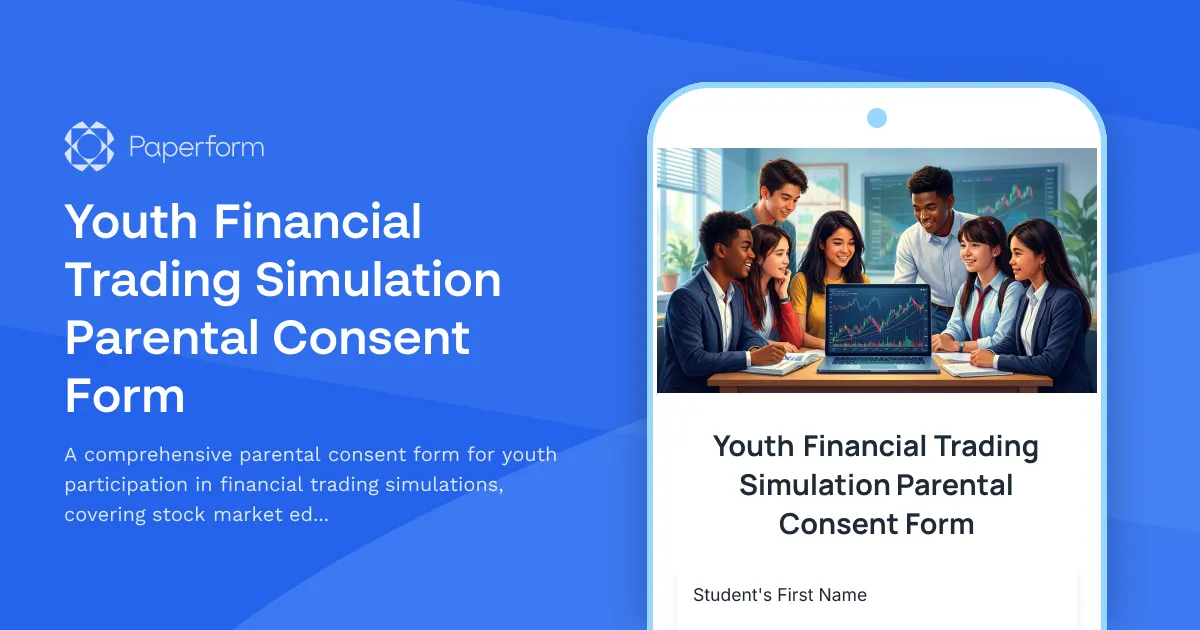
Youth Financial Trading Simulation: Empowering Tomorrow's Investors Through Safe, Educational Practice
Financial literacy is one of the most valuable skills young people can develop, and hands-on experience with trading simulations provides an engaging, risk-free environment to learn about markets, investments, and portfolio management. This Youth Financial Trading Simulation Parental Consent Form is designed for educational institutions, financial literacy programs, investment clubs, and youth organizations running stock market simulations and trading competitions.
Why This Form Matters for Financial Education Programs
Trading simulations give students practical experience with market concepts—analyzing stocks, managing portfolios, understanding risk, and making informed investment decisions—all without real financial exposure. However, these programs require clear parental consent that covers participation terms, educational objectives, competition rules, and appropriate risk education.
This template streamlines the consent process by capturing all necessary guardian approvals, participant information, and acknowledgments in one professional, easy-to-complete form. Whether you're running a semester-long simulation, a weekend trading competition, or an ongoing investment club, this form ensures parents understand the educational nature of the program while protecting your organization.
Perfect for Multiple Financial Education Contexts
This parental consent form works across various youth financial education settings:
- School-based programs: Economics classes, business studies, and financial literacy courses incorporating trading simulations
- Investment clubs: Youth investment clubs and junior trader programs teaching market fundamentals
- Competition organizers: Stock market challenge events, trading competitions, and investment tournaments
- Nonprofit organizations: Financial literacy nonprofits and community programs teaching wealth-building skills
- Summer programs: Finance camps, business boot camps, and STEM programs with investment components
- After-school programs: Enrichment activities focused on economics, entrepreneurship, and investing
What This Form Captures
The consent form is structured to provide comprehensive coverage of program participation:
Student and Parent Information: Complete contact details for both the participant and parent/guardian, ensuring clear communication channels throughout the program.
Program Understanding: Clear acknowledgment that parents understand this is an educational simulation using virtual funds, not real money, setting appropriate expectations from the start.
Educational Objectives: Recognition of the learning goals—understanding stock markets, portfolio diversification, risk management, and investment principles—so parents appreciate the pedagogical value.
Competition Rules: Consent regarding competition format, trading rules, allowed securities, position limits, and fair play expectations that govern the simulation environment.
Risk Education: Acknowledgment that while the simulation uses virtual money, students will learn about real investment risks, market volatility, and the potential for losses in actual trading.
Time Commitment: Understanding of the program duration, time requirements for research and trading, and any meetings or sessions students must attend.
Technology Access: Confirmation that students can access the required trading platform, whether through school computers, home devices, or mobile apps.
Media and Recognition: Permission for program-related photography, winner announcements, and recognition in school or competition communications.
Liability and Safety: Standard consent language covering program participation, understanding of rules, and appropriate use of simulation tools.
How Financial Educators and Program Coordinators Use This Form
For Teachers and Educators: Quickly gather parental consent at the start of the semester or unit, with clear communication about how the simulation integrates with curriculum objectives. The form can be distributed during parent-teacher nights or sent home with course materials.
For Competition Organizers: Collect all necessary consents before the trading competition begins, ensuring every participant has proper authorization and parents understand the competitive format, prizes, and rules.
For Youth Program Directors: Maintain organized records of parental approvals for your investment club or financial literacy program, with documented understanding of program goals and time commitments.
For Compliance and Records: Keep compliant documentation of parental consent for youth participation in financial education activities, particularly important when programs involve external partnerships with financial institutions or use professional trading platforms.
Enhancing Your Program with Paperform + Stepper
This Paperform template does more than collect signatures—it can power your entire consent and registration workflow:
- Automated confirmations: Instantly send parents a copy of their consent with program details, platform login instructions, and orientation schedules
- CRM integration: Sync participant data directly into your student information system, learning management platform, or program database
- Conditional logic: Show different questions based on participant age, experience level, or program track (beginner vs. advanced simulation)
- Document generation: Use Papersign to create formal consent records with parent eSignatures for secure, legally-compliant documentation
- Program triggers: Connect to Stepper to automatically enroll approved students in the trading platform, add them to communication channels, send welcome packets, and schedule orientation sessions
Why Trading Simulations Build Critical Life Skills
Stock market simulations aren't just about learning to pick winning stocks—they teach fundamental skills that apply far beyond investing:
- Critical thinking: Analyzing company data, market trends, and economic indicators to make informed decisions
- Risk assessment: Understanding risk-reward tradeoffs and the importance of diversification
- Emotional regulation: Managing the psychological aspects of gains, losses, and market volatility
- Research skills: Conducting due diligence on companies, industries, and market conditions
- Mathematics application: Calculating returns, percentages, portfolio allocations, and performance metrics
- Financial vocabulary: Building fluency in investment terminology, market concepts, and economic principles
- Long-term thinking: Appreciating the power of compound growth and patient, strategic investing
These competencies serve students throughout their lives, whether they pursue finance careers or simply manage their personal wealth more effectively.
Building Trust with Parents Through Transparency
Parents naturally want to understand any program involving financial concepts, even in simulation format. This form addresses common parental concerns directly:
- No real money at risk: Clear statement that students trade with virtual funds, eliminating financial exposure
- Educational focus: Emphasis on learning objectives rather than simply "making money"
- Appropriate oversight: Assurance that educators monitor the simulation and provide guidance
- Time boundaries: Realistic expectations about time commitment so families can plan accordingly
- Safe environment: Confirmation that the simulation operates in an age-appropriate, supervised context
By proactively addressing these points, you build parent confidence in your program and increase participation rates.
Trusted by Financial Educators Worldwide
Paperform's intuitive platform makes it easy for teachers, program coordinators, and youth organization leaders to create professional consent forms without technical expertise. With SOC 2 Type II compliance and GDPR adherence, your participant data remains secure and properly managed.
Whether you're launching your first classroom trading simulation or managing a national youth investment competition, this template gives you a head start on the consent process. Customize the questions to match your specific program format, competition rules, and educational objectives, then share via link, embed on your program website, or distribute through your school's parent portal.
Get students started on their financial literacy journey with proper parental consent—empowering the next generation of informed investors, critical thinkers, and financially savvy adults.
More templates like this
Construction Site & Architecture Tour Permission Form
A comprehensive permission form for students attending construction site or architecture tours, covering safety requirements, hard hat protocols, and career exploration in the building trades.

Habitat for Humanity Community Building Project Field Trip Permission Form
A comprehensive permission slip for school service learning trips to Habitat for Humanity builds or community construction projects, including safety waivers, emergency contacts, and affordable housing education acknowledgment.
Oyster Restoration Field Trip Permission Form
A comprehensive permission slip for student participation in oyster restoration field trips, covering marine ecosystem education, water filtration demonstrations, and hands-on habitat restoration activities.
Refugee Resettlement Agency & Cultural Center Field Trip Permission Form
Permission slip for educational field trips to refugee resettlement agencies and cultural centers, focusing on diversity education, global awareness, and humanitarian values.
Senior Center Trip Consent & Intergenerational Activity Form
A comprehensive permission form for senior center or assisted living facility trips, designed to facilitate intergenerational activities that build empathy, respect, and meaningful community connections between generations.
Youth Astronomy Club Parental Consent Form
A comprehensive parental consent form for youth astronomy club participation, covering evening observation sessions, telescope use, planetarium trips, and dark sky site travel.
Youth Aviation Program Parental Consent Form
A comprehensive parental consent form for youth aviation programs offering flight simulator experiences, airport tours, pilot mentorship, and introductory flights.
Youth Civic Design Challenge Parental Consent Form
A comprehensive parental consent form for youth participating in civic design challenges that involve community research, problem-solving, prototype development, and presentations to local officials.
Youth Film Production Workshop Parental Consent Form
A comprehensive parental consent form for youth film production workshops covering on-camera participation, copyright ownership, equipment use, and screening event attendance permissions.
Youth Leadership Conference Parental Consent Form
A comprehensive parental consent form for youth leadership conferences featuring overnight accommodations, workshop participation, and college credit authorization.
Youth Philosophy Cafe Parental Consent Form
A consent form for parents and guardians to authorize their child's participation in youth philosophy cafe sessions featuring ethical discussions, Socratic questioning, and critical thinking activities.
Bowling Field Trip Permission Slip
A permission form for school bowling field trips that includes emergency contacts, shoe rental fees, skill level information, and participation preferences for both competitive and casual activities.