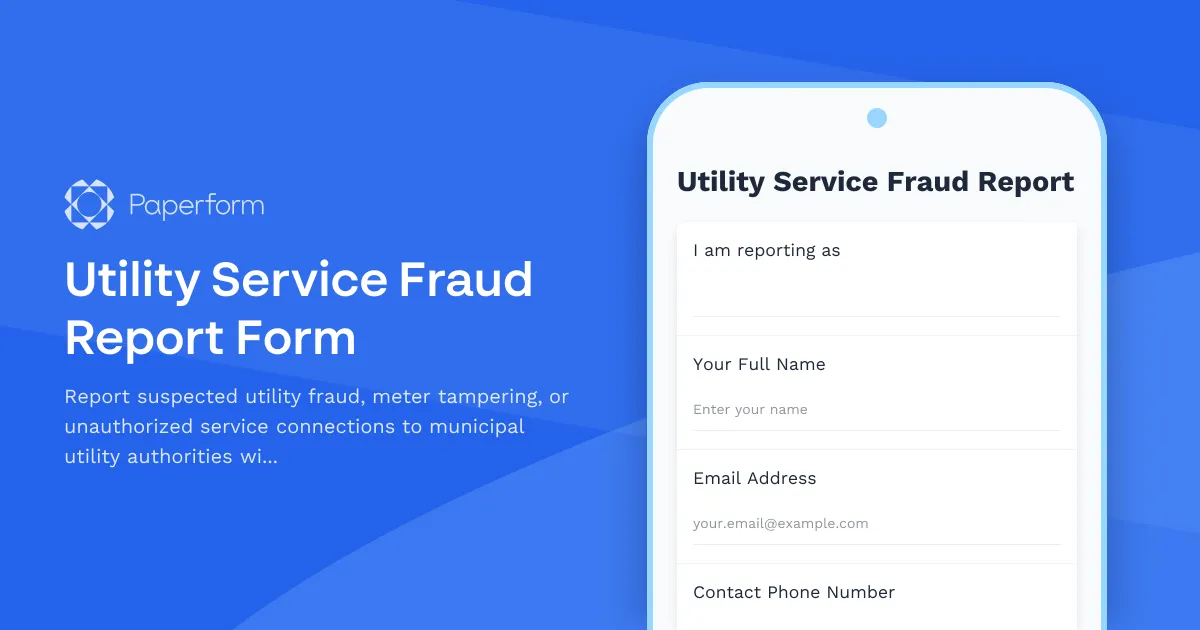
Report Utility Service Fraud and Protect Your Community
Utility fraud—including meter tampering, unauthorized connections, and service theft—costs municipalities millions annually and puts public safety at risk. Whether you've noticed suspicious activity around utility meters, observed evidence of bypassed equipment, or suspect account manipulation, reporting is the first step toward protecting community resources and ensuring everyone pays their fair share.
This Utility Service Fraud Report Form provides a secure, structured way for residents, utility workers, and concerned citizens to report suspected fraud to municipal utility authorities. The form captures essential details about the suspected violation, incident location, evidence documentation, and witness information, while also collecting the authorization needed for investigators to act on your report.
Why Report Utility Fraud?
Unreported utility fraud creates cascading problems for municipalities and ratepayers:
- Lost revenue that could fund infrastructure improvements and service expansion
- Safety hazards from improper electrical work, gas line tampering, or water system contamination
- Unfair cost burden passed along to honest ratepayers through higher rates
- Damaged infrastructure requiring expensive emergency repairs
- Legal liability for property owners who may be unaware of illegal modifications
By reporting suspected fraud promptly and providing detailed evidence, you help utility investigators prioritize cases, gather the documentation needed for prosecution, and protect your community's shared resources.
Common Types of Utility Fraud
This form is designed to capture reports of various utility service violations, including:
Meter Tampering: Physical damage to meters, reversed meters, magnets or devices affecting readings, broken seals, or meters that have been stopped or slowed.
Meter Bypass: Jumper cables, direct connections, unauthorized taps, or piping installed to route service around metering equipment—common with both electrical and water services.
Account Manipulation: Using fraudulent identification to open accounts, transferring service to deceased persons or fictitious names, or manipulating billing records.
Unauthorized Connections: Illegal taps into water mains, sewer laterals, gas lines, or electrical distribution systems without proper authorization or billing.
Service Restoration Fraud: Reconnecting service after disconnection for non-payment, tampering with disconnection devices, or bypassing lockout equipment.
What Happens After You Submit Your Report
Once you submit this fraud report, municipal utility investigators follow a structured review and investigation process:
Initial Review: Your report is logged, assigned a case number, and reviewed for completeness and urgency.
Evidence Assessment: Investigators evaluate the documentation, photos, and witness statements you've provided to determine the strength of the case.
Field Investigation: Utility inspectors conduct site visits, examine meters and connections, document violations, and gather additional evidence.
Account Analysis: Billing records, consumption patterns, and account history are reviewed for anomalies consistent with fraud.
Resolution: Depending on findings, actions may include service disconnection, meter replacement, billing adjustments, civil penalties, or referral for criminal prosecution.
Most utility departments maintain confidentiality for reporters where legally possible, though you may be contacted if investigators need clarification or additional information. Anonymous reports are typically accepted but may be more difficult to investigate without follow-up access.
Who Should Use This Form
This utility fraud report form is designed for:
- Residents and neighbors who observe suspicious activity around meters or utility infrastructure in their community
- Utility field workers who discover evidence of tampering during routine service calls or meter readings
- Property managers and landlords who find unauthorized modifications during inspections or tenant turnover
- Municipal employees from other departments who encounter potential violations during their work
- Business owners concerned about utility theft affecting their property or neighboring premises
You don't need to be certain that fraud has occurred—if you observe evidence that raises reasonable suspicion, utility investigators can determine whether a violation exists.
Building Trust Through Transparency and Compliance
Municipalities handling utility fraud reports must balance efficient investigation with individual privacy rights. Paperform's SOC 2 Type II compliance ensures that sensitive reporter information, account details, and investigation documentation remain secure throughout the reporting and case management process.
For utility departments receiving multiple fraud reports, Stepper workflows (stepper.io) can automate case intake, assign reports to the appropriate investigator based on utility type or geographic zone, trigger field inspection scheduling, and ensure timely follow-up. This automation means no report falls through the cracks, and investigators spend less time on administrative tasks and more time in the field.
When investigations result in violations requiring property owner acknowledgment or payment plan agreements, Papersign (papersign.com) enables municipalities to send secure, legally binding eSignature documents directly from the case file, maintaining a complete audit trail from initial report through final resolution.
Customizing This Template for Your Municipality
Every utility department operates differently. You can adapt this template to match your jurisdiction's specific needs:
- Add fields for utility account numbers if you want to allow account holders to self-report suspected fraud on their own service
- Include anonymous reporting options with limited contact information requirements to encourage whistleblowing
- Customize the incident type categories to reflect the most common violations in your service area
- Add photo upload fields for additional evidence documentation like meter photos, wiring images, or connection diagrams
- Include GPS coordinates or map pin fields to help investigators locate incidents in rural or hard-to-describe locations
- Integrate with your case management system via webhooks or Stepper to automatically create investigation tickets
This form is designed to serve municipal water, wastewater, electric, and gas utilities, as well as rural electric cooperatives and other public service providers. Whether you're a small town utility department or a regional water authority, this template helps you standardize fraud intake, protect revenue, and maintain service integrity across your system.
Strengthen Your Community's Utility Infrastructure
Utility fraud isn't a victimless crime—it undermines the financial sustainability of essential services and creates safety risks for entire neighborhoods. By providing a clear, accessible reporting channel, municipalities empower residents to become partners in protecting shared infrastructure and ensuring fair billing for all customers.
Start with this Utility Service Fraud Report Form template on Paperform and customize it to match your utility department's investigation protocols, evidence requirements, and case management workflow. With secure submission handling, automated case routing through Stepper, and seamless integration with your existing systems, you'll be equipped to respond quickly and effectively to protect your community's utility resources.
More templates like this
Vulnerable Customer Registry Enrollment Form
Register as a vulnerable customer with your utility provider to ensure priority support, advance notice of service interruptions, and tailored communication during emergencies.
Combined Sewer Overflow Notification Signup
Register for CSO alerts and water contact advisories for waterfront properties. Receive timely notifications about combined sewer overflow events and water quality warnings.
Fire Flow Availability Request Form
Request a fire flow availability letter from your municipal utility department for development permits, construction projects, and fire marshal compliance.
Industrial Pretreatment Permit Self-Monitoring Report
Submit self-monitoring reports for industrial pretreatment permits including analytical results, QA/QC documentation, and certification statements for wastewater discharge compliance.
Septic to Sewer Conversion Application
Apply to connect your property to the municipal sewer system. Submit property details, request connection timeline, and explore financing options for your septic system conversion.
Sewer Backup Emergency Report & Property Damage Claim
Report sewer backup emergencies, assess property damage, request cleanup assistance, and document your insurance claim all in one comprehensive municipal form.
Sewer Lateral Inspection Request Form
Request a sewer lateral inspection for home sale compliance. Schedule your preferred inspection date, submit property details, and pay the inspection fee—all in one streamlined form.
Sewer Service Area Master Plan Review Comment Submission
Submit your comments and proposed changes to the sewer service area master plan, assess community impact, and register for the public hearing.
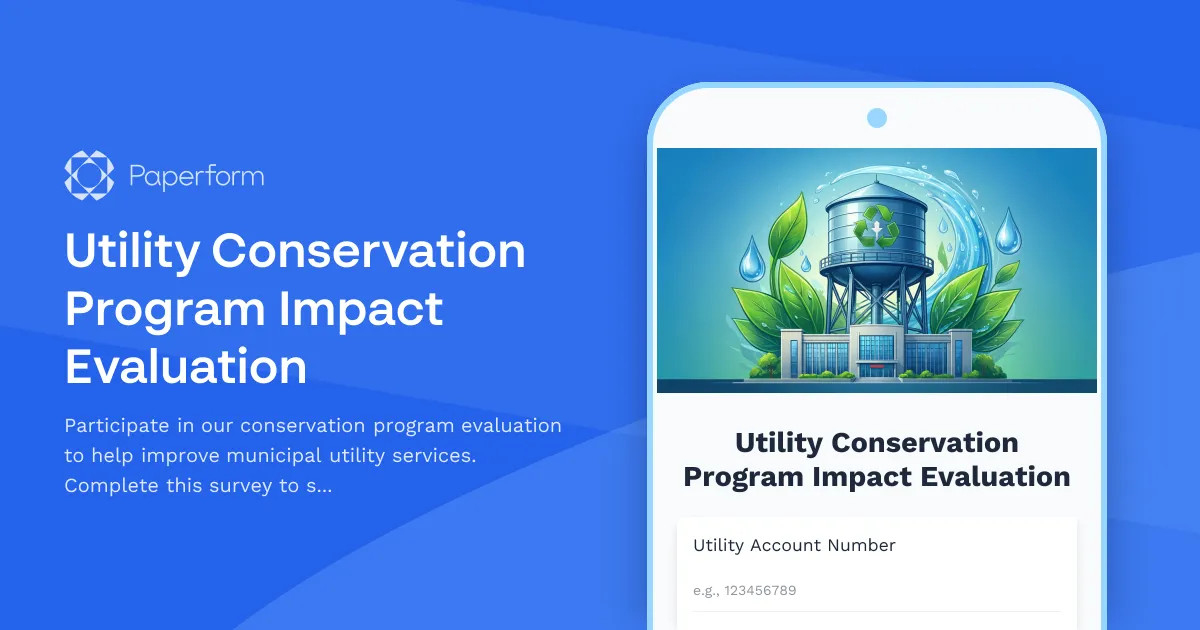
Utility Conservation Program Impact Evaluation
Participate in our conservation program evaluation to help improve municipal utility services. Complete this survey to share your experience and authorize usage analysis for program effectiveness research.
Utility Infrastructure Asset Data Contribution Form
Submit detailed asset information for water, sewage, and municipal utility infrastructure including materials, installation dates, condition assessments, and location data for GIS mapping systems.
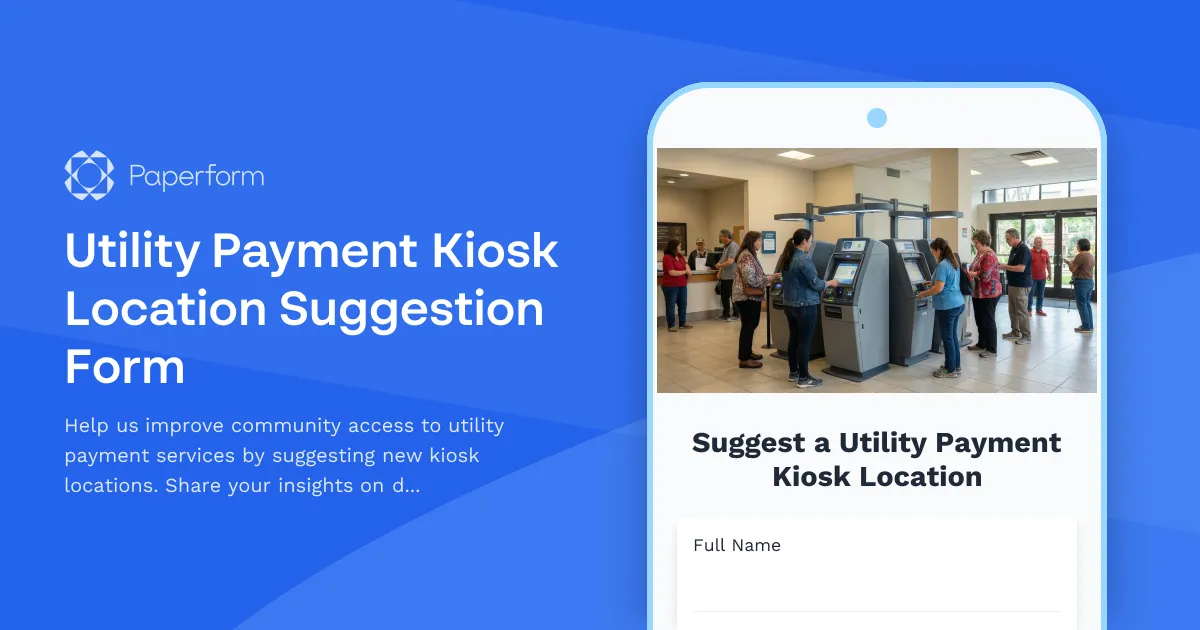
Utility Payment Kiosk Location Suggestion Form
Help us improve community access to utility payment services by suggesting new kiosk locations. Share your insights on demographics, accessibility needs, and site feasibility to make utility payments more convenient for everyone.
Utility Rate Assistance Program Application
Apply for financial assistance with water, sewage, and municipal utility bills. Income-based program designed to help eligible households reduce their monthly utility costs.