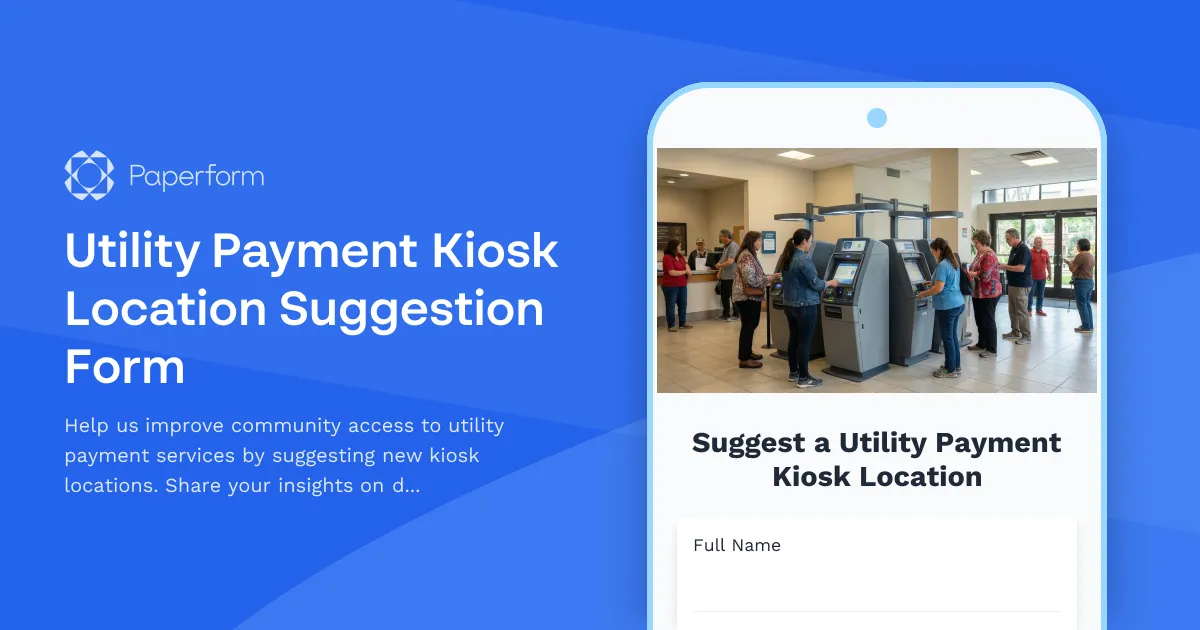
Make Utility Payments More Accessible in Your Community
Access to convenient payment options shouldn't be a barrier to essential utility services. Our Utility Payment Kiosk Location Suggestion Form empowers community members, local organizations, and municipal staff to recommend strategic locations for new self-service payment kiosks, ensuring that water, sewage, and other utility services remain accessible to all residents.
Why Kiosk Location Matters
Payment kiosks serve as critical access points for residents who may not have reliable internet access, prefer in-person transactions, or need after-hours payment options. The right location can dramatically improve service accessibility, reduce travel burdens for underserved communities, and increase on-time payment rates across the municipality.
Who Should Use This Form
This form is designed for:
- Community advocates identifying underserved neighborhoods
- Municipal utility departments gathering public input on infrastructure expansion
- City planners assessing service gaps and accessibility needs
- Local business owners proposing partnership locations
- Residents experiencing barriers to current payment options
- Accessibility coordinators ensuring ADA compliance across facilities
What Makes This Form Effective
Built with Paperform, this template provides a structured approach to location suggestions that goes beyond simple address submissions. The form collects comprehensive information about:
Demographics & Community Needs: Understanding who lives, works, and travels through the proposed area helps prioritize locations that serve the most residents, particularly those facing transportation challenges or digital access barriers.
Accessibility Considerations: The form specifically addresses ADA compliance, public transportation access, parking availability, pedestrian safety, and other factors that determine whether a kiosk will truly serve all community members, including seniors, people with disabilities, and families with young children.
Installation Feasibility: By gathering details about property ownership, foot traffic patterns, existing infrastructure, weather protection, security features, and available utilities, the form helps municipal teams quickly assess which suggestions are most viable and cost-effective to implement.
Multi-Language Support & Extended Hours: The form considers language diversity in the community and the need for payment options outside standard business hours, ensuring kiosks serve all residents regardless of work schedules or primary language.
How Municipalities Benefit from Paperform
Municipal utility departments face unique challenges: serving diverse populations, managing limited budgets, ensuring compliance with accessibility regulations, and maintaining public trust. This Paperform template addresses these challenges by:
Streamlining Community Input: Rather than managing scattered emails, phone calls, and in-person suggestions, all location recommendations flow into one organized system where staff can review, compare, and prioritize proposals based on consistent criteria.
Supporting Data-Driven Decisions: The structured format ensures every suggestion includes the demographic, accessibility, and feasibility data needed to evaluate locations objectively, building a defensible case for infrastructure investments.
Enhancing Public Engagement: By providing a clear, accessible channel for community input, municipalities demonstrate responsiveness to resident needs while gathering valuable ground-level knowledge about service gaps and barriers.
Automating Workflows with Stepper: Connect this form to Stepper to automatically route submissions to appropriate departments, trigger site assessment workflows, update GIS mapping systems, and keep suggesters informed about evaluation progress—all without manual data entry.
Accessibility Features Built In
Government forms must serve everyone, and Paperform makes that possible with:
- Clean, mobile-responsive design that works on any device
- Clear section headings and helpful field descriptions
- Conditional logic that shows only relevant questions
- Multiple input formats (dropdowns, checkboxes, text areas) to accommodate different communication preferences
- Option to save and return later for users who need time to gather information
Integration with Municipal Systems
This form template works seamlessly with the tools government agencies already use:
- Export to Excel or CSV for budget planning and internal reviews
- Connect to Google Sheets or Airtable for collaborative evaluation and GIS mapping
- Send notifications to Slack or email when high-priority suggestions arrive
- Trigger workflows in Stepper to automatically initiate site assessments, schedule stakeholder meetings, or update public-facing project trackers
- Use webhooks to integrate with existing municipal management systems
From Suggestion to Installation
The information collected through this form supports the entire kiosk deployment process:
- Initial Review: Staff quickly assess feasibility based on infrastructure, accessibility, and community need data
- Site Evaluation: Detailed information guides field teams during physical site assessments
- Stakeholder Engagement: Demographic and accessibility data supports discussions with property owners and community groups
- Prioritization: Consistent data across all suggestions enables objective comparison and ranking
- Implementation Planning: Technical details about utilities, security, and weather protection inform installation specifications
- Community Communication: Contact information allows follow-up with suggesters about timeline and outcomes
Building Public Trust Through Transparency
When residents see their input valued and acted upon, trust in municipal services grows. This form demonstrates that the utility department is:
- Actively seeking community knowledge and participation
- Committed to accessibility and equity in service delivery
- Using structured, transparent processes for infrastructure decisions
- Responsive to the specific needs of diverse neighborhoods
Paperform: Built for Government Efficiency
Unlike rigid survey tools or complex database systems, Paperform offers the perfect balance for municipal teams:
- No technical expertise required: Marketing, customer service, and operations staff can create and manage forms without IT support
- Professional appearance: Forms reflect well on your department and inspire public confidence
- SOC 2 Type II compliance: Enterprise-grade security meets government data protection requirements
- Flexible workflows: As needs evolve, forms can be quickly updated without vendor delays or developer bottlenecks
Get Started Today
This template is ready to customize with your municipality's branding, specific utility types, and internal review criteria. Add your logo, adjust the theme colors to match your website, and embed the form on your utility department page—or share a direct link through community newsletters, social media, and partner organizations.
Over 500,000 teams worldwide trust Paperform to handle their most important forms and workflows. From small municipal utilities to large metropolitan service departments, government agencies choose Paperform when they need professional forms that are both citizen-friendly and staff-efficient.
Make it easier for your community to access essential utility services. Start gathering strategic kiosk location suggestions today and demonstrate your commitment to equitable, accessible service delivery across every neighborhood you serve.



More templates like this
Combined Sewer Overflow Notification Signup
Register for CSO alerts and water contact advisories for waterfront properties. Receive timely notifications about combined sewer overflow events and water quality warnings.
Septic to Sewer Conversion Application
Apply to connect your property to the municipal sewer system. Submit property details, request connection timeline, and explore financing options for your septic system conversion.
Sewer Lateral Inspection Request Form
Request a sewer lateral inspection for home sale compliance. Schedule your preferred inspection date, submit property details, and pay the inspection fee—all in one streamlined form.
Utility Rate Assistance Program Application
Apply for financial assistance with water, sewage, and municipal utility bills. Income-based program designed to help eligible households reduce their monthly utility costs.
Utility Service Application for Manufactured/Mobile Homes
Apply for water, sewage, and utility services for manufactured or mobile home installations with site preparation verification and temporary service options.
Water Conservation Rebate Application
Apply for rebates on water-saving fixtures like low-flow toilets, showerheads, and faucets. Upload receipts and installation photos to receive your municipal rebate.
Water Main Break Compensation Claim Form
Submit a compensation claim for property damage caused by a water main break. Upload photos, repair estimates, and track your claim status through the municipal review and settlement process.
Alcohol Sales Density Restriction Ordinance Public Comment Form
Submit your public comment on the proposed alcohol sales density restriction ordinance, including opinions on proximity limits, license transfer restrictions, and crime impact analysis.
Animal Control Complaint Registration Form
Report animal control incidents with detailed descriptions, photo evidence, and location information. Submit complaints about aggressive animals, neglect, nuisance behavior, or stray animals in your community.
Animal Control License & Residence Verification Form
Verify pet owner residency and submit required documentation for animal control licensing, including proof of residence, vaccination records, and pet information.
Axe Throwing Facility License Application
A comprehensive license application form for axe throwing facilities, covering safety protocols, insurance verification, supervision requirements, and facility specifications for municipal licensing authorities.
Backyard Chicken Ordinance Public Hearing Comment Form
Submit your comments on the proposed backyard chicken ordinance, including regulations on flock size, coop setbacks, and rooster restrictions for public hearing consideration.