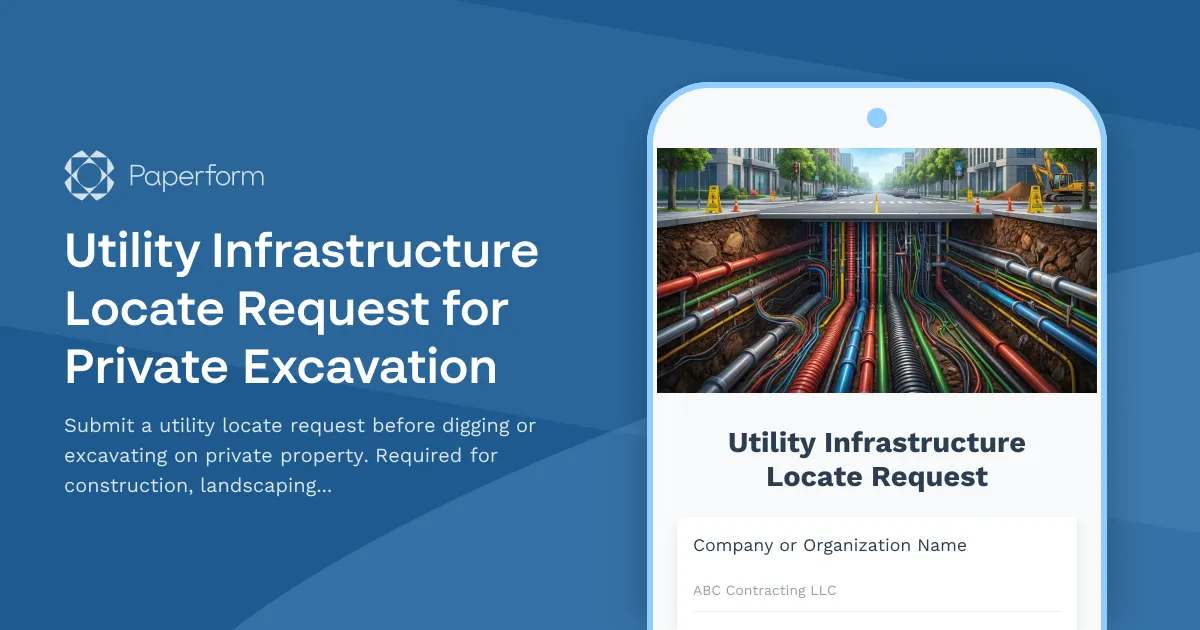
Protect Underground Infrastructure with Professional Utility Locate Requests
Before breaking ground on any excavation project—whether you're installing a fence, planting trees, building an addition, or performing underground repairs—you're legally required to request utility locates to identify buried infrastructure. Striking underground utilities can cause service disruptions, costly repairs, serious injuries, and even fatalities.
This Utility Infrastructure Locate Request Form streamlines the mandatory notification process for homeowners, contractors, landscapers, and developers planning private excavation work. Instead of juggling phone calls, paper forms, and unclear requirements, Paperform gives you a single, professional digital form that captures all required project details and ensures compliance with safe digging regulations.
Why Municipal Utility Departments Choose Paperform
Municipal utility departments, public works offices, and regional notification centers rely on Paperform to modernize their utility locate request workflows:
Capture complete project details upfront – Conditional logic ensures excavators provide all necessary information about work scope, location, depth, equipment, and timelines before submission, reducing back-and-forth and enabling faster processing.
Automate ticket assignment and notifications – Connect your form to Stepper to automatically generate ticket numbers, route requests to the appropriate utility departments (water, sewer, gas, electric), send confirmation emails with marking validity periods, and trigger field crew dispatch workflows.
Improve safety and compliance – Built-in safe digging guidelines, marking validity reminders, and emergency contact information help excavators understand their responsibilities and reduce accidental utility strikes.
Create an audit trail – Every submission is timestamped and stored with full project documentation, creating a compliance record that protects both the municipality and the excavator in case of incidents or disputes.
Integrate with GIS and work management systems – Use Stepper, Zapier, or webhooks to push locate request data into your GIS mapping platform, work order management system, or asset management database, keeping utility location records synchronized across departments.
Who Benefits from This Template
This utility locate request form serves multiple stakeholders in the excavation safety ecosystem:
- Municipal utility departments processing locate requests for water, sewer, stormwater, and municipal electric/gas infrastructure
- Regional notification centers (like 811 services) coordinating multi-utility locate requests across service territories
- Private excavation contractors submitting locate requests before construction, trenching, boring, or demolition work
- Homeowners and property owners planning DIY projects like fence installation, tree planting, or landscaping that require digging
- Developers and engineers managing site preparation and utility coordination for commercial and residential development projects
- Public works departments tracking locate request volumes, response times, and damage prevention metrics
Key Features Built into This Template
This form includes everything required for professional utility locate request processing:
- Complete excavator information – Capture company details, on-site contact information, and excavation start dates
- Detailed project location – Address fields with space for specific location descriptions, cross streets, and GPS coordinates
- Comprehensive work scope – Questions about excavation type, purpose, depth, duration, and equipment to help utility locators assess risk
- Site marking preferences – Options for white-paint marking of the excavation area and accessibility information for locators
- Automated ticket generation – Design your form to display or email a unique ticket/reference number upon submission
- Safe digging education – Include reminders about marking validity periods (typically 14-28 days), hand-digging requirements near marked utilities, and emergency procedures
- Emergency contact protocols – Clear instructions for what to do if utilities are damaged during excavation
The form uses conditional logic to show additional questions based on project type—for example, directional boring projects trigger specific depth and entry/exit point questions, while emergency excavations follow an expedited workflow.
Automate Your Utility Locate Workflow with Stepper
Once a locate request is submitted through Paperform, Stepper can handle the entire downstream workflow automatically:
- Generate and assign ticket numbers from your numbering system or database
- Route requests to the appropriate utility locator teams based on service area, utility type, or project complexity
- Send confirmation emails to excavators with ticket details, expected locate completion dates, and safe digging guidelines
- Update GIS and work order systems with new locate request details and schedule field crew assignments
- Trigger follow-up reminders as marking validity expiration approaches, prompting excavators to renew if work continues
- Log incidents if damage reports are submitted, creating case files and notifying appropriate response teams
This automation transforms utility locate requests from a manual, paper-intensive process into a streamlined digital workflow that improves response times, reduces administrative burden, and enhances excavation safety across your service territory.
Real-World Applications Across Public Works
Utility locate request forms serve multiple use cases beyond basic excavation notifications:
- Routine construction permitting – Link utility locate requests to building permits, ensuring no construction work begins until clearances are documented
- Emergency excavation authorization – Expedited workflows for urgent repairs, main breaks, or emergency service installations
- Seasonal project planning – Batch processing for annual street resurfacing, sidewalk replacement, or capital improvement projects
- Third-party utility coordination – Joint notification workflows when private utilities (cable, fiber, gas) also need to mark their infrastructure
- Damage prevention education – Collect data on close calls, near misses, and actual strikes to inform contractor training and public awareness campaigns
Designed for Municipal Efficiency and Public Safety
This template reflects the practical needs of public works departments managing high volumes of locate requests:
Mobile-friendly for field use – Contractors can submit requests from job sites using phones or tablets, with location services helping capture accurate GPS coordinates.
Accessible and multilingual-ready – Paperform's translation features and accessible design ensure all excavators—regardless of language or technical skill—can submit compliant requests.
Embeddable on municipal websites – Place the form directly on your utility department's website, or link from your 811 notification center, permitting portal, or contractor resource pages.
Scalable for growing service areas – From small towns processing dozens of monthly requests to regional centers handling thousands, Paperform scales with your volume without requiring custom development.
SOC 2 Type II compliant and secure – Protect excavator information, project details, and utility infrastructure data with enterprise-grade security that meets public sector compliance standards.
Get Started with Paperform's Utility Locate Request Template
Municipal utility departments and notification centers across North America trust Paperform to modernize damage prevention programs and improve excavation safety. This template gives you a professional, compliant starting point—just customize the utility types, marking standards, and local regulations specific to your jurisdiction.
Whether you're digitizing paper locate request forms for the first time or replacing an outdated system that doesn't integrate with modern GIS and work management tools, Paperform offers the flexibility and automation capabilities public works departments need.
Combine this form with Papersign to collect excavator agreements acknowledging safe digging requirements, or use Stepper to build complete damage prevention workflows that span request intake, field crew dispatch, marking verification, and incident reporting.
Start protecting your underground infrastructure today with Paperform's Utility Infrastructure Locate Request template—because every excavation begins with knowing what's below.



More templates like this
Residential Basement Waterproofing Permit Application
Apply for a residential basement waterproofing permit with detailed specifications for membranes, drainage systems, sump pumps, and foundation inspection coordination.
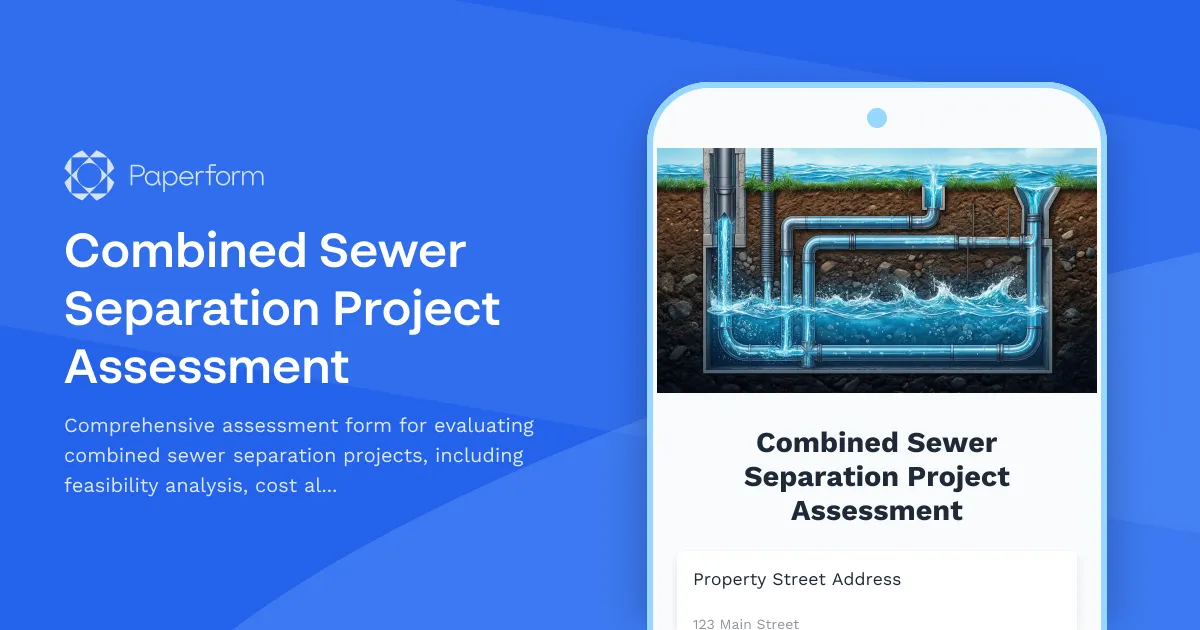
Combined Sewer Separation Project Assessment
Comprehensive assessment form for evaluating combined sewer separation projects, including feasibility analysis, cost allocation options, and available funding mechanisms for municipal infrastructure upgrades.
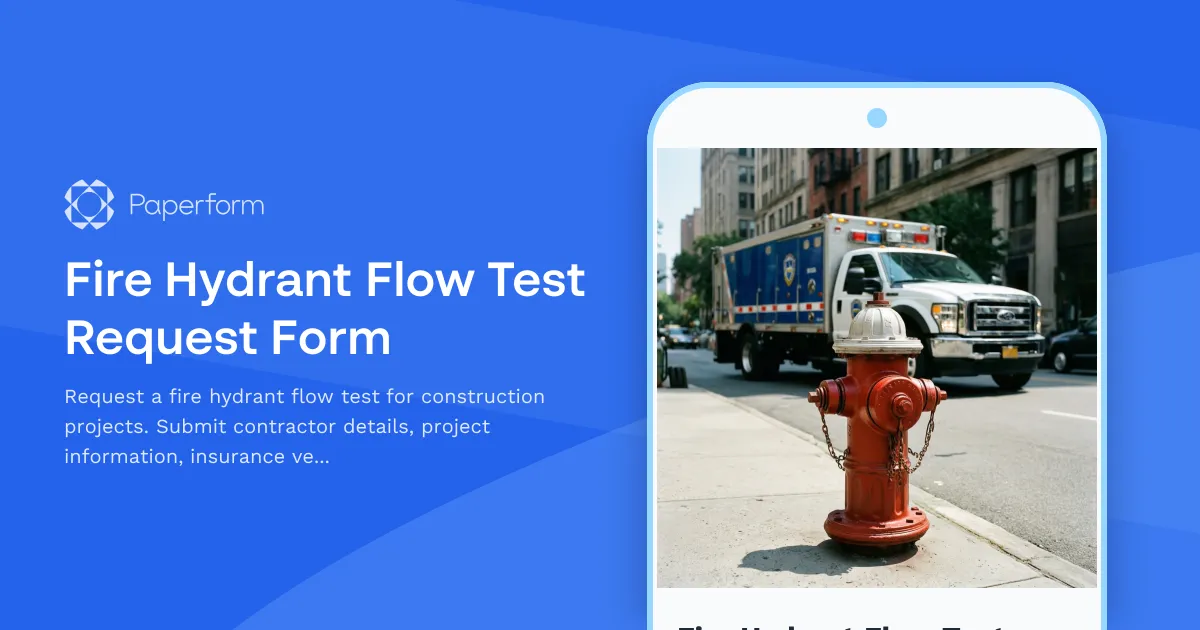
Fire Hydrant Flow Test Request Form
Request a fire hydrant flow test for construction projects. Submit contractor details, project information, insurance verification, and schedule your test with the municipal water department.
Grease Interceptor Sizing Variance Request Form
Request a variance for grease interceptor sizing requirements for food service establishments with unusual circumstances or alternative compliance methods.
Hydrant Meter Rental Application
Apply for a temporary hydrant meter rental for construction water use. Submit contractor information, license details, and required deposit for municipal water access.
Residential Well Drilling Permit Application
Apply for a residential well drilling permit with this comprehensive form covering depth specifications, casing details, environmental protection measures, and water quality testing requirements.
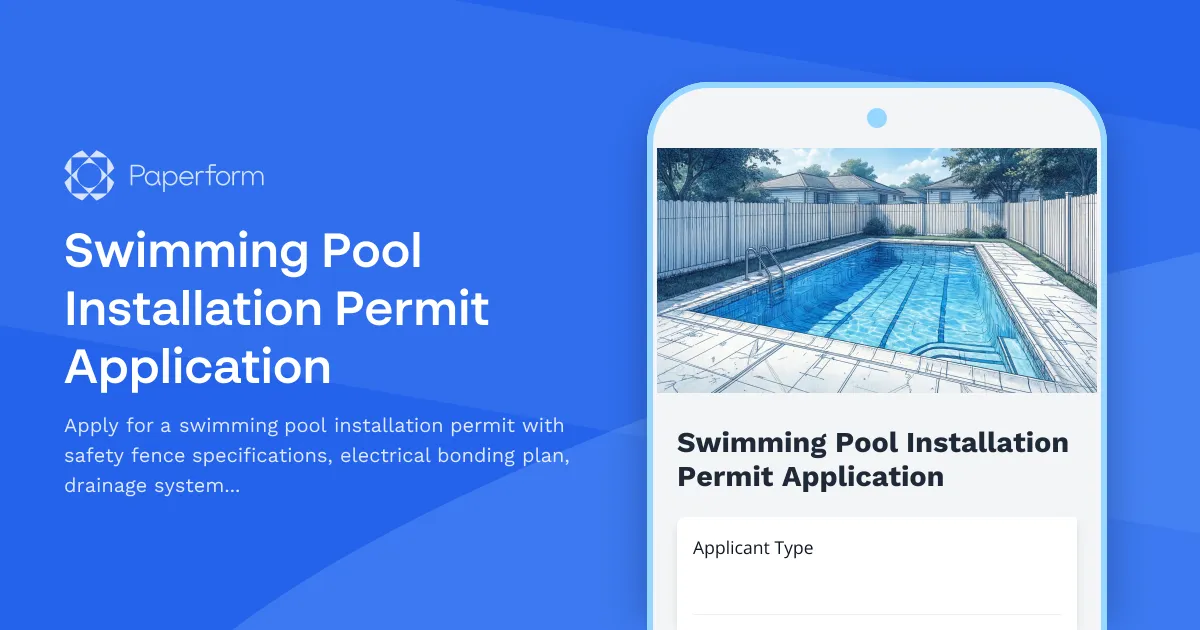
Swimming Pool Installation Permit Application
Apply for a swimming pool installation permit with safety fence specifications, electrical bonding plan, drainage system details, and contractor insurance documentation.
Temporary Construction Water Meter Application
Apply for a temporary water meter for construction projects. Submit project details, estimated water usage, and arrange the required security deposit based on consumption needs.
Backflow Prevention Assembly Registration Form
Register new backflow prevention assemblies with certified tester details, device specifications, and annual testing reminders. Streamline compliance for water utilities and property owners.
Commercial Emergency Lighting System Permit Application
Apply for a commercial emergency lighting system permit with battery backup specifications, illumination calculations, exit path coverage, testing schedules, and code compliance verification.
Commercial Vehicle Wash System Installation Permit Application
Apply for permits to install a commercial vehicle wash system with water reclamation, drainage specifications, environmental compliance, and oil-water separator requirements.

Electrical Work Permit Application
Apply for an electrical work permit with detailed scope of work, electrician license verification, inspection scheduling, and safety compliance documentation.