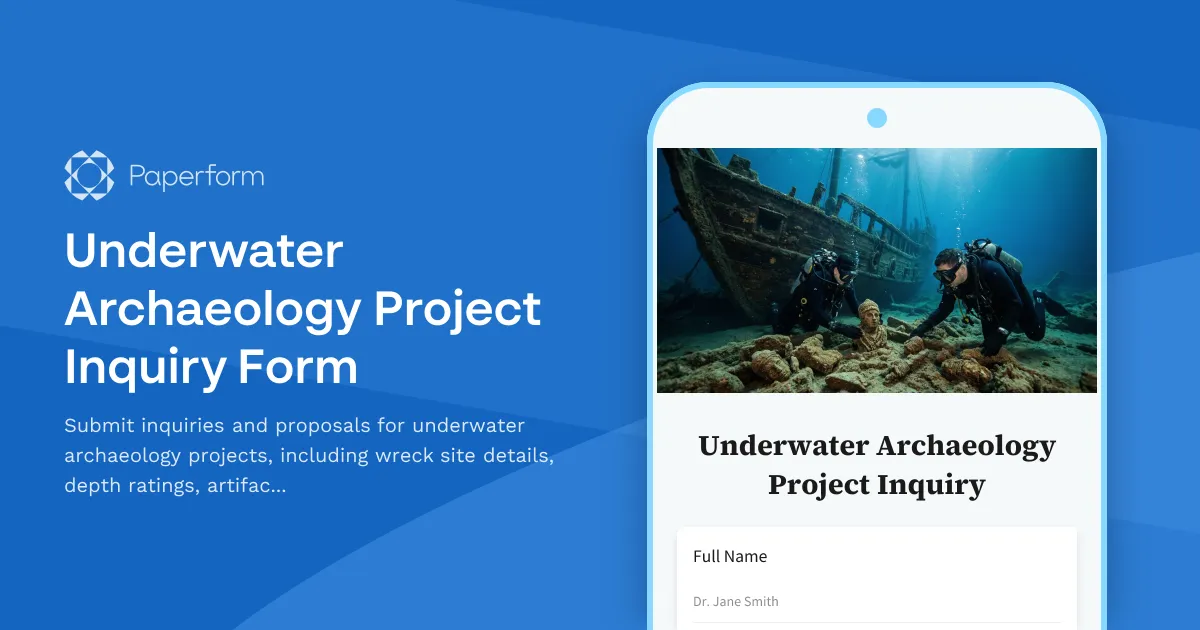
Streamline Your Underwater Archaeology Project Inquiries with Paperform
Underwater archaeology is one of the most fascinating and complex fields in historical research, requiring careful coordination between researchers, dive teams, conservation specialists, and funding bodies. Whether you're a marine archaeologist seeking collaboration, a research institution evaluating new wreck sites, or a government agency managing cultural heritage, having a professional inquiry form is essential for capturing the critical details that make or break expedition planning.
This Underwater Archaeology Project Inquiry Form template is designed specifically for maritime archaeology organizations, university marine archaeology departments, cultural heritage agencies, and underwater excavation teams who need to collect comprehensive project proposals and site information in one organized submission.
Why This Template Works for Marine Archaeology Teams
Traditional inquiry methods—lengthy email chains, scattered PDF attachments, and inconsistent data collection—create unnecessary friction in the project evaluation process. This form template consolidates everything you need into a single, professional submission experience:
- Comprehensive site documentation: Capture wreck location coordinates, depth ratings, site conditions, and access requirements
- Detailed recovery planning: Collect artifact recovery methodologies, conservation facility information, and team credentials
- Timeline and logistics: Gather excavation schedules, permit status, funding details, and equipment needs
- Supporting documentation: Accept dive site surveys, photogrammetry data, research proposals, and conservation plans through secure file uploads
The form uses conditional logic to adapt based on project type—whether it's a preliminary survey, full excavation, or artifact conservation proposal—ensuring you only collect relevant information for each inquiry type.
Perfect for Research Institutions and Heritage Organizations
This template is ideal for:
- University marine archaeology programs evaluating student research proposals and expedition partnerships
- National and regional heritage agencies managing underwater cultural heritage sites and excavation permits
- Maritime museums assessing artifact recovery projects and conservation collaborations
- Commercial archaeology firms screening project inquiries and partnership opportunities
- Research foundations reviewing grant applications for underwater archaeology funding
How Paperform Enhances Archaeological Project Management
Paperform's flexible form builder lets you create inquiry forms that feel professional and purpose-built for the scientific community, without any coding required. The doc-style editor means you can add project guidelines, safety protocols, and heritage compliance requirements inline with your form fields, creating a clear, informative experience for researchers.
Conditional logic ensures different project types trigger the right follow-up questions—preliminary surveys need different details than full excavations or emergency salvage operations. This keeps your form streamlined while capturing comprehensive data.
File upload fields let researchers submit essential documentation like dive site surveys, preliminary artifact assessments, photogrammetry models, and letters of institutional support—keeping everything organized in one submission rather than scattered across email attachments.
Custom calculations can help assess project complexity scores, estimated conservation costs, or dive operation requirements based on depth, site conditions, and artifact types, giving your review team instant insight into resource needs.
Automate Your Archaeological Project Workflows
Once you receive an inquiry, Paperform's integration ecosystem helps you move projects forward efficiently:
- Send submissions to your project management tools like Asana, Monday, or Notion to create project evaluation workflows
- Trigger email notifications to relevant department heads, conservation specialists, or permit coordinators based on project type and location
- Connect to Google Sheets or Airtable to build a searchable database of proposed wreck sites and research projects
- Use Stepper (stepper.io) to automate multi-stage review processes—route proposals through scientific review, budget assessment, permit verification, and final approval with automated status updates to applicants
For organizations managing multiple projects, these automations eliminate manual data entry and ensure every inquiry moves through your evaluation process with full transparency and accountability.
Secure Data Collection for Sensitive Site Information
Underwater wreck sites often contain sensitive location data that needs protection from looters and unauthorized salvage operations. Paperform is SOC 2 Type II compliant and offers secure data handling, role-based access controls, and data residency options, so you can confidently collect coordinates, artifact assessments, and research plans knowing they're protected.
You can also customize your success page to set clear expectations about review timelines, next steps, and how researchers will be contacted—reducing follow-up inquiries and building trust with the scientific community.
Easy to Customize for Your Institution
While this template is ready to use immediately, you can easily adapt it to your organization's specific needs:
- Add questions about specific regional regulations, UNESCO convention compliance, or indigenous consultation requirements
- Include sections for collaborative partnerships, institutional affiliations, or academic credentials
- Incorporate rating scales for site significance, artifact condition, or conservation urgency
- Add appointment scheduling for preliminary consultations or site review meetings
- Customize the design with your institution's branding, colors, and logo
Paperform's visual editor makes it simple for museum staff, heritage coordinators, or research administrators to maintain and update the form without technical expertise—keeping your inquiry process current as your project requirements evolve.
Get Started with Professional Project Inquiries
Whether you're managing a national shipwreck database, coordinating university research expeditions, or overseeing cultural heritage protection programs, this template helps you collect the detailed, structured information you need to evaluate underwater archaeology projects efficiently and professionally.
Start with this template, customize it to your institutional requirements, and create a streamlined inquiry experience that respects the scientific rigor of underwater archaeology while making it easier for researchers to connect with your organization.



More templates like this
Observatory Time Booking Request
Request telescope time for astronomical observations with detailed target information, instrument requirements, and scheduling preferences.
Cultural Heritage Digitization Equipment Request Form
A comprehensive form for museum registrars to request and document digitization equipment for cultural heritage collections, ensuring archival quality standards and grant funding compliance.
High Energy Physics Detector Development Services Brochure Request
Request comprehensive information about our detector development services for high energy physics research. Get brochures, technical specifications, and schedule a consultation to discuss your project needs.
Particle Accelerator Time Rental Information Request
Request detailed information about particle accelerator facility rental, beam specifications, and schedule a consultation to discuss your experimental research needs.
Biotechnology Lab Reagent Request Form
A comprehensive reagent and materials request form for biotech labs with experimental protocols, cold chain requirements, MSDS documentation, and PI authorization.
College Departmental Honors Thesis Inquiry Form
A comprehensive inquiry form for students interested in pursuing an honors thesis, including advisor matching, topic proposals, research timelines, and academic goals.
Cryogenic Preservation Consultation Request
Request a consultation for cryogenic preservation services. Capture preservation preferences, medical eligibility details, legal documentation status, storage facility selection, and funding arrangements.
Laboratory Chemical & Equipment Requisition Form
Streamline lab supply ordering with a comprehensive requisition form for chemicals, equipment, and materials. Includes CAS numbers, safety data requirements, storage specifications, and PI approval workflows.

Superconducting Magnet Laboratory Access Request Form
Request access to superconducting magnet laboratory facilities with cryogenic safety training verification and quench procedure certification requirements.
Antarctic Research Expedition Inquiry Form
Streamline your Antarctic research expedition planning with this comprehensive inquiry form. Capture research objectives, team details, vessel requirements, equipment logistics, and optimal season timing in one efficient submission.
Aquarium Exhibit Species Introduction Request Form
A comprehensive request form for introducing new species to aquarium exhibits, covering quarantine protocols, water chemistry compatibility, veterinary health assessments, and curator approval workflows.
Biotech Laboratory Services Catalog Request Form
Request a comprehensive catalog of biotech laboratory services including testing capabilities, turnaround times, compliance standards, and schedule a consultation with an account manager.