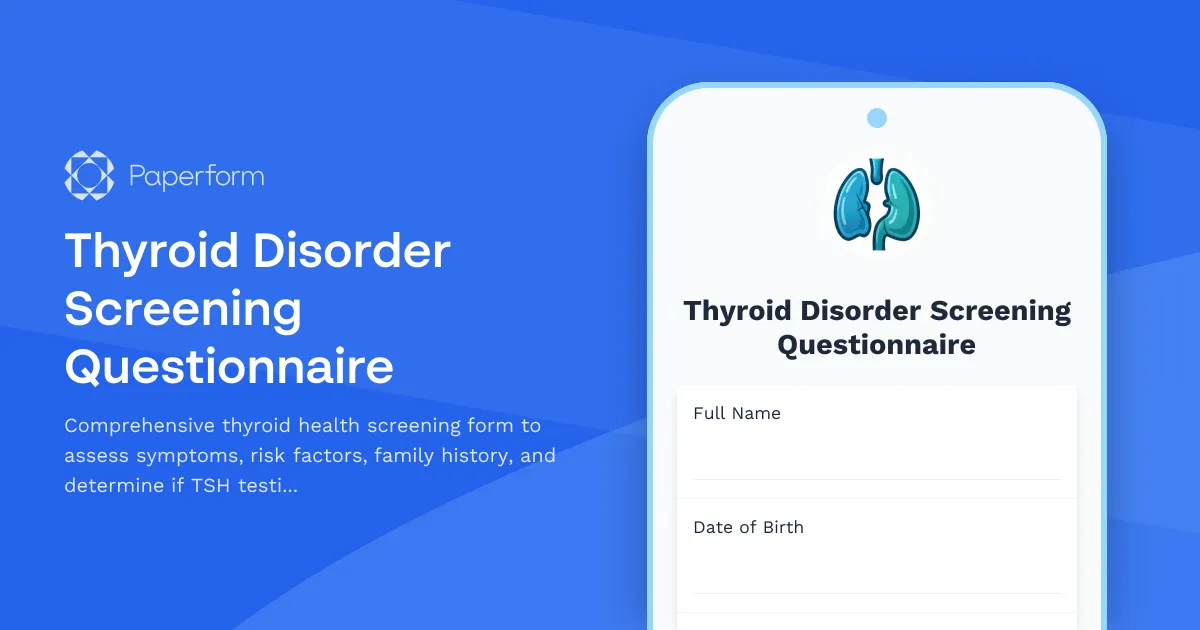
Comprehensive Thyroid Disorder Screening Made Simple
Thyroid disorders affect millions of people worldwide, yet many cases go undiagnosed for years. Whether you're a primary care clinic, endocrinology practice, wellness center, or telehealth provider, having a structured thyroid screening questionnaire is essential for identifying at-risk patients early and streamlining the referral process.
This Thyroid Disorder Screening Questionnaire template is designed to help healthcare providers efficiently assess patients for potential thyroid dysfunction through a comprehensive symptom checklist, family history review, and risk factor analysis. The form guides patients through a structured evaluation that helps determine whether TSH lab testing or an endocrinology consultation is warranted.
Why Use This Thyroid Screening Template?
Streamline Patient Assessment
Rather than piecing together thyroid symptoms from unstructured intake forms or lengthy consultations, this template presents a organized, evidence-based approach to thyroid screening. Patients can complete the questionnaire before their appointment, giving your clinical team valuable insights to prepare for the consultation and make informed decisions about next steps.
Identify Risk Factors Early
The form includes sections on family history of thyroid disease, autoimmune conditions, radiation exposure, and other key risk factors that significantly increase the likelihood of thyroid disorders. This comprehensive approach ensures nothing is missed during the screening process.
Reduce Administrative Burden
With Paperform's conditional logic, the questionnaire adapts to each patient's responses—showing relevant follow-up questions only when needed. This creates a personalized experience while capturing detailed clinical information that would typically require multiple rounds of clarification.
Perfect for Healthcare Providers and Wellness Practices
This template is ideal for:
- Primary care physicians conducting routine thyroid screenings for at-risk populations
- Endocrinology practices streamlining new patient intake and pre-consultation assessments
- Functional medicine practitioners evaluating thyroid health as part of comprehensive wellness assessments
- Telehealth providers gathering detailed patient history before virtual consultations
- Employee health programs offering thyroid screening as part of workplace wellness initiatives
- Women's health clinics screening patients with menstrual irregularities or fertility concerns
- Mental health practices identifying potential thyroid-related mood and cognitive symptoms
Key Features of This Template
The questionnaire includes:
- Comprehensive symptom checklist covering hyperthyroidism and hypothyroidism symptoms
- Family history assessment for thyroid disease and autoimmune conditions
- Risk factor evaluation including age, gender, previous radiation exposure, and medication history
- Current medication review to identify drugs that may affect thyroid function
- Lifestyle and dietary factors that influence thyroid health
- Previous thyroid testing history to track longitudinal patterns
- TSH lab order indication based on screening results
- Endocrinology referral assessment for patients requiring specialist evaluation
Automate Your Clinical Workflows with Stepper
Once a patient completes this thyroid screening, you can use Stepper to automatically trigger the right next steps based on their responses. For instance, if a patient's symptom score indicates high risk, Stepper can:
- Automatically generate a TSH lab order and send it to your laboratory system
- Create a task for your clinical team to review the results and schedule a follow-up
- Send the patient educational materials about thyroid health
- Route high-risk cases directly to an endocrinologist's scheduling system
- Update the patient's EHR with screening results and recommended actions
This level of automation means your team spends less time on manual triage and more time providing personalized care.
HIPAA Considerations and Data Security
Important: While Paperform offers SOC 2 Type II compliance and enterprise-grade security features, it is not a HIPAA-compliant solution. If you need to collect protected health information (PHI) that requires HIPAA compliance, please ensure you have appropriate systems and business associate agreements in place.
For clinical workflows that require HIPAA compliance, you may use this template for preliminary screening purposes where patients are informed that their responses will be transferred to a HIPAA-compliant system for clinical documentation.
Designed for Patient Experience
This template balances clinical thoroughness with patient-friendliness. The clean, professional design reduces form fatigue, while conditional logic ensures patients only see questions relevant to their situation. Clear instructions and plain-language symptom descriptions help patients provide accurate information without medical jargon confusion.
Flexible and Customizable
Every practice has unique protocols and screening criteria. This Paperform template is fully customizable—add your clinic logo, adjust symptom weighting, modify risk factor questions, or integrate with your existing EHR and practice management systems. The doc-style editor makes it simple to adapt the form to your specific clinical guidelines.
Get Started with Better Thyroid Screening
Whether you're looking to improve early detection of thyroid disorders, streamline your endocrinology referral process, or simply gather more structured patient data, this thyroid screening questionnaire provides a professional, patient-friendly solution. With Paperform's powerful features and seamless integrations, you can transform how your practice identifies and manages thyroid health concerns.
Start using this template today to deliver more efficient, thorough thyroid assessments while reducing administrative burden on your healthcare team.
More templates like this
Achondroplasia Growth Monitoring & Care Coordination Form
A comprehensive telehealth form for monitoring growth patterns, assessing treatment options, screening for complications, and coordinating psychosocial support for patients with achondroplasia.
Ambulatory Surgery Center Pre-Operative Intake Form
Complete pre-operative assessment for ambulatory surgery patients including anesthesia history, NPO compliance verification, medication management, and same-day discharge planning.
Anticoagulation Safety Checklist & Bleeding Risk Assessment
A comprehensive pre-visit assessment for patients on anticoagulation therapy to evaluate bleeding risk, fall frequency, medication compliance, and dietary vitamin K intake.
Asthma Action Plan Compliance & Symptom Tracker
Track asthma symptoms, peak flow readings, trigger exposure, and medication usage to help your healthcare provider assess control and adjust your treatment plan.
Atrial Fibrillation Screening & Stroke Risk Assessment
Comprehensive AFib screening form for high-risk patients including pulse assessment, ECG ordering, CHA₂DS₂-VASc stroke risk calculation, and cardiology consultation scheduling.
Autoimmune Disease Management & Flare Tracking Form
Comprehensive virtual care form for managing autoimmune conditions, tracking disease flares, monitoring immunosuppressant therapy, and coordinating steroid tapers with infection prevention protocols.
Benign Prostatic Hyperplasia (BPH) Screening Form
A comprehensive BPH screening form with International Prostate Symptom Score (IPSS), quality of life assessment, urinary flow evaluation, and urology consultation request for men experiencing lower urinary tract symptoms.
Chronic Eosinophilic Pneumonia Assessment Form
A comprehensive clinical assessment form for evaluating patients with suspected chronic eosinophilic pneumonia, documenting respiratory symptoms, imaging findings, steroid response, and pulmonology consultation details.
Chronic Hyponatremia Assessment Form
A comprehensive assessment form for evaluating chronic hyponatremia, including symptom evaluation, medication review, SIADH screening, and consultation recommendations for nephrology or endocrinology specialists.
Chronic Inflammatory Demyelinating Polyneuropathy (CIDP) Screening & Assessment Form
Comprehensive CIDP screening form for evaluating progressive weakness, nerve conduction study criteria, and determining neurology referral needs for suspected chronic inflammatory demyelinating polyneuropathy.
Cystic Fibrosis Pulmonary Exacerbation Assessment Form
A comprehensive telehealth assessment form for monitoring CF pulmonary exacerbations, including sputum culture results, airway clearance adherence, CFTR modulator response, and nutritional status evaluation.
Endocrinology Diabetes Symptom Checker
A comprehensive pre-visit diabetes assessment form that tracks blood glucose levels, medication adherence, symptoms, and potential complications to help endocrinologists provide better care.