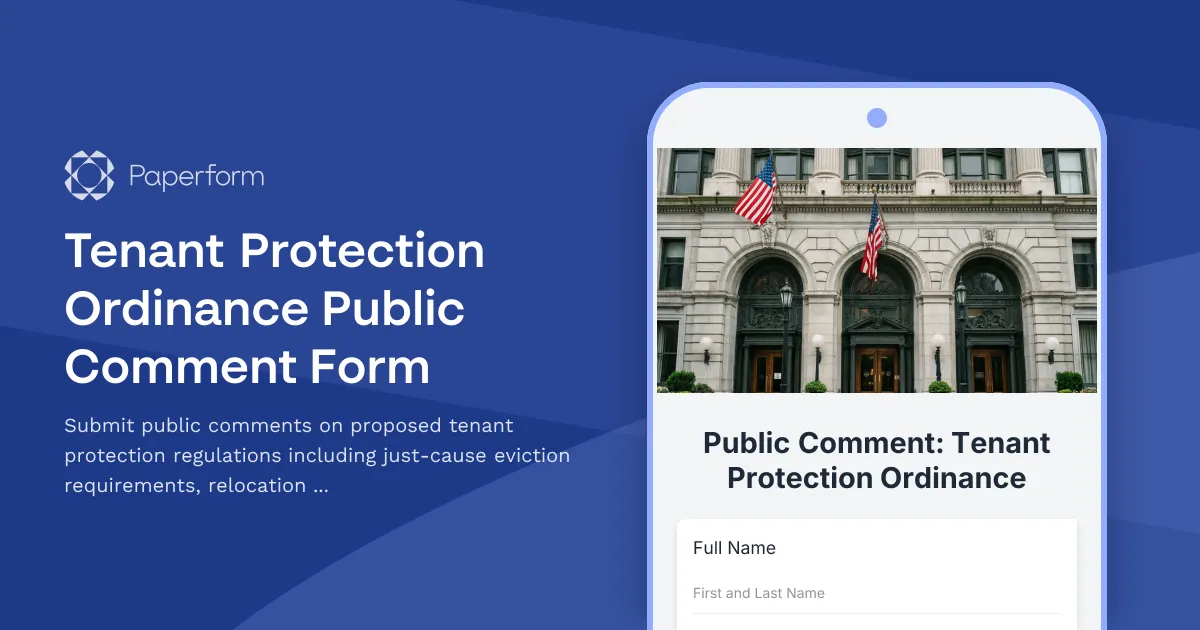
Tenant Protection Ordinance Public Comment Form
Strong tenant protections are essential for creating stable, equitable communities where residents can thrive without fear of displacement. When your local government proposes new tenant protection ordinances—including just-cause eviction requirements, relocation assistance programs, and rent increase limitations—your voice matters.
This Tenant Protection Ordinance Public Comment Form makes it simple for residents, landlords, housing advocates, and community stakeholders to submit formal comments on proposed regulations during the public review period. Whether you're sharing personal experiences with housing insecurity, providing data-driven policy recommendations, or representing an organization's position, this template ensures your feedback reaches decision-makers clearly and officially.
Why tenant protection ordinances need public input
Proposed tenant protection policies directly impact thousands of residents, property owners, and the broader housing landscape. Public comment periods are your opportunity to:
- Share lived experiences that illustrate why protections are needed (or how they might create unintended consequences)
- Provide expert analysis on policy language, implementation challenges, or best practices from other jurisdictions
- Represent community voices as a housing advocate, tenant union, or neighborhood association
- Offer landlord perspectives on compliance feasibility, economic impacts, and operational considerations
- Submit data and research that supports or questions specific provisions in the proposed ordinance
Collecting these diverse perspectives through a structured form ensures that government administrators, city council members, and planning commissions receive comprehensive feedback to inform their final decisions.
What makes this form template effective for civic engagement
Unlike generic contact forms, this template is purpose-built for formal public comment submission on tenant protection ordinances:
Structured comment categories: Respondents can indicate which specific provisions they're addressing—just-cause eviction requirements, relocation assistance amounts and eligibility, annual rent increase caps, exemptions for small landlords, enforcement mechanisms, or implementation timelines. This helps administrators organize feedback by topic rather than sorting through narrative comments manually.
Multiple stakeholder paths: The form uses conditional logic to tailor questions based on whether the commenter is a tenant, landlord, housing advocate, legal professional, or other stakeholder. This ensures relevant follow-up questions while keeping the form focused.
Space for detailed testimony: Long-form text fields allow respondents to provide thorough explanations, personal stories, policy recommendations, and supporting evidence—crucial for meaningful public input.
Document attachment capability: Commenters can upload supporting materials like research studies, rent increase documentation, eviction notices, organizational position statements, or letters of support from community members.
Official record creation: Each submission becomes a time-stamped public record that can be included in official hearing packets, administrative records, and policy development documentation.
How this form streamlines government workflows
For municipal housing departments, planning commissions, and city clerk offices, managing public comment can be administratively overwhelming—especially during high-profile policy debates. This Paperform template helps by:
- Centralizing all comments in one organized database instead of tracking emails, paper letters, and in-person testimony separately
- Auto-categorizing feedback by policy provision, stakeholder type, and position (support/oppose/amend) for faster analysis
- Creating exportable summaries that can be shared with elected officials, included in staff reports, and published for transparency
- Tracking participation metrics to demonstrate community engagement levels and identify which provisions generate the most concern
Since the form is SOC 2 Type II compliant and can handle data residency requirements, it meets the security and transparency standards government agencies need when collecting public input.
Automating follow-up with Stepper
Once comments are submitted, government teams can use Stepper (stepper.io) to automate acknowledgment and routing:
- Send immediate confirmation emails thanking residents for participating in the democratic process and providing submission ID numbers
- Route comments to the appropriate department staff based on topic (housing authority, city attorney, planning department)
- Create summary reports for upcoming public hearings that group comments by theme and sentiment
- Flag comments that request follow-up or indicate interest in testifying at live hearings
- Update community engagement databases or constituent relationship management systems
This automation ensures no comment goes unacknowledged and that staff can focus on substantive policy analysis rather than administrative tracking.
Who benefits from this template
Municipal government: Housing departments, city clerk offices, planning commissions, and city councils managing public comment periods for proposed tenant protection ordinances.
Community organizations: Tenant unions, housing justice coalitions, legal aid societies, and advocacy groups mobilizing members to submit coordinated comments.
Property management: Landlord associations, property owner groups, and real estate professionals providing industry perspective on proposed regulations.
Individual residents: Tenants sharing personal experiences with rent increases, evictions, or housing instability, and homeowners or small landlords offering their viewpoints.
Tenant protections deserve informed policy—and your voice matters
Whether you're a city administrator opening a 30-day comment period, a housing advocate organizing a community response campaign, or an individual resident who wants to be heard, this form provides the structure needed for meaningful civic participation.
With Paperform's flexible editor, you can customize the form to reflect your municipality's specific proposal—adjust policy provisions, add local context, include links to draft ordinance language, and embed the form directly on your city's website or share it through community networks.
Trusted by government agencies and community organizations for secure, accessible public engagement, this template helps ensure that tenant protection policies are shaped by the voices of those they'll impact most.


More templates like this
Tenant Opportunity to Purchase Act (TOPA) Public Comment Form
Submit public comments on proposed Tenant Opportunity to Purchase Act regulations, including first-right-to-buy procedures, financing assistance programs, and affordability covenant requirements.
Energy Benchmarking and Disclosure Ordinance Comment Form
Submit public comments on proposed energy benchmarking requirements, building performance standards, compliance timelines, and retrofit incentives for commercial and residential properties.
Basement and Cellar Conversion Regulation Public Hearing Form
Submit public comments on proposed basement and cellar conversion regulations, including ceiling height requirements, egress standards, and affordable housing unit creation guidelines.
Housing Discrimination Ordinance Public Input Form
Submit public comments on proposed housing discrimination ordinance expansions, including protected class additions, complaint procedures, and landlord education requirements.
Planning Commission Rezoning Proposal Comment Form
Submit official comments on proposed rezoning applications to your local planning commission, including parcel details, land use concerns, and neighborhood impact assessments.
Section 8 Housing Application - Proof of Residence & Income Verification
Complete Section 8 housing application form with proof of residence verification, income documentation, employment records, landlord references, and background check consent.
Affordable Housing Lottery Application Feedback Form
Gather citizen feedback on the affordable housing lottery application process, including eligibility requirements, documentation needs, selection transparency, and income verification concerns.
Elevator & Escalator Permit - Proof of Building Address
A comprehensive verification form for elevator and escalator permit applications requiring proof of building address, property documentation, utility accounts, maintenance contracts, and safety inspection reports.
Land Rent Clearance Certificate Application Form
Apply for a land rent clearance certificate in Kenya. Submit your plot details, land reference numbers, and arrears information for processing by the relevant county authority.
Legal Aid Services Application
Apply for free or low-cost legal assistance with a comprehensive application that screens for income eligibility, case type, and conflict of interest.
Mobile Home Park Conversion & Closure Public Input Form
Submit public comments on proposed mobile home park conversion or closure ordinances, including input on resident relocation assistance, purchase rights, and affordability preservation measures.
New Citizen Voter Registration Form
A comprehensive voter registration form designed specifically for newly naturalized U.S. citizens, featuring naturalization certificate verification and citizenship date confirmation for election eligibility.