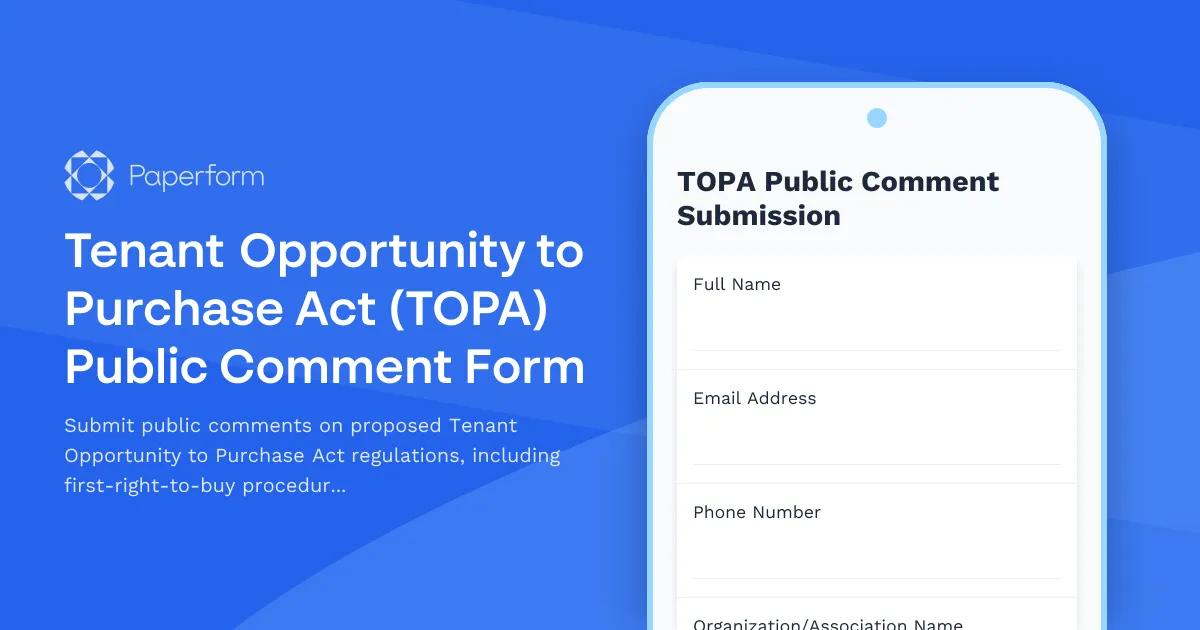
Tenant Opportunity to Purchase Act Public Comment Form
Tenant Opportunity to Purchase Act (TOPA) legislation represents a critical tool for preserving affordable housing and empowering renters with the right to collectively purchase their buildings when owners decide to sell. As municipalities across the country consider implementing or refining TOPA regulations, public input becomes essential to crafting policies that balance tenant rights, property owner interests, and community housing needs.
This Tenant Opportunity to Purchase Act Public Comment Form provides housing advocates, tenant associations, property owners, community organizations, and concerned residents with a structured platform to submit detailed feedback on proposed TOPA regulations. Whether you're commenting on first-right-to-buy notification procedures, financing assistance eligibility, or long-term affordability covenant requirements, this template ensures your voice reaches policymakers effectively.
Why TOPA Regulations Matter
TOPA laws give tenants the first opportunity to purchase their rental property when an owner decides to sell, creating pathways to homeownership, preserving affordable housing stock, and stabilizing communities facing gentrification pressures. Key components typically include:
- Notice requirements specifying how and when landlords must inform tenants of intent to sell
- Negotiation periods allowing tenant associations time to organize and secure financing
- Right of first refusal ensuring tenants can match third-party offers
- Financing assistance programs providing access to loans, grants, and technical support
- Affordability covenants maintaining long-term rent restrictions and income limits
Public comment periods allow stakeholders to weigh in on implementation details, exemptions, enforcement mechanisms, and support structures that will determine whether TOPA legislation successfully achieves its housing justice goals.
Who Should Submit TOPA Public Comments
This form serves multiple constituencies in the affordable housing ecosystem:
Tenants and Tenant Associations can advocate for stronger notification requirements, longer negotiation periods, and robust financing assistance that makes collective ownership realistic rather than theoretical.
Community Development Corporations and Housing Nonprofits bring implementation expertise to comment on technical assistance programs, capacity-building resources, and the infrastructure needed to support tenant purchases.
Property Owners and Real Estate Professionals provide perspective on practical challenges, reasonable timelines, and exemptions that prevent unintended market consequences while respecting tenant rights.
Housing Finance Agencies and Lenders contribute insights on financing structures, underwriting standards, and loan programs that can make tenant purchases financially viable.
Municipal Housing Departments and Planners coordinate citywide housing strategies, ensuring TOPA regulations integrate with other affordability preservation tools.
Housing Justice Organizations and Legal Aid Groups advocate for enforcement mechanisms, legal protections, and equitable implementation across diverse neighborhoods.
Key Issues for Public Comment
When TOPA regulations move through the public comment process, stakeholders typically address:
Notification Procedures: How much advance notice must owners provide? What information must be included? How are notices delivered to ensure all tenants receive them? What happens with absentee tenants or language barriers?
Formation and Recognition of Tenant Associations: What constitutes a legitimate tenant association? How many residents must participate? What registration or certification processes apply? How quickly must associations form to exercise purchase rights?
Negotiation Timelines: How long do tenants have to express interest, conduct inspections, secure financing, and close on purchases? Are extensions available for complex transactions? How do timelines balance tenant needs against seller interests?
Financing Assistance Programs: What public financing mechanisms support tenant purchases? Are there grant programs, low-interest loans, or loan guarantees? What are eligibility requirements and maximum assistance amounts? How are funds administered?
Affordability Covenants and Restrictions: What income limits and rent restrictions apply to TOPA purchases? How long do affordability requirements last? Are there resale restrictions? How is compliance monitored and enforced?
Exemptions and Exclusions: Which property types or ownership situations are exempt? Are owner-occupied buildings, small properties, or nonprofit owners treated differently? How are exemptions verified?
Third-Party Assignment Rights: Can tenant associations assign their purchase rights to qualified nonprofits or community land trusts? What approval processes apply? How are assignments structured?
Enforcement and Penalties: What happens when owners violate notification or negotiation requirements? What remedies are available to tenants? Who investigates complaints and enforces compliance?
How Paperform Streamlines Public Comment Submission
Government agencies managing public comment periods need organized, accessible submission systems that capture detailed input while respecting diverse communication preferences. This Paperform template creates a professional, user-friendly experience that encourages meaningful participation:
Structured Input Fields guide commenters through key regulatory issues—notification procedures, financing programs, affordability requirements—ensuring agencies receive organized feedback rather than scattered narratives.
Conditional Logic tailors the form experience based on commenter type (tenant, property owner, nonprofit, etc.), presenting relevant questions while maintaining a streamlined submission process.
Document Upload Capabilities allow stakeholders to attach supporting materials—research studies, financial analyses, case studies from other jurisdictions, legal memoranda—enriching comments with evidence-based recommendations.
Accessibility and Language Support ensure that tenants, community members, and organizations with limited digital access or English proficiency can meaningfully participate in shaping policies that directly impact their housing security.
Automated Confirmation and Documentation provide submitters with timestamped records of their comments, creating transparency and accountability in the public input process.
For housing departments managing multiple concurrent public comment periods—on TOPA, rent control, eviction protections, inclusionary zoning—Paperform's brand customization ensures each initiative maintains appropriate branding while backend systems organize submissions efficiently.
Connecting Public Comment to Policy Action with Stepper
Public comment doesn't end with submission—it triggers analysis, categorization, response drafting, and incorporation into final regulations. Stepper, Paperform's AI-native workflow automation platform, transforms raw public input into actionable policy insights:
Automated Categorization and Tagging: Stepper can analyze comment content, automatically tagging submissions by topic (financing assistance, notification procedures, exemptions), stakeholder type, and support/opposition stance, helping policy staff identify themes and priorities.
Stakeholder Database Management: Route commenter information to constituent relationship management systems, building databases that inform future engagement on housing policy initiatives.
Comment Analysis and Summaries: For comment periods generating hundreds or thousands of submissions, Stepper can work with AI to generate thematic summaries, quantitative breakdowns, and representative quote compilations that staff present to decision-makers.
Response Workflows: Trigger acknowledgment emails immediately upon submission, schedule follow-up communications when comment periods close, and coordinate internal review assignments across legal, planning, and housing policy teams.
Public Hearing Coordination: For commenters requesting to speak at public hearings, Stepper can automatically add them to speaker lists, send hearing logistics, and coordinate testimony time slots.
Policy Tracking: Connect comments to document management systems where regulation drafts evolve, ensuring stakeholder input remains accessible to drafters throughout the policy development process.
This integration means housing departments can manage robust public participation processes even with lean staff resources, ensuring every voice contributes to more equitable housing policy.
Building Housing Justice Through Accessible Participation
TOPA legislation succeeds when it reflects lived experiences of tenants navigating housing insecurity, practical realities of property ownership and management, and innovative financing structures that make collective ownership viable. Public comment periods democratize policy development, but only when participation barriers are minimized.
This Paperform template meets stakeholders where they are—whether that's a tenant association meeting in a community room, a nonprofit's policy team drafting detailed recommendations, or an individual renter submitting feedback from their phone during a work break. By making comment submission straightforward and accessible, municipalities signal that public input genuinely matters in shaping housing policy.
For agencies committed to housing justice, this isn't just about regulatory compliance with public comment requirements—it's about building trust, centering impacted communities, and creating policies that reflect collective wisdom rather than top-down assumptions.
Trusted by Housing Departments and Community Organizations
Paperform serves over 500,000 teams worldwide, including municipal housing departments, community development corporations, tenant advocacy organizations, and public participation platforms that require secure, accessible, and professional digital forms. SOC 2 Type II and GDPR compliant, Paperform ensures that sensitive commenter information—contact details, housing situations, organizational affiliations—remains protected throughout the public comment process.
Whether you're a housing policy team managing your first TOPA public comment period or a tenant rights organization coordinating member input across multiple municipalities, this template provides the foundation for meaningful civic participation that shapes more equitable housing futures.
More templates like this
Tenant Protection Ordinance Public Comment Form
Submit public comments on proposed tenant protection regulations including just-cause eviction requirements, relocation assistance, and rent increase limitations.
Energy Benchmarking and Disclosure Ordinance Comment Form
Submit public comments on proposed energy benchmarking requirements, building performance standards, compliance timelines, and retrofit incentives for commercial and residential properties.
Basement and Cellar Conversion Regulation Public Hearing Form
Submit public comments on proposed basement and cellar conversion regulations, including ceiling height requirements, egress standards, and affordable housing unit creation guidelines.
Housing Discrimination Ordinance Public Input Form
Submit public comments on proposed housing discrimination ordinance expansions, including protected class additions, complaint procedures, and landlord education requirements.
Planning Commission Rezoning Proposal Comment Form
Submit official comments on proposed rezoning applications to your local planning commission, including parcel details, land use concerns, and neighborhood impact assessments.
Section 8 Housing Application - Proof of Residence & Income Verification
Complete Section 8 housing application form with proof of residence verification, income documentation, employment records, landlord references, and background check consent.
Danish Apartment Owner Association Registration Form
A comprehensive registration form for Danish apartment owner associations (ejerforening) to register unit owners, collect CPR numbers, and maintain compliance with Danish property law requirements.
Elevator & Escalator Permit - Proof of Building Address
A comprehensive verification form for elevator and escalator permit applications requiring proof of building address, property documentation, utility accounts, maintenance contracts, and safety inspection reports.

Land Rent Clearance Certificate Application Form
Apply for a land rent clearance certificate in Kenya. Submit your plot details, land reference numbers, and arrears information for processing by the relevant county authority.
New Citizen Voter Registration Form
A comprehensive voter registration form designed specifically for newly naturalized U.S. citizens, featuring naturalization certificate verification and citizenship date confirmation for election eligibility.
Voter Registration Public Records Request
Request voter registration records and election data with customizable field selection, format preferences, and automatic fee calculation.
Voter Registration Purge Appeal Form
Appeal a voter registration removal decision with supporting documentation and request an administrative hearing. Ensure your voting rights are protected through the formal appeals process.