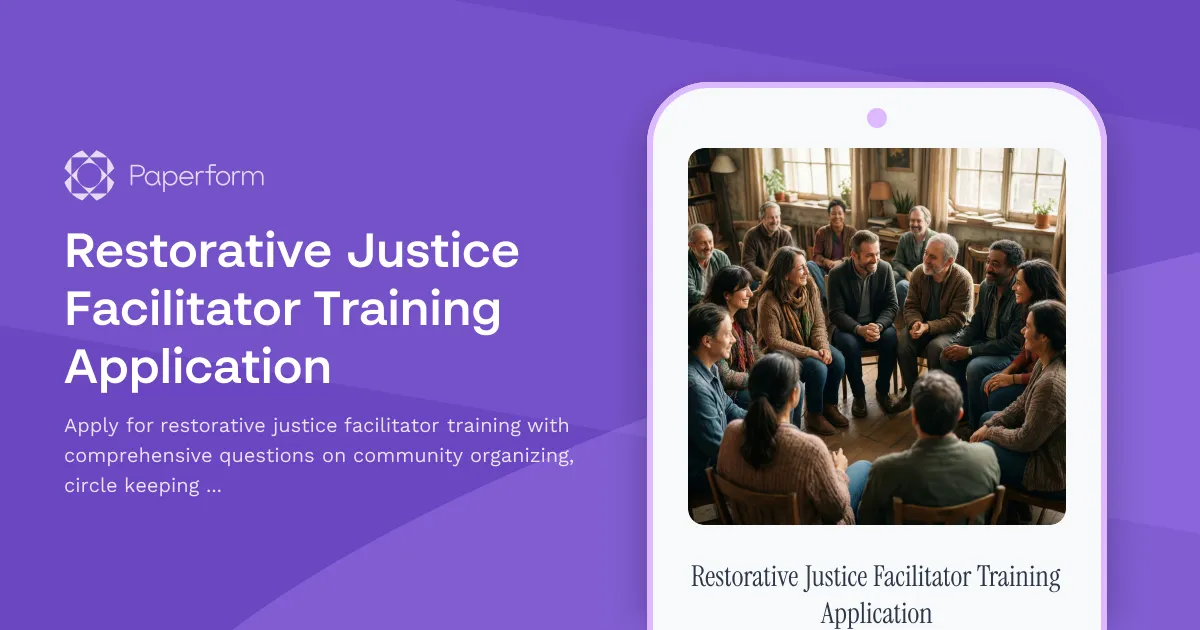
Transform Conflict into Connection: Apply for Restorative Justice Facilitator Training
Restorative justice is reshaping how communities approach conflict, healing, and accountability. Whether you're a social worker, educator, community organizer, nonprofit leader, or justice reform advocate, becoming a certified restorative justice facilitator opens doors to meaningful work that repairs harm and builds stronger communities.
This Restorative Justice Facilitator Training Application template is designed for organizations offering comprehensive training programs in restorative practices, circle keeping, and community-based conflict resolution. Built with Paperform, this application helps you identify candidates who bring the right combination of lived experience, community connection, trauma awareness, and commitment to transformative justice.
Why Use Paperform for Your Restorative Justice Program Applications?
Training restorative justice facilitators isn't just about teaching techniques—it's about selecting individuals who understand community dynamics, can hold space for difficult conversations, and are committed to ongoing learning and practice. This template helps you:
- Assess lived experience and community ties to ensure facilitators reflect and understand the communities they'll serve
- Evaluate circle keeping practice and facilitation readiness through scenario-based and reflective questions
- Understand trauma awareness and cultural competency to create safe, inclusive healing spaces
- Identify implementation settings where graduates will practice restorative justice (schools, courts, nonprofits, faith communities)
- Gauge commitment to ongoing mentorship and peer support essential for facilitator development
Paperform's flexible form builder lets you create an application that feels welcoming and accessible—critical when you're inviting people to share personal stories, community experiences, and their vision for justice. Use conditional logic to adapt questions based on professional background or experience level, and leverage AI-powered insights to identify themes across applicant pools.
Who Benefits from This Template?
This application template serves:
- Restorative justice training programs and institutes seeking qualified facilitator candidates
- Nonprofit organizations building internal capacity for restorative practices
- Educational institutions training teachers and administrators in circle processes
- Community-based organizations developing peer facilitators for neighborhood conflict resolution
- Juvenile justice and criminal legal reform programs training diversion and re-entry facilitators
- Faith communities preparing leaders to facilitate healing circles
- Victim services organizations training staff in restorative dialogue and conferencing
Key Features Built Into This Template
Community Organizing and Lived Experience Gather information about applicants' connection to the communities they'll serve, their organizing experience, and how their own experiences with conflict and justice inform their commitment to restorative practices.
Circle Keeping Practice Assessment Understand applicants' familiarity with circle processes, their experience (if any) facilitating or participating in circles, and their readiness to learn and practice this foundational skill.
Trauma Awareness and Cultural Competency Evaluate understanding of trauma-informed practice, cultural humility, and the ability to hold space for people with different experiences of harm, accountability, and healing.
Implementation Setting Details Learn where and how facilitators plan to apply their training—whether in schools, courts, workplaces, community centers, or other settings—so you can provide relevant examples and support.
Commitment to Mentorship and Ongoing Development Assess availability for training sessions, willingness to participate in practice circles and supervision, and commitment to continued learning as part of a facilitator cohort.
Streamline Your Selection Process with Paperform + Stepper
Once applications arrive, Stepper can help you manage the review and selection workflow:
- Route applications to program coordinators or selection committees based on region, setting, or experience level
- Send automated status updates as applications move from submitted to under review to interview scheduled
- Create tasks for follow-up interviews, reference checks, or additional documentation requests
- Track cohort composition to ensure diverse representation across backgrounds and implementation settings
- Trigger welcome sequences for accepted participants with training schedules, pre-work, and community agreements
Build Facilitators Who Build Community
Restorative justice works when facilitators bring authenticity, humility, and deep community connection to their practice. This application template helps you identify candidates who don't just want to learn techniques—they want to contribute to a movement that reimagines justice, repairs harm, and centers community healing.
Whether you're training a small cohort of peer facilitators or running a certification program that serves hundreds of schools and nonprofits, Paperform gives you the flexibility to create an application process that reflects restorative values: accessibility, respect, and shared power.
Ready to welcome your next cohort of restorative justice facilitators? Customize this template to match your program's focus—whether that's youth justice, workplace conflict, community accountability, or victim-offender dialogue—and start building a network of skilled, committed facilitators rooted in their communities.
Trusted by nonprofit training programs, social justice organizations, and community-based initiatives worldwide, Paperform is SOC2 Type II compliant and offers flexible, accessible forms that support equity-centered selection processes.



More templates like this
Participatory Budgeting Facilitator Training Application
Apply for professional training to facilitate participatory budgeting processes in your community. This program equips civic leaders with democratic engagement, conflict resolution, and municipal partnership skills.
Alternative Dispute Resolution Training Application
Apply for professional ADR training with this comprehensive application form that collects legal background, mediation experience, facilitation skills, and specialization preferences for certification programs.
Adventure Therapy Practitioner Training Application
Professional training application for adventure therapy practitioners to assess outdoor leadership credentials, mental health background, risk management qualifications, and supervision experience for program admission.
Animal-Assisted Therapy Certification Scholarship Application
A comprehensive scholarship application for aspiring animal-assisted therapy practitioners seeking certification funding, including therapy animal handling experience, special populations interest, and professional recommendations.
Animal-Assisted Therapy Handler Program Application
Apply to become a certified animal-assisted therapy handler. This comprehensive application collects information about your animal partner, therapy experience, specialization preferences, and training requirements.
Conflict Resolution Mediator Certification Application
Apply for professional mediator certification. Assessment includes dispute experience, communication skills evaluation, neutrality scenarios, and state registration requirements.
Drama Therapy Certification Program Application
Apply for accredited drama therapy certification training. Professional program for aspiring drama therapists covering theatrical arts, clinical skills, and supervised practice requirements.
Equine Assisted Learning Facilitator Training Application
Apply for professional certification training in equine assisted learning. Complete application includes horse experience assessment, educational background, and population focus areas.
Forensic Social Work Certification Scholarship Application
Apply for a specialized scholarship supporting social workers pursuing forensic certification with experience in court testimony, child welfare, or criminal justice settings.
Harm Reduction Specialist Training Application
Application for harm reduction specialist training program covering substance use knowledge, naloxone administration, syringe services, and trauma-informed care approaches.
Parent Educator Certification Training Application
A comprehensive application form for individuals seeking certification as parent educators, assessing child development knowledge, family support experience, and program readiness.
Restorative Justice Grant Application
Apply for funding to implement restorative justice programs in schools and communities, including circle training, community conferencing, and victim services integration.