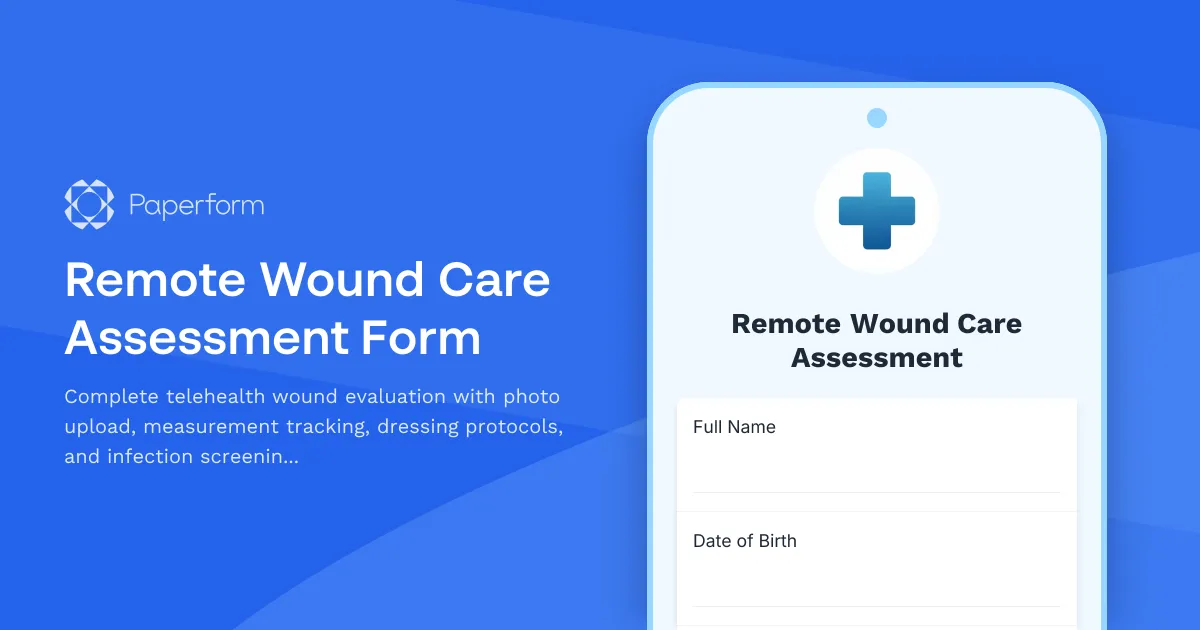
Remote Wound Care Assessment Form Template
Managing wound care remotely has become an essential part of modern healthcare delivery. This Remote Wound Care Assessment Form template empowers healthcare providers to conduct thorough virtual wound evaluations, track healing progress, and make informed treatment decisions without requiring in-person visits.
Why Remote Wound Care Assessment Matters
For patients recovering from surgery, managing chronic wounds, or dealing with injuries, frequent clinic visits can be challenging—especially for those with mobility issues, living in rural areas, or managing multiple health conditions. Remote wound care assessment bridges this gap, allowing healthcare providers to monitor wounds effectively while patients remain comfortable at home.
This telehealth approach reduces the burden on both patients and healthcare systems. Patients save time and travel costs, while providers can assess more patients efficiently and intervene quickly when complications arise. Regular remote monitoring also improves adherence to care plans and catches potential infections early, when they're most treatable.
Who Benefits From This Telehealth Form
This remote wound care assessment template is designed for:
- Home health agencies conducting regular wound checks for homebound patients
- Wound care clinics offering virtual follow-up appointments between in-person visits
- Post-surgical care teams monitoring incision sites during recovery
- Telehealth providers managing chronic wound conditions like diabetic ulcers or pressure sores
- Primary care practices triaging wound concerns before determining if an office visit is necessary
- Long-term care facilities coordinating wound care with consulting providers remotely
Healthcare professionals including nurses, nurse practitioners, physician assistants, and physicians across various specialties use these assessments to maintain continuity of care and ensure optimal healing outcomes.
What Makes This Wound Assessment Form Effective
This template captures all the clinical information needed for comprehensive remote wound evaluation:
Visual Documentation: High-quality photo upload fields allow patients or caregivers to submit clear images of the wound from multiple angles, providing crucial visual context that guides clinical decision-making.
Precise Measurement Tracking: Structured fields for documenting wound dimensions (length, width, depth), undermining, and wound bed characteristics create a standardized record that makes it easy to track healing progress over time.
Infection Screening Protocols: A systematic checklist covers key infection indicators including increased pain, redness, warmth, swelling, purulent drainage, and systemic symptoms like fever—enabling early detection and intervention.
Dressing and Treatment History: Documentation of current dressing types, change frequency, and adherence helps providers adjust treatment plans and identify barriers to proper wound care.
Pain and Function Assessment: Understanding how the wound impacts daily activities and pain levels provides important context for the overall healing trajectory and patient quality of life.
How Paperform Enhances Remote Wound Care
Built on Paperform's flexible platform, this telehealth assessment form offers capabilities that streamline remote wound management:
Professional, Patient-Friendly Design: The form uses clear language and intuitive layout that makes it easy for patients or caregivers to complete accurately, even with limited medical knowledge. Conditional logic shows only relevant follow-up questions based on previous answers.
Secure Image Upload: Multiple image upload fields with clear instructions help patients capture useful photos for clinical assessment, all transmitted securely and attached directly to the patient's submission.
Mobile-First Experience: Most patients will complete this assessment from their smartphones, so the form is optimized for mobile devices—making it simple to take photos and upload them in one seamless workflow.
HIPAA-Friendly Infrastructure: While Paperform itself is not HIPAA compliant, the platform offers SOC 2 Type II compliance and strong security foundations that many healthcare organizations build upon with additional safeguards to meet their compliance needs.
Streamline Your Workflow with Automation
Connect this wound assessment form to your healthcare workflow using Stepper (stepper.io), Paperform's AI-native workflow automation platform, or existing integrations:
- Automatically route urgent cases flagged with infection symptoms directly to on-call providers via email or Slack alerts
- Create follow-up tasks in your practice management system when wound measurements indicate deteriorating conditions
- Populate EHR records by pushing submission data into your electronic health record system through API integrations
- Schedule follow-up assessments automatically based on healing progress or care protocols
- Generate provider reports that summarize wound status across multiple patients for efficient caseload management
This automation reduces administrative burden on clinical staff and ensures timely responses to patient-submitted assessments.
Customization for Your Practice Needs
Every wound care practice has unique protocols and documentation requirements. This template provides a solid foundation that you can customize:
- Add specialty-specific assessment scales like the Braden Scale for pressure injury risk or Wagner classification for diabetic foot ulcers
- Include your organization's branding, logo, and patient education resources
- Adjust infection screening criteria based on your clinical protocols and patient populations
- Create custom success pages with next-step instructions tailored to different wound types or severity levels
- Add calculation logic to auto-score wound healing indicators based on clinical parameters
The doc-style editor makes these customizations straightforward—no coding required.
From Assessment to Action
Remote wound care assessment is most effective when it's part of a complete telehealth workflow. After a patient submits their assessment:
- Clinical Review: Providers receive the submission with all photos and measurements in an organized format
- Treatment Adjustment: Based on the assessment, update dressing protocols or medication orders
- Patient Communication: Send personalized care instructions through automated emails or schedule a video consultation if needed
- Documentation: Export data to your medical records system for complete documentation
- Outcome Tracking: Build a longitudinal record that shows wound healing trends over time
This systematic approach improves patient outcomes while maintaining the documentation standards required in healthcare settings.
Real-World Impact for Patients and Providers
Healthcare organizations using remote wound assessment forms report significant benefits:
- Reduced readmissions through earlier detection of complications
- Improved patient satisfaction by minimizing unnecessary clinic visits
- Better resource allocation by triaging which patients need in-person care
- Enhanced care coordination between home health, primary care, and specialty providers
- Stronger documentation supporting medical necessity and quality metrics
For patients, the convenience of submitting assessments from home increases engagement with their care plan and provides peace of mind between appointments.
Getting Started with Remote Wound Care
This template is ready to use out of the box, but consider these best practices for implementation:
- Train patients and caregivers on proper photo techniques (adequate lighting, appropriate distance, multiple angles)
- Establish clear protocols for how quickly providers will review submissions and respond
- Set expectations about which situations require immediate in-person care vs. remote management
- Create reference materials showing examples of proper wound measurements and dressing techniques
- Build feedback loops to continuously improve the form based on provider and patient experience
Part of Your Telehealth Toolkit
Remote wound care assessment represents just one way healthcare providers are leveraging digital tools to deliver patient-centered care. Whether you're building a comprehensive telehealth practice or adding virtual visits to complement in-person care, Paperform provides the flexibility and reliability you need.
With over 500,000 teams worldwide trusting Paperform for critical workflows, SOC 2 Type II compliance, and purpose-built features for healthcare teams, this platform supports your mission to provide excellent patient care—wherever your patients are.
Ready to modernize your wound care monitoring? Start with this template and customize it to match your clinical protocols and patient population. The result is a streamlined telehealth assessment that improves outcomes, reduces costs, and keeps patients connected to the care they need.



More templates like this
Remote ALS Monitoring & Functional Assessment Form
A comprehensive telehealth form for monitoring ALS progression, assessing functional status, respiratory function, nutritional needs, and assistive technology requirements for remote patient care.
Virtual Prenatal Care Visit Form
A comprehensive telehealth form for virtual prenatal appointments with gestational age calculator, symptom tracking, ultrasound image uploads, and high-risk pregnancy screening to support expectant mothers remotely.
Achondroplasia Growth Monitoring & Care Coordination Form
A comprehensive telehealth form for monitoring growth patterns, assessing treatment options, screening for complications, and coordinating psychosocial support for patients with achondroplasia.
Cystic Fibrosis Pulmonary Exacerbation Assessment Form
A comprehensive telehealth assessment form for monitoring CF pulmonary exacerbations, including sputum culture results, airway clearance adherence, CFTR modulator response, and nutritional status evaluation.
Online Infectious Disease Consultation Form
A comprehensive telehealth intake form for infectious disease consultations, capturing exposure history, travel documentation, vaccination records, and contact tracing information for virtual healthcare visits.
Pediatric Telehealth Visit Form
A comprehensive pediatric telehealth intake form with parent/guardian consent, child medical history, symptoms assessment, and medication authorization for virtual healthcare visits.
Remote Geriatric Assessment Form
Comprehensive telehealth assessment form for elderly patients including cognitive screening, fall risk evaluation, medication review, and care planning.
Remote Nephrology Visit Form
A comprehensive telehealth form for nephrology appointments with dialysis access assessment, fluid and dietary tracking, and transplant evaluation referral capabilities.
Remote Palliative Care Consultation Form
A comprehensive telehealth form for remote palliative care consultations, including symptom assessment, quality of life evaluation, advance directive collection, and family meeting coordination.
Telehealth Osteoporosis Management Form
A comprehensive telehealth form for osteoporosis management including DEXA scan uploads, fracture risk assessment, nutritional tracking, and fall prevention evaluation.
Traumatic Brain Injury Follow-Up Form
A comprehensive TBI follow-up assessment for virtual healthcare visits, tracking post-concussion symptoms, cognitive function, headache patterns, and vocational rehabilitation needs.
Adult Congenital Heart Disease Telehealth Follow-Up Form
A comprehensive telehealth form for adult patients with congenital heart disease, including echocardiogram results upload, arrhythmia monitoring, exercise capacity assessment, and pregnancy counseling for women of childbearing age.