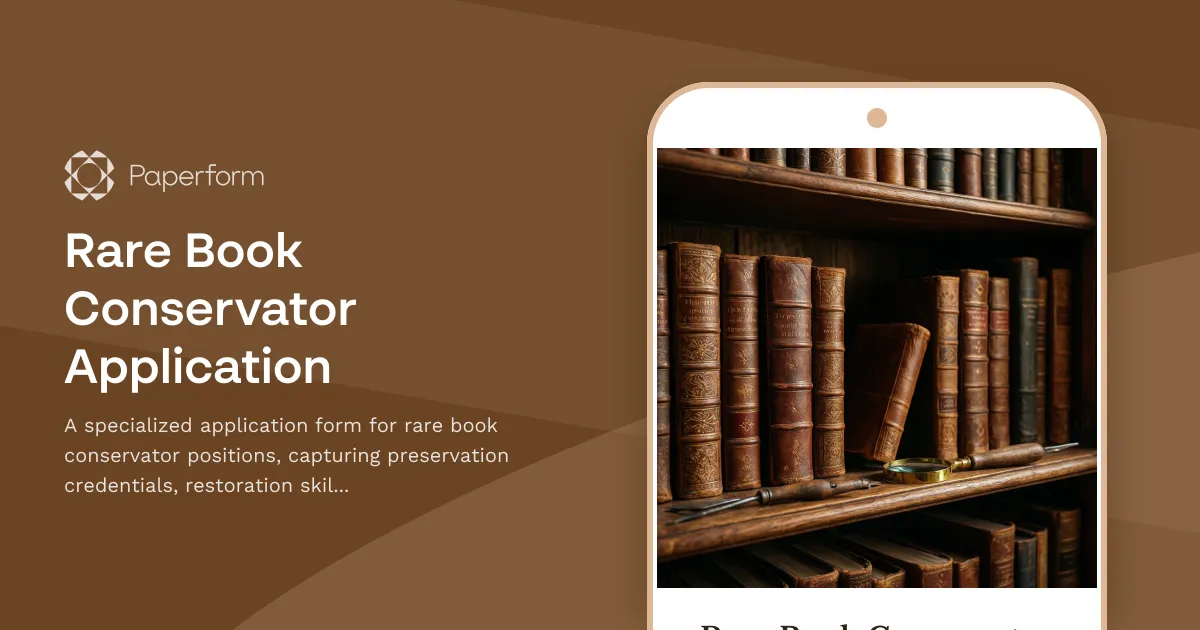
Apply for a Rare Book Conservator Position with a Professional Application Form
Finding the right rare book conservator requires assessing a unique blend of technical expertise, artistic sensibility, and deep knowledge of historical materials. This Rare Book Conservator Application template is designed specifically for libraries, museums, universities, archives, and private collections seeking skilled professionals who can preserve and restore invaluable literary treasures.
Whether you're a research library building your conservation team, a museum expanding your rare books department, or a private collection seeking specialized expertise, this application form captures everything you need to evaluate candidates thoroughly—from formal preservation training and hands-on restoration experience to climate control knowledge and collection appraisal capabilities.
Why specialized rare book conservator applications matter
Rare book conservation is a highly specialized field that sits at the intersection of art, science, and history. Unlike general job applications, conservator positions require detailed assessment of:
- Formal preservation training and certifications from recognized institutions
- Technical proficiency in paper repair, binding restoration, and material analysis
- Hands-on experience with historical binding structures, vellum, hand-made papers, and specialized techniques
- Scientific knowledge of climate control, pH testing, and environmental monitoring
- Collection management skills including appraisal, condition reporting, and treatment prioritization
A well-structured application form ensures you collect this specialized information upfront, helping you identify candidates with the right combination of training, experience, and passion for preserving cultural heritage.
What makes this template ideal for archives, libraries, and museums
This Rare Book Conservator Application template has been thoughtfully designed for cultural institutions and collecting organizations:
For research libraries and universities, the form captures academic credentials, experience with specific collection types (medieval manuscripts, incunabula, modern fine press), and familiarity with library conservation standards.
For museums and galleries, it assesses exhibition preparation skills, preventive conservation knowledge, and experience collaborating with curators and collection managers.
For archives and historical societies, it evaluates proficiency with varied materials—from vellum and parchment to 20th-century materials—and understanding of archival best practices.
For private collectors and auction houses, the form includes appraisal experience, authentication capabilities, and client communication skills.
The template uses conditional logic to reveal relevant follow-up questions based on specializations, making the application thorough yet streamlined for each candidate's unique background.
Streamline your conservation hiring with Paperform
Built on Paperform's flexible platform, this template gives cultural institutions and conservation studios a professional, branded application experience that reflects the quality and care you bring to preserving rare materials.
On-brand, professional presentation: Customize fonts, colors, and imagery to match your institution's visual identity. Embed the form directly into your careers page or host it on a custom domain for a seamless candidate experience.
File uploads for portfolios and credentials: Candidates can easily upload before-and-after restoration photos, treatment reports, certifications, and letters of recommendation—all organized and attached to their submission.
Conditional logic for relevant questions: The form adapts based on experience level and specializations, showing conservation technique questions to experienced conservators while streamlining the experience for early-career applicants.
Instant notifications and automated workflows: Receive email alerts when promising candidates apply, and use Stepper (stepper.io) to automate your review process—route applications to department heads, schedule candidate presentations, and update your applicant tracking system automatically.
Integration with your hiring tools: Connect seamlessly to your ATS, send applications to Google Sheets for review committees, or trigger Slack notifications to keep your team informed of new submissions.
Extend your hiring workflow with Stepper automation
Once you receive applications, Stepper can help you manage the entire conservation hiring process without manual data entry:
- Automatically score applications based on required credentials and experience thresholds
- Route applications to different reviewers based on specialization (binding vs. paper conservation)
- Send personalized acknowledgment emails with information about your institution and next steps
- Schedule portfolio reviews and practical assessments with qualified candidates
- Update your HR system and keep stakeholders informed throughout the interview process
For institutions hiring conservators across multiple departments or locations, Stepper ensures consistency and saves your team valuable time that can be better spent reviewing candidate work samples and conducting interviews.
Designed for the rare book conservation community
This template reflects the specialized vocabulary, techniques, and standards recognized within the book conservation profession. From questions about Japanese paper repair techniques and wheat starch paste application to binding structure identification and environmental monitoring protocols, every field is crafted with input from the conservation community.
Whether you're hiring your first conservator or expanding an established conservation lab, this application form helps you identify candidates who combine technical mastery, historical knowledge, ethical practice, and the patience and precision required to preserve our shared cultural heritage for future generations.
Get started with your rare book conservator applications today
With Paperform's SOC 2 Type II compliance and secure file handling, you can trust that candidate information and portfolio materials are protected throughout your hiring process. The platform is trusted by over 500,000 organizations worldwide, including museums, libraries, universities, and cultural institutions.
Start collecting professional rare book conservator applications today with this specialized template—customize it to your institution's needs, embed it on your website, and begin building your conservation team with confidence.



More templates like this
Oral History Project Grant Application
Apply for funding to document and preserve community stories through oral history interviews with professional archival standards and public access platforms.
Rare Book Conservator Skills Assessment
A comprehensive skills test evaluating competency in paper repair, binding restoration, and environmental control for rare book conservation professionals.

Cultural Heritage Preservation Grant Application
Apply for grant funding to preserve, digitize, and make accessible important cultural heritage materials and artifacts through professional conservation methods.
Community Archive Volunteer Application
A comprehensive application for volunteers interested in preserving community history through oral history recording, document preservation, and collective memory stewardship.
Museum Exhibit Permit Application
Apply for a museum exhibit permit for special exhibitions. Cover environmental controls, security systems, insurance, artifact handling protocols, and educational programming requirements.
Museum Docent Application Form
A comprehensive application form for prospective museum docents to assess their art history knowledge, public speaking abilities, language skills, and availability for volunteer tour guide positions.
Art Gallery Internship Application Form
A comprehensive application form for art gallery internship positions, evaluating exhibition installation experience, artist liaison capabilities, art handling certification, and collection management software proficiency.
Artist Residency Application Form
A comprehensive application form for artist residency programs. Collect artist statements, project proposals, portfolio images, budget requirements, and timeline details for creative residencies and fellowship programs.
Library Circulation Assistant Application Form
A comprehensive application form for library circulation assistant positions that evaluates customer service skills, shelving capabilities, cataloging knowledge, and technical aptitude.
Museum Collections Manager Application Form
A comprehensive application form for museum collections manager positions, evaluating candidates' conservation training, cataloging expertise, environmental monitoring knowledge, grant writing skills, and artifact handling certifications.
Museum Curation Internship Application Form
A comprehensive application form for museum curation internship programs. Collect information about art history education, exhibition experience, collection interests, and academic references from aspiring curators.
Museum Curator Credential Verification Form
A comprehensive credential verification form for museum curators to validate advanced degrees, specialized certifications, collection management training, and professional memberships.