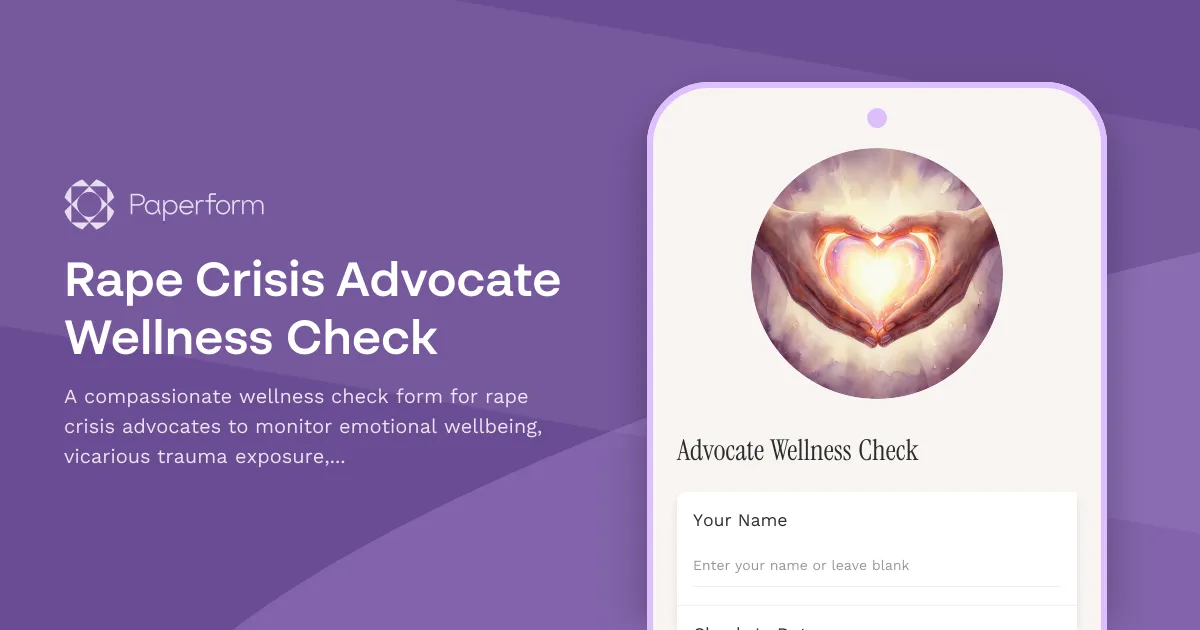
Supporting Those Who Support Survivors: Rape Crisis Advocate Wellness Checks
Rape crisis advocates provide life-changing support to survivors during their most vulnerable moments—answering hotline calls in the middle of the night, accompanying survivors through invasive medical exams and intimidating court proceedings, and holding space for deeply traumatic stories. This essential work takes an emotional toll that organizations must actively monitor and address.
Regular wellness checks aren't just a "nice to have"—they're a critical safeguard against burnout, vicarious trauma, and compassion fatigue among your advocacy team. This Rape Crisis Advocate Wellness Check template helps crisis centers, sexual assault service agencies, and victim advocacy programs create a structured, confidential way for advocates to report their emotional state, identify warning signs of trauma exposure, and access the support they need to continue this vital work sustainably.
Why Rape Crisis Centers Need Structured Wellness Monitoring
Unlike many helping professions, rape crisis advocates face unique stressors that compound quickly:
- Trauma saturation from hearing multiple survivor stories in short timeframes, often with graphic details of violence
- Secondary traumatic stress from court accompaniment where advocates witness re-traumatization during cross-examination
- Hotline coverage stress with unpredictable hours, crisis de-escalation, and the weight of being someone's lifeline
- Systemic frustration when survivors face victim-blaming, case dismissals, or inadequate legal protections
- Isolation and confidentiality boundaries that prevent advocates from processing cases with friends or family
Without regular check-ins, these stressors accumulate silently until advocates experience sudden burnout, compassion fatigue, or vicarious PTSD symptoms. A confidential wellness check form creates a low-barrier way for advocates to self-report before reaching crisis point—and gives leadership the data needed to allocate counseling resources, adjust workloads, and intervene early.
Who Benefits from This Template
This template serves multiple stakeholders in the sexual assault response ecosystem:
Rape crisis centers and sexual assault service organizations can implement regular (weekly, bi-weekly, or monthly) wellness checks as part of their advocate support infrastructure, demonstrating duty of care while gathering aggregate data on team wellbeing trends.
Advocacy program directors and clinical supervisors use responses to identify advocates who may need immediate debriefing, additional supervision, reduced caseloads, or referrals to vicarious trauma counseling before symptoms escalate.
Hospital-based SANE/SART coordinators can adapt this template for forensic nurse examiners and sexual assault response team members who face similar trauma exposure during evidence collection and immediate crisis response.
Court advocacy programs and legal aid organizations working with sexual violence survivors can track the specific stressors of accompanying clients through criminal and civil proceedings, including triggers from cross-examination and secondary victimization.
Victim services coordinators in prosecutor's offices, law enforcement victim assistance units, and community-based advocacy programs can ensure their teams receive appropriate support regardless of setting.
What This Wellness Check Form Captures
This template goes beyond generic "How are you feeling?" questions to address the specific dimensions of rape crisis advocacy work:
Hotline and crisis response exposure: Assesses the volume and intensity of recent crisis calls, overnight shifts, and acute safety interventions that may indicate heightened stress periods.
Survivor story trauma: Confidentially tracks exposure to particularly disturbing narratives, including cases involving children, intimate partner sexual violence, or human trafficking that may carry higher vicarious trauma risk.
Court accompaniment stress: Monitors the emotional impact of trial preparation, testimony observation, and witnessing survivors being disbelieved or blamed—a major source of moral injury for advocates.
Vicarious trauma symptoms: Screens for warning signs including intrusive thoughts, hypervigilance, emotional numbing, disrupted sleep, changes in worldview, and relationship impacts that signal trauma exposure.
Self-care and coping: Evaluates whether advocates are maintaining healthy boundaries, accessing clinical supervision, engaging in restorative activities, and utilizing available support resources.
Support needs and requests: Provides advocates a confidential channel to request debriefing sessions, counseling referrals, schedule adjustments, additional training, or other accommodations without having to initiate a difficult conversation.
The form balances standardized screening with open-ended reflection space, recognizing that advocates need both structure and freedom to name what they're experiencing.
How Paperform Supports Trauma-Informed Wellness Monitoring
Paperform's flexible, compassionate design makes it ideal for sensitive wellness checks that require trust and psychological safety:
The document-style editor lets you craft forms that feel warm and supportive rather than clinical or bureaucratic—critical when asking people to be vulnerable about their mental health. You can intersperse reassuring text, normalize vicarious trauma, and use gentle language that honors advocates' experiences.
Conditional logic allows the form to adapt based on responses. If an advocate indicates high distress, elevated vicarious trauma symptoms, or crisis-level burnout, the form can automatically branch to immediate support resources, display crisis hotline numbers, or route their submission as urgent to clinical supervisors—ensuring timely intervention.
Papersign integration (papersign.com) can be valuable if your wellness protocol includes mutual care agreements, voluntary safety plans, or acknowledgments of available resources that require documentation for organizational compliance or insurance purposes.
Stepper workflows (stepper.io) transform wellness check submissions into coordinated care responses. When an advocate flags concerning symptoms, Stepper can automatically notify clinical supervisors, schedule a debriefing session, send counseling resource lists, update caseload tracking, or create follow-up reminders—ensuring no advocate falls through the cracks even when leadership is managing multiple priorities.
Anonymous response options combined with Paperform's password protection and conditional notifications mean advocates can choose their comfort level with identification while ensuring high-risk responses still trigger appropriate support, maintaining both privacy and safety.
Best Practices for Implementing Advocate Wellness Checks
Establish a consistent cadence. Weekly checks during high-stress periods (like Sexual Assault Awareness Month when media coverage spikes) and bi-weekly or monthly checks during baseline periods help normalize wellness monitoring and catch issues early.
Make it genuinely confidential with clear protocols. Advocates must trust that responses won't be used punitively, shared casually, or impact job security. Clearly communicate who reviews responses, under what circumstances information is escalated, and how aggregate data is used for program improvement.
Pair with accessible support resources. A wellness check is only effective if advocates can actually access counseling, supervision, and respite when they need it. Budget for external trauma therapists with relevant expertise, peer support circles, and flexible scheduling that honors the realities of crisis work.
Normalize vicarious trauma as an occupational hazard, not personal weakness. Use the wellness check and surrounding communications to educate that trauma exposure is an expected consequence of this work, frame self-care as professional competence, and celebrate advocates who identify their limits as demonstrating wisdom.
Use aggregate data to drive systemic change. If wellness checks reveal that court accompaniment consistently triggers the highest distress, that's a signal to build stronger partnerships with prosecutors, increase co-accompaniment models, or develop better decompression protocols—not just to tell individual advocates to "practice self-care harder."
Adapting This Template for Your Organization
While designed specifically for rape crisis advocates, this template adapts easily to other high-trauma advocacy and service roles:
- Domestic violence advocates can adjust questions to address shelter-based crisis intervention, protection order accompaniment, and lethality assessment stress.
- Child advocacy center staff can modify for multidisciplinary team dynamics, forensic interview observation, and mandated reporting complexities.
- Human trafficking case managers can incorporate questions about rescue operations, immigration advocacy, and long-term client relationships that create attachment and loss.
- Crisis intervention specialists in any high-acuity setting can customize to reflect their specific trauma exposure patterns and support infrastructure.
Paperform's intuitive editor makes these adaptations simple—you can duplicate the template, adjust terminology, add organization-specific resources, and rebrand to match your visual identity in minutes, not hours.
Why This Matters: The Retention and Quality Connection
Organizations that prioritize advocate wellness don't just do the right thing—they also deliver better outcomes. Advocates who receive appropriate support for vicarious trauma provide more consistent, present, trauma-informed services to survivors. They're less likely to experience burnout-driven turnover that disrupts continuity of care and strains already-limited advocacy capacity.
Regular wellness checks signal to your team that their emotional wellbeing matters as much as their service statistics—building a culture where seeking support is normalized, boundaries are respected, and longevity in this work becomes sustainable rather than exceptional.
Paperform makes implementing this level of care straightforward, affordable, and scalable for organizations of any size. Whether you're a small grassroots collective or a multi-site service agency, you can launch a professional wellness monitoring system today without IT support or enterprise software budgets. Trusted by over 500K teams worldwide and SOC2 Type II & GDPR compliant, Paperform provides the security and reliability that sensitive wellness data requires.
Your advocates show up for survivors in their darkest moments. Show up for your advocates with structured, compassionate wellness support that acknowledges the weight of this work and provides real pathways to sustainability and healing.


More templates like this
Perinatal Loss Doula Wellness Check Form
A compassionate wellness check form for perinatal loss doulas providing stillbirth support, NICU vigil care, memory photography, and bereaved family follow-up services.
Community Mental Health Worker Wellness Check
A comprehensive wellness check form for community mental health workers to assess client wellbeing, safety risks, medication compliance, and caseload concerns with structured risk assessment protocols.
Crisis Hotline Counselor Wellness Check
A comprehensive wellness assessment for crisis hotline counselors addressing call volume stress, vicarious trauma, boundary maintenance, and supervision needs to support mental health professionals in high-stress roles.

Crisis Intervention Specialist Supervisor Wellness Check
A comprehensive wellness check form for crisis intervention supervisors to assess staff trauma exposure, facilitate critical incident debriefing, and monitor supervisor wellbeing.
Domestic Violence Legal Advocate Wellness Check Form
A confidential wellness check form for domestic violence legal advocates to monitor their well-being, manage vicarious trauma, and receive appropriate supervision and support.
Domestic Violence Shelter Resident Wellness Check
A compassionate wellness check form for domestic violence shelter residents to assess safety, wellbeing, trauma symptoms, children's needs, and connection to support services.
Mass Violence Response Counselor Wellness Check
A comprehensive wellness assessment for crisis counselors and mental health professionals responding to mass violence events, focusing on community trauma healing, media exposure, anniversary stress, and cumulative disaster fatigue.
Neonatal Bereavement Follow-Up Wellness Check
A compassionate follow-up form for neonatal bereavement support, enabling nurses to conduct wellness checks, coordinate grief support services, and provide ongoing care for families experiencing pregnancy loss.
Psychiatric Crisis Clinician Wellness Check
A confidential wellness check form designed to support psychiatric crisis assessment clinicians managing telephonic evaluations, disposition pressures, and call volume fatigue.
Refugee Trauma Therapist Wellness Check
A comprehensive wellness and support form designed for therapists working with refugee trauma survivors, addressing cultural competence strain, vicarious trauma, and the unique challenges of interpreter-mediated sessions.
Adventure Therapy Program Emergency Contact Form
Comprehensive emergency contact and participant information form for adventure therapy programs, capturing outdoor experience, medical clearance, risk assessment, and group dynamics history for challenge-based therapeutic activities.
Chronic Illness Support Group Emergency Contact Form
A comprehensive emergency contact form for chronic illness support groups that captures critical medical information, treatment status, disability accommodations, and specialist coordination details to ensure proper care during emergencies.