Keep Your Manufacturing QC Process Organized and Compliant
Managing retention samples is a critical part of quality control in manufacturing—but tracking product batches, storage locations, retention periods, and disposal dates across spreadsheets and paper logs can quickly become overwhelming. This Quality Control Retention Sample Management Form gives manufacturers, quality assurance teams, and production managers a centralized, digital system for logging and tracking every retention sample with full traceability.
Built for Manufacturing QC Workflows
Whether you're producing food and beverage, pharmaceuticals, cosmetics, chemicals, or consumer goods, this template captures all the essential details for compliant retention sample management: batch numbers, production dates, product specifications, storage conditions, required retention periods, and scheduled disposal dates. Conditional logic ensures that only relevant fields appear based on sample type and regulatory requirements, while calculation fields automatically determine disposal dates based on retention rules—no manual calendar counting required.
By digitizing retention sample intake with Paperform, you replace error-prone manual processes with a clean, auditable record that's accessible to your entire QC team. Every submission is timestamped, searchable, and can be exported or synced to your quality management system for centralized oversight.
Automate Retention Sample Workflows with Stepper
Once a retention sample is logged, you can use Stepper to automate the rest of the workflow. Trigger notifications to warehouse or lab teams when samples are ready for storage, send automatic reminders as disposal dates approach, update inventory management systems, and route approval requests for early disposal or extended retention. By connecting Paperform submissions to your broader QC and compliance stack, Stepper ensures nothing falls through the cracks and every sample is handled according to your SOPs.
Professional, Compliant, and Ready to Deploy
This template is designed to meet the rigorous documentation standards of manufacturing environments. It's fully customizable to match your industry regulations (FDA, ISO, GMP, etc.), branding, and internal workflows—while remaining simple enough for production line supervisors and QC technicians to use every day. Trusted by manufacturers worldwide, Paperform is SOC 2 Type II compliant and built to support the operational backbone of quality-driven teams.



More templates like this

Production Material Traceability Form
Track raw materials from supplier to customer with comprehensive batch tracking, lot numbers, and recall-ready documentation for manufacturing quality control and compliance.
Factory Quality Control Sampling Plan Change Request Form
Request changes to quality control sampling plans with statistical validation, inspection station reconfiguration details, training requirements, and manager approval workflow.
Finished Goods Inspection Report
A comprehensive quality control form for final product inspection, covering visual checks, dimensional measurements, functional testing, and packaging compliance before shipment.
Layered Process Audit (LPA) Quality Assurance Form
A comprehensive quality assurance form for conducting layered process audits across manufacturing operations with verification questions, sample frequency tracking, audit layer designation, and non-conformance documentation.
Lock-Out Tag-Out (LOTO) Procedure Form
A comprehensive safety form for documenting equipment lock-out tag-out procedures, energy isolation points, and authorized personnel to ensure safe maintenance and servicing operations.
Manufacturing Carbon Footprint Tracking Form
Track and calculate your manufacturing facility's carbon footprint with detailed reporting on energy consumption, material sourcing, waste generation, and emissions data.
Manufacturing Cycle Time Analysis Form
A comprehensive cycle time analysis form for manufacturing teams to document process steps, identify waste, measure value-added time, and set improvement targets to optimize production efficiency.
Manufacturing Equipment Effectiveness Tracker
Track and calculate Overall Equipment Effectiveness (OEE) with automated calculations for availability, performance, and quality rates to optimize production efficiency.
Manufacturing Equipment Maintenance Checklist
A comprehensive preventive maintenance checklist for manufacturing equipment, covering inspection tasks, lubrication points, safety checks, and technician documentation.
Manufacturing Equipment Validation Protocol Form
A comprehensive validation protocol form for manufacturing equipment covering installation qualification (IQ), operational qualification (OQ), performance qualification (PQ), and approval workflows to ensure equipment meets regulatory and operational standards.
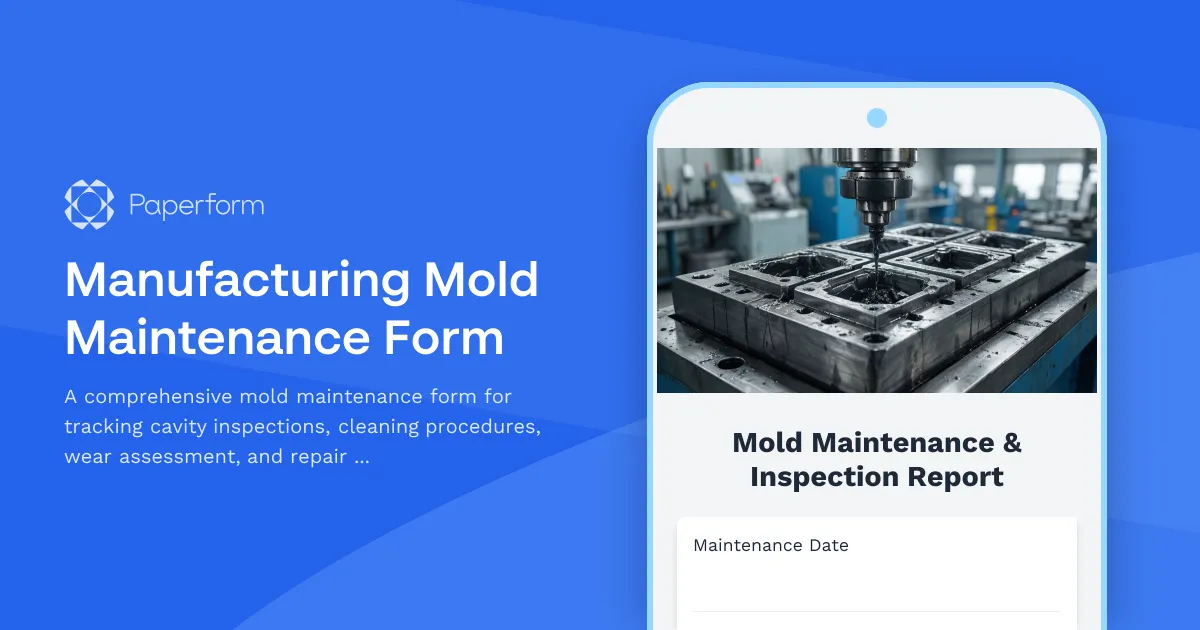
Manufacturing Mold Maintenance Form
A comprehensive mold maintenance form for tracking cavity inspections, cleaning procedures, wear assessment, and repair documentation to ensure consistent production quality.
Manufacturing Process Flow Documentation Form
Document manufacturing processes with input materials, transformation steps, quality control parameters, and output specifications for production optimization and compliance.