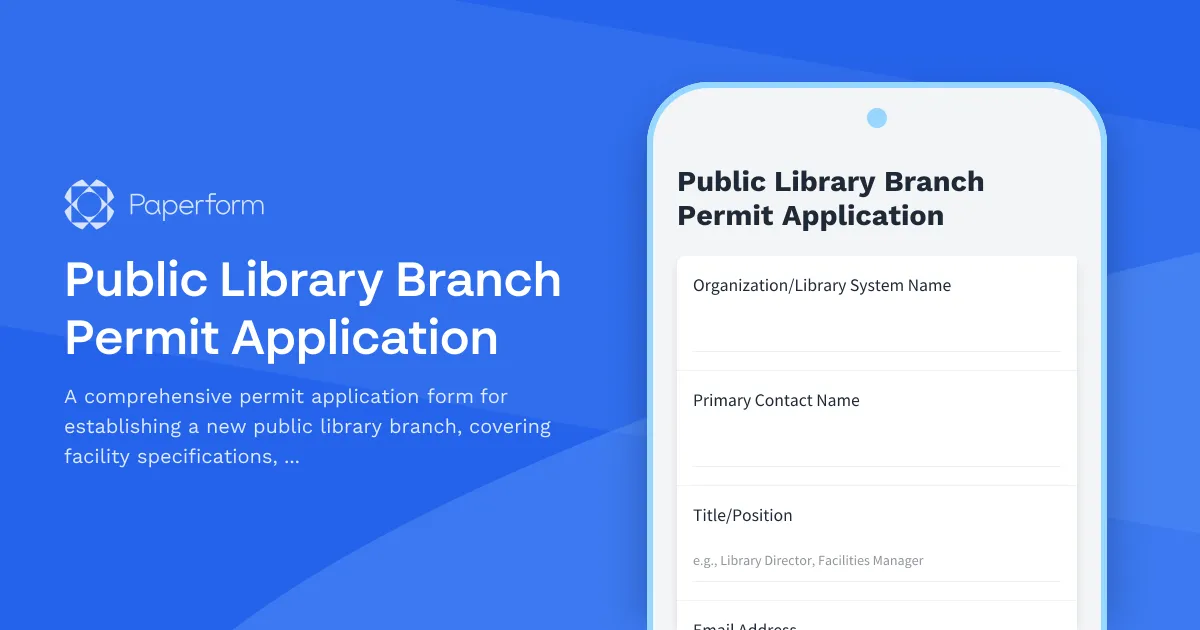
Streamline Your Public Library Branch Permit Application with Paperform
Opening a new public library branch is a significant undertaking that requires careful planning, documentation, and regulatory compliance. Whether you're a municipal government, library district, or nonprofit organization expanding community access to information and resources, securing the proper permits and approvals is essential. This Public Library Branch Permit Application template helps libraries, city planners, and community development teams submit comprehensive, professional applications that address all regulatory requirements—from collection capacity and technology infrastructure to ADA accessibility and operating parameters.
Why Use This Library Permit Application Template?
Traditional permit processes often involve stacks of paperwork, multiple department reviews, and lengthy approval timelines. This template consolidates all essential information into a single, structured application that:
- Captures comprehensive facility details including square footage, collection size projections, computer stations, meeting room capacity, and children's area specifications
- Documents ADA compliance measures to ensure your new branch serves all community members equitably
- Defines operational parameters such as proposed operating hours, staffing levels, and service offerings
- Streamlines the review process by organizing information logically for planning departments, building inspectors, and library boards
- Creates a permanent digital record of your application for future reference and reporting
For library directors, facilities managers, and municipal administrators, having a clear, complete application from the start accelerates approvals and demonstrates professionalism and thorough planning.
Who Benefits From This Template?
This public library permit application is designed for:
- Public library systems expanding their network of community branches
- Municipal governments establishing new library facilities as part of community development initiatives
- Library directors and operations managers coordinating facility expansion projects
- Nonprofit organizations creating community-access library spaces
- City planning and zoning departments that need to collect standardized information for permit reviews
- Architects and facility consultants working with library clients on new branch development
Whether you're converting an existing building, constructing purpose-built library space, or establishing a library within a shared community facility, this template ensures you provide all the information decision-makers need.
Key Features of This Library Branch Permit Application
This template goes beyond basic contact information to capture the full scope of what makes a library branch functional and compliant:
Facility Specifications: Document total square footage, designated areas for different functions (adult collections, children's area, teen space, meeting rooms), and how the layout supports library operations.
Collection Capacity: Specify projected collection size across different formats (books, audiovisual materials, digital resources), shelving capacity, and plans for collection growth over time.
Technology Infrastructure: Detail the number of public computer workstations, Wi-Fi capacity, adaptive technology for patrons with disabilities, and other digital resources that support modern library services.
Meeting and Program Space: Describe meeting rooms, study rooms, multipurpose areas, and community programming spaces with capacity specifications and intended uses.
Children's Services Area: Outline dedicated children's spaces, age-appropriate furniture, early literacy stations, and design features that create safe, engaging environments for young library users.
ADA Compliance: Document accessibility features including ramps, elevators, accessible restrooms, assistive listening devices, adjustable-height service desks, accessible computer stations, and other accommodations ensuring full access for patrons with disabilities.
Operating Hours and Staffing: Propose operating schedules, staffing levels, and service model (full-service branch, express location, technology center, etc.).
Security and Safety: Address security systems, emergency exits, fire suppression, and other safety measures appropriate for public facilities serving diverse age groups.
How Paperform Enhances Your Permit Application Process
While other form builders offer basic templates, Paperform gives library administrators and municipal teams the professional tools needed for complex regulatory applications:
Document-style editing lets you structure your application exactly as a formal permit submission should flow—with clear sections, explanatory text, required documentation uploads, and conditional questions that adapt based on facility type or services offered.
File upload fields allow applicants to attach architectural plans, site surveys, ADA compliance certifications, proof of insurance, organizational documentation, and other supporting materials directly within the application.
Conditional logic shows or hides questions based on responses—for example, if the branch will include a dedicated children's area, additional questions about child safety features and age-appropriate design appear automatically.
Calculation fields can automatically compute metrics like collection capacity per square foot, patron seating ratios, or computer access per capita based on entered values.
Professional, branded design ensures your permit application reflects the professionalism of your library system, with customizable themes, logos, and formatting that match your organization's identity.
Secure, compliant data handling with SOC 2 Type II compliance gives you confidence that sensitive organizational and facility information is protected throughout the application and review process.
Automate Workflows with Stepper
Once applications are submitted, the real work begins—routing for review, requesting additional documentation, coordinating inspections, and ultimately issuing permits. With Stepper, Paperform's AI-native workflow automation platform, you can turn each submission into a structured approval process:
- Automatically route applications to the appropriate departments (planning, zoning, building inspection, library board) based on facility type or location
- Send confirmation emails to applicants with expected timelines and next steps
- Trigger task assignments for site inspections, compliance reviews, or architectural plan assessments
- Create approval workflows where multiple stakeholders can review and sign off sequentially
- Update project management tools like Notion, Airtable, or Monday.com with application status
- Send automated reminders when additional documentation is needed or deadlines approach
This automation reduces administrative burden on both applicants and reviewers, ensuring applications move efficiently through the approval pipeline without manual tracking or follow-up emails.
Add eSignatures with Papersign
Many library branch permits require signatures from multiple parties—library directors, municipal officials, property owners, or board members. With Papersign, you can transform approved applications into formal permit agreements and collect legally binding eSignatures from all required parties. This creates a complete audit trail from initial application through final permit issuance, all connected to the original form submission.
Integrate with Your Existing Systems
Library systems and municipal governments often use specialized tools for project management, asset tracking, and public records. Paperform connects seamlessly with the platforms you already rely on:
- Send application data to Google Sheets or Airtable to create dashboards tracking all pending library branch applications
- Sync with CRMs like HubSpot or Pipedrive to manage stakeholder communications throughout the approval process
- Connect to Slack or Microsoft Teams to notify planning teams immediately when new applications arrive
- Use webhooks and integrations via Stepper, Zapier, or Make to update municipal databases, GIS systems, or public transparency portals
These integrations ensure permit data flows where it needs to go without manual data entry or risk of transcription errors.
Build Trust Through Transparency and Compliance
Public library branches serve entire communities, and the permit process should reflect the same values of transparency, accessibility, and public service that libraries embody. This template helps you:
- Demonstrate thorough planning and attention to regulatory requirements
- Show commitment to accessibility and inclusive design from the earliest planning stages
- Provide clear documentation for public meetings, board reviews, and community engagement
- Create records that support grant applications, funding requests, and public accountability
For municipal administrators and library boards, having complete, standardized applications makes reviews more efficient and decisions more defensible.
Get Started in Minutes
Whether you're opening your first branch library or expanding an established system, this template gives you a professional starting point. Simply customize the questions to match your jurisdiction's specific permit requirements, add your library system's branding, and share the form via a custom link or embed it on your planning department or library website.
With Paperform's free plan, you can start accepting applications immediately, then scale up to Essentials, Pro, or Agency+ plans as your facility development pipeline grows.
Transform Library Planning with Paperform
Public libraries are cornerstones of educated, connected communities—and opening new branches requires the same attention to detail, accessibility, and public service that defines great library systems. This permit application template, combined with Paperform's powerful automation and integration capabilities, helps library administrators, municipal planners, and community development teams bring new library facilities from concept to ribbon-cutting with less paperwork and more confidence.
Start building better library infrastructure today with Paperform—the all-in-one form builder trusted by government agencies, educational institutions, and community organizations worldwide.

More templates like this
Swimming Pool Public Facility Permit Application
Comprehensive permit application for public swimming pool facilities including lifeguard certifications, water quality protocols, chemical storage compliance, ADA accessibility, and emergency response plans.
Animal Hospital Permit Application
Apply for an animal hospital operating permit with 24-hour care capability, isolation facilities, diagnostic equipment, pharmaceutical storage, and emergency protocols.
Fairground & Carnival Permit Application
Apply for a temporary amusement permit for fairgrounds, carnivals, and traveling shows. Includes ride safety inspections, insurance verification, and site compliance requirements.
Federal Fisheries Licence Application Form
Apply for a commercial or recreational fishing licence in Canadian federal waters. Submit vessel information, fishing history, and operator qualifications for review by Fisheries and Oceans Canada (DFO).
Finnish Accessibility Compliance Declaration Form
Comprehensive accessibility compliance form for Finnish public buildings and digital services, meeting WCAG and Finnish regulatory requirements.

South Korea Educational Institution License Application
A comprehensive application form for obtaining an educational institution license in South Korea, including curriculum approval, facility requirements, and regulatory compliance documentation.
Anonymous Disability Services Discrimination Complaint Form
A confidential form for reporting disability discrimination and requesting ADA compliance review with accommodation assessment in educational institutions, workplaces, and public services.
Birthing Center Permit Application
A comprehensive permit application form for birthing centers covering facility details, delivery rooms, staff credentials, emergency protocols, and infection control compliance.
CHED College Permit Application Form
A comprehensive application form for Commission on Higher Education (CHED) college permit with sections for program offerings, faculty qualifications, and library resources documentation.
Colombian Community Action Board (JAC) Registration Form
Complete registration form for Colombian Juntas de Acción Comunal (JAC) including municipality requirements, member election documentation, and community development plan submission for DIAN and regulatory compliance.
Community Garden Plot Permit Application
Apply for a community garden plot permit. Submit your plot preferences, confirm organic growing practices, and agree to participation requirements.
Durable Medical Equipment Supplier Permit Application
Comprehensive permit application for DME suppliers covering business operations, inventory management, delivery services, equipment fitting capabilities, insurance billing, and quality assurance protocols.