Comprehensive Posterior Tibial Tendon Dysfunction Screening Made Simple
Posterior tibial tendon dysfunction (PTTD) is one of the most common causes of adult-acquired flatfoot deformity, affecting thousands of patients each year. Early detection and intervention are critical to preventing progression and avoiding surgical intervention. This Posterior Tibial Tendon Dysfunction Screening Form provides podiatrists, orthopedic specialists, and physical therapists with a structured, professional tool to assess, document, and triage patients presenting with foot and ankle pain, arch collapse, or suspected PTTD.
Why Paperform is the ideal solution for PTTD screening
Healthcare providers need assessment tools that are both clinically comprehensive and administratively efficient. This Paperform template combines detailed clinical evaluation criteria—including the single-leg heel raise test, arch collapse measurement, and orthotic assessment—with smart conditional logic that adapts the form based on patient responses. Unlike static PDFs or paper forms, Paperform allows you to collect structured data that can be instantly reviewed, shared with specialists, or integrated into your practice management system.
For podiatry clinics, sports medicine practices, and orthopedic centers, this form streamlines patient intake while ensuring no critical assessment criteria are missed. The form guides patients through symptom reporting, functional testing results, and medical history, then uses conditional logic to determine whether immediate specialist referral is warranted or if conservative management should be explored first.
Key features for clinical excellence
This PTTD screening form includes all essential assessment components recommended by foot and ankle specialists:
- Symptom documentation: Pain location, onset, duration, and aggravating factors specific to PTTD presentation
- Single-leg heel raise test results: The gold standard functional assessment for posterior tibial tendon integrity
- Arch collapse assessment: Visual and measurement-based evaluation of medial longitudinal arch height and progression
- Orthotic use evaluation: Current orthotic devices, effectiveness, and tolerance
- Risk factor identification: Including BMI, activity level, diabetes, rheumatoid arthritis, and previous foot injuries
- Referral determination: Smart logic that recommends podiatry or orthopedic specialist consultation based on severity and functional limitation
Streamline referrals and follow-up care
One of the biggest advantages of using Paperform for clinical screening is the ability to automate what happens after the form is submitted. Using Stepper (stepper.io), Paperform's AI-native workflow builder, you can create sophisticated post-submission workflows that route patients appropriately based on their screening results.
For example, patients who show Stage III or IV PTTD characteristics can automatically receive a high-priority referral notification, while their screening results are simultaneously sent to your orthopedic surgery partners. Patients with early-stage PTTD can be enrolled in your conservative management protocol with automated follow-up appointment reminders. All of this happens without manual intervention, freeing your staff to focus on patient care rather than administrative coordination.
Perfect for multi-location practices and telehealth
If you run multiple clinic locations or offer virtual consultations, this form template is especially valuable. Patients can complete the screening remotely before their appointment, uploading photos of their arch collapse or describing their symptoms in detail. This pre-visit data collection makes your actual consultation more efficient and clinically focused.
For practices offering telehealth evaluations, the structured format ensures you gather all necessary clinical information even when physical examination is limited. The form can include image upload fields for patients to submit photos of their foot position during single-leg stance or other functional tests performed at home.
Integration with your existing healthcare stack
Paperform integrates seamlessly with the tools healthcare practices already use. Send screening results directly to your EHR system via webhooks, log referrals in your practice management software, or automatically create follow-up tasks in project management tools like Asana or Monday.com. With native integrations and Stepper workflows, you can connect this screening form to virtually any system in your clinical workflow.
For practices using Google Sheets or Airtable to track referral patterns, treatment outcomes, or research data, Paperform submissions can populate these databases automatically, giving you real-time analytics on PTTD prevalence in your patient population.
HIPAA considerations and data security
While Paperform is not a HIPAA-compliant solution, it is SOC 2 Type II certified and offers enterprise-grade security features including data encryption, SSO, and role-based access controls. Many healthcare practices use Paperform for initial screening and pre-visit data collection where full HIPAA compliance is not required, then transfer clinical data to HIPAA-compliant systems after the appointment.
For practices that require full HIPAA compliance for all patient data collection, we recommend consulting with your compliance officer about appropriate use cases and data handling protocols.
Who benefits from this template
This Posterior Tibial Tendon Dysfunction Screening Form is specifically designed for:
- Podiatry practices screening patients with foot and ankle pain
- Orthopedic surgeons evaluating candidates for flatfoot reconstruction
- Sports medicine clinics assessing athletes with overuse injuries
- Physical therapy practices performing initial functional assessments
- Primary care providers determining when specialist referral is appropriate
- Occupational health clinics evaluating workers with job-related foot strain
Customize for your specific clinical protocols
Every practice has unique protocols and preferences. With Paperform's intuitive editor, you can easily modify this template to match your specific needs—add your clinic's staging criteria, include custom outcome measures, incorporate your preferred orthotic brands, or adjust referral thresholds. The doc-style editor makes customization as simple as editing a document, with no coding or technical expertise required.
Whether you're a solo practitioner or part of a large multi-specialty group, this PTTD screening form helps you deliver consistent, high-quality assessments while reducing administrative burden and improving patient flow.
Ready to modernize your clinical screening process? Start with this professionally designed template and experience how Paperform transforms routine assessments into efficient, automated workflows that improve both patient outcomes and practice efficiency.



More templates like this
COVID-19 Pre-Visit Screening Questionnaire
A comprehensive COVID-19 screening form for healthcare facilities to assess patient symptoms, exposure history, vaccination status, and obtain contact tracing consent before appointments.
Piriformis Syndrome Screening Form
A comprehensive screening form for assessing piriformis syndrome symptoms, sciatic pain patterns, physical examination findings, and determining appropriate treatment pathways including pain management referrals.
Scoliosis Screening & Posture Assessment Form
Comprehensive pre-visit screening form for scoliosis assessment including posture evaluation, back pain history, and family medical background to support clinical diagnosis.

Acupuncture Intake & Symptom Assessment Form
A comprehensive intake form for acupuncture patients that assesses symptoms, identifies traditional Chinese medicine patterns, and establishes treatment goals and expectations.
Athletic Injury Risk Assessment Quiz
Comprehensive athletic injury risk assessment for sports medicine clinics evaluating movement patterns, training load, and injury prevention strategies for athletes.

Auto Insurance PIP Claim Form for Accident-Related Treatment
A professional PIP (Personal Injury Protection) claim form for medical practices treating auto accident patients. Streamlines insurance billing with policy limits tracking and treatment documentation.
Benign Paroxysmal Positional Vertigo (BPPV) Screening Form
A comprehensive BPPV screening form with Dix-Hallpike test documentation, symptom trigger assessment, fall risk evaluation, and vestibular rehabilitation referral recommendations for healthcare providers.
Chiropractic New Patient Intake Form
A comprehensive chiropractic intake form for new patients that captures personal information, medical history, pain assessment, lifestyle factors, and treatment consent to ensure effective care planning.

Chiropractic to Physical Therapy Referral Form
A comprehensive referral form for chiropractors to refer patients to physical therapy, including injury assessment, treatment history, mobility limitations, and insurance verification.
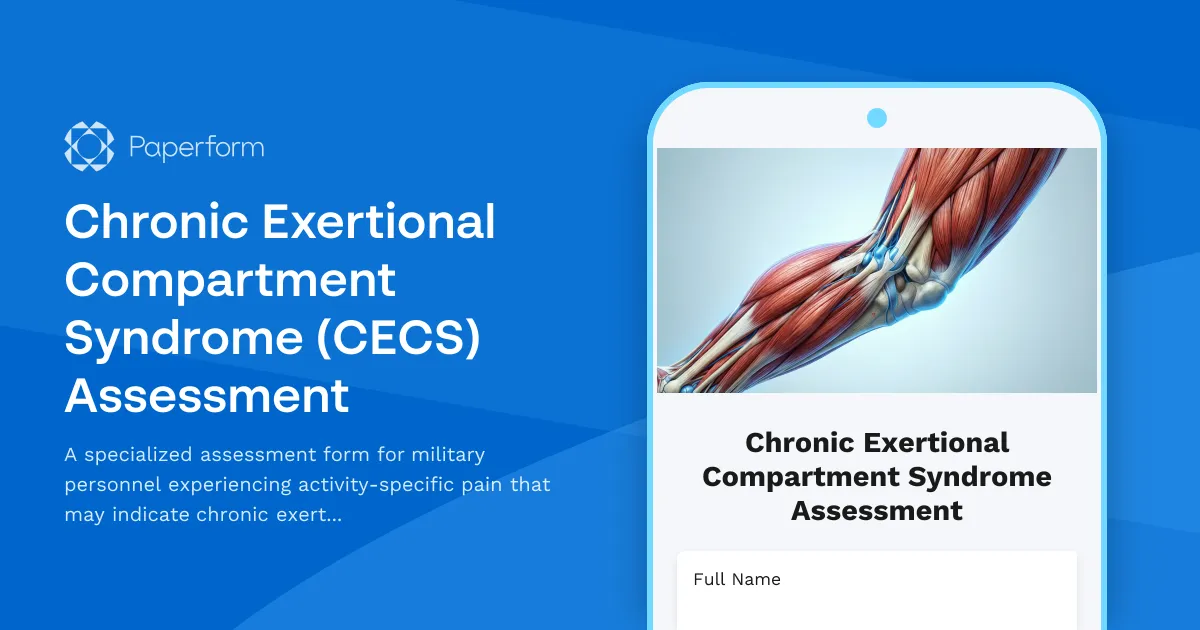
Chronic Exertional Compartment Syndrome (CECS) Assessment
A specialized assessment form for military personnel experiencing activity-specific pain that may indicate chronic exertional compartment syndrome, with pressure testing criteria and sports medicine referral pathways.
Chronic Regional Pain Syndrome (CRPS) Screening Form
A comprehensive screening tool for identifying Complex Regional Pain Syndrome (CRPS) symptoms including pain intensity, autonomic changes, functional limitations, and determining appropriate pain management referrals.
Diabetic Peripheral Neuropathy Screening Form
A comprehensive screening tool for detecting peripheral neuropathy in diabetic patients, including monofilament testing, vibration sense assessment, symptom evaluation, and automated podiatry referral pathway.