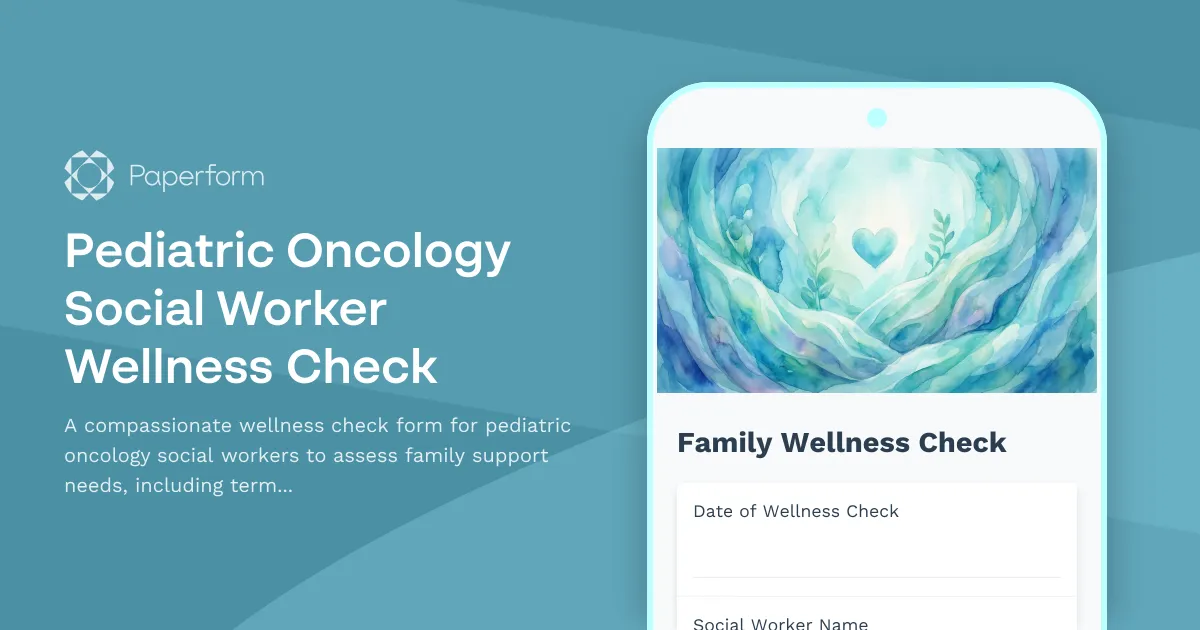
Supporting Families Through Pediatric Cancer: A Comprehensive Wellness Check Form
When a child faces a cancer diagnosis, the entire family experiences profound emotional, financial, and practical challenges. Pediatric oncology social workers play a critical role in identifying family needs and connecting them with appropriate resources—but only when they have the right tools to assess and document these complex situations.
This Pediatric Oncology Social Worker Wellness Check template is designed specifically for healthcare professionals working in pediatric oncology units, children's hospitals, and cancer treatment centers. It provides a structured yet compassionate framework for conducting regular wellness assessments with families navigating the most difficult journey imaginable.
Why This Template Matters for Pediatric Oncology Teams
Social workers in pediatric oncology face unique challenges. Beyond the medical complexity of childhood cancer, they must address:
- Terminal diagnosis support when curative treatment is no longer viable
- Family financial strain from treatment costs, lost wages, and travel expenses
- Sibling adjustment concerns as brothers and sisters cope with disrupted family life
- Bereavement counseling needs both anticipatory and after loss
- Psychosocial barriers that impact treatment adherence and family functioning
This form template creates a consistent, thorough assessment process that ensures no family falls through the cracks. By using Paperform, your social work team can document concerns in real-time, trigger appropriate follow-up workflows, and maintain comprehensive records that inform multidisciplinary care planning.
Key Features for Pediatric Healthcare Settings
Comprehensive Family Assessment: The form captures essential information about the patient, primary caregivers, household composition, and current treatment phase. Conditional logic reveals relevant questions based on diagnosis status—whether families are newly diagnosed, in active treatment, facing terminal prognosis, or in bereavement.
Financial Stress Evaluation: Dedicated sections assess transportation barriers, housing instability, food insecurity, medication access, and employment impact. This helps social workers quickly identify families who need connections to financial assistance programs, hospital lodging, meal support, or prescription assistance.
Sibling Support Screening: The template includes targeted questions about siblings' emotional well-being, school performance, behavioral changes, and access to age-appropriate support. This ensures that brothers and sisters—often the "forgotten patients"—receive the attention they need.
Terminal Diagnosis and Bereavement Pathways: When families are facing end-of-life decisions or have experienced loss, the form adapts to assess palliative care understanding, advance directive completion, funeral planning needs, and grief support engagement. This sensitivity helps social workers provide appropriate, timely interventions.
Immediate Risk Flagging: Questions about caregiver mental health, substance use, domestic safety, and suicidal ideation help identify families in crisis who need urgent intervention and safety planning.
How Paperform Transforms Pediatric Social Work
Using Paperform for wellness checks offers significant advantages over traditional clipboard assessments or disconnected electronic systems:
Mobile-Friendly for Bedside Assessments: Social workers can complete forms on tablets or phones directly in patient rooms, family lounges, or off-site locations, creating a more natural, conversational assessment experience.
Conditional Logic for Compassionate Questioning: Only relevant questions appear based on previous responses, reducing form fatigue and avoiding insensitive inquiries (like asking about financial assistance applications to families who haven't yet disclosed financial need).
Instant Documentation: Submissions are captured immediately with timestamps, creating reliable records for medical charts, grant reporting, and care coordination without duplicate data entry.
Integration with Care Coordination Tools: Through Stepper, you can automatically notify team members when high-priority needs are identified, create tasks in project management systems, or update patient records in your EHR—ensuring that assessment findings immediately translate into action.
Secure, HIPAA-Aware Design: While Paperform itself is not HIPAA compliant, it offers SOC 2 Type II certification and can be configured with appropriate safeguards for storing de-identified data or triggering workflows that sync to compliant systems. For organizations requiring full HIPAA compliance, consider using Paperform to capture initial screening data that flows into your certified EHR through secure integrations.
Supporting Multidisciplinary Pediatric Oncology Care
This template serves as more than just a social work tool—it's a bridge between disciplines. Oncologists, nurses, child life specialists, chaplains, and psychologists all benefit from systematic family wellness data that informs holistic care planning.
By identifying patterns across families—such as common financial barriers or unmet bereavement needs—your pediatric oncology program can also use aggregated data (via Paperform's AI Insights feature) to justify new support services, secure grant funding, or design targeted interventions.
Who Benefits from This Template
This form is ideal for:
- Pediatric oncology social workers conducting intake, routine wellness checks, and crisis assessments
- Children's hospital social work departments standardizing family support screening
- Cancer center psychosocial teams coordinating comprehensive family care
- Nonprofit organizations serving pediatric cancer families who need assessment tools
- Research programs studying psychosocial impacts of childhood cancer
Customization for Your Program's Needs
Every pediatric oncology program has unique resources, referral pathways, and documentation requirements. This Paperform template is fully customizable—you can add questions about your specific assistance programs, modify language to match your organizational voice, include links to your resources, or adjust workflows to align with your team's processes.
You can also use Papersign to follow up wellness checks with consent forms for counseling services, photography releases for memory-making programs, or authorization forms for emergency assistance—keeping all family documentation connected and easily accessible.
Getting Started
This template provides a compassionate, comprehensive starting point for pediatric oncology wellness checks. By implementing a consistent assessment process, your social work team can ensure that every family receives the support they need, when they need it most.
Trusted by healthcare organizations worldwide, Paperform offers the flexibility, security, and integration capabilities that modern pediatric oncology programs require—wrapped in an interface that's simple enough for time-pressed clinicians to use effectively every single day.
More templates like this
Community Mental Health Worker Wellness Check
A comprehensive wellness check form for community mental health workers to assess client wellbeing, safety risks, medication compliance, and caseload concerns with structured risk assessment protocols.
Neonatal Bereavement Follow-Up Wellness Check
A compassionate follow-up form for neonatal bereavement support, enabling nurses to conduct wellness checks, coordinate grief support services, and provide ongoing care for families experiencing pregnancy loss.
Perinatal Loss Doula Wellness Check Form
A compassionate wellness check form for perinatal loss doulas providing stillbirth support, NICU vigil care, memory photography, and bereaved family follow-up services.
Psychiatric Crisis Clinician Wellness Check
A confidential wellness check form designed to support psychiatric crisis assessment clinicians managing telephonic evaluations, disposition pressures, and call volume fatigue.
Youth Residential Treatment Worker Wellness Check
Comprehensive wellness check for youth residential treatment workers to assess wellbeing, safety concerns, crisis exposure, and support needs in therapeutic care environments.
Adventure Therapy Program Emergency Contact Form
Comprehensive emergency contact and participant information form for adventure therapy programs, capturing outdoor experience, medical clearance, risk assessment, and group dynamics history for challenge-based therapeutic activities.
Crisis Hotline Counselor Wellness Check
A comprehensive wellness assessment for crisis hotline counselors addressing call volume stress, vicarious trauma, boundary maintenance, and supervision needs to support mental health professionals in high-stress roles.
Crisis Intervention Counselor Wellness Check Form
A confidential wellness assessment form designed for crisis counselors managing high-stress interventions, suicide follow-ups, and transition care with comprehensive safety planning and support resources.

Crisis Intervention Specialist Supervisor Wellness Check
A comprehensive wellness check form for crisis intervention supervisors to assess staff trauma exposure, facilitate critical incident debriefing, and monitor supervisor wellbeing.
Crisis Stabilization Unit Counselor Wellness Check
A comprehensive wellness check form designed for crisis stabilization unit counselors to assess work-related stress, burnout, and emotional wellbeing in high-pressure healthcare environments.
Domestic Violence Shelter Resident Wellness Check
A compassionate wellness check form for domestic violence shelter residents to assess safety, wellbeing, trauma symptoms, children's needs, and connection to support services.
Horticulture Therapy Program Emergency Contact Form
A comprehensive emergency contact form for horticulture therapy programs that captures participant information, plant allergies, outdoor tolerance levels, gardening experience, and therapeutic goals.