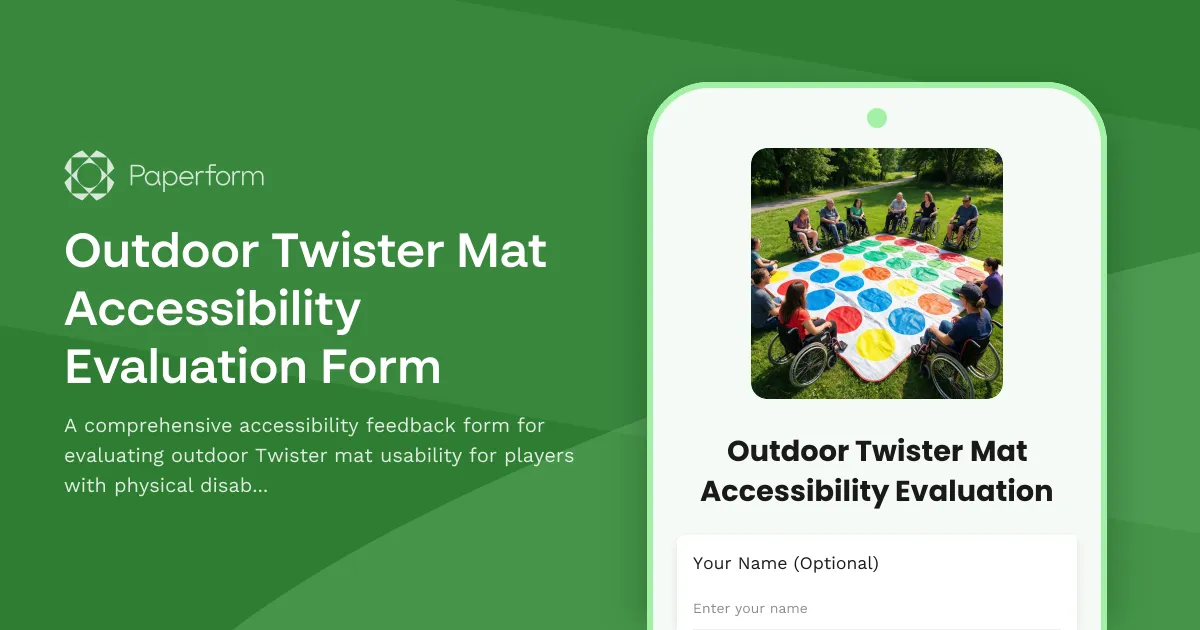
Make Outdoor Games Accessible for Everyone with This Twister Mat Evaluation Form
Creating inclusive play experiences is essential for community centers, recreational programs, schools, and event organizers. This Outdoor Twister Mat Accessibility Evaluation Form helps you gather detailed feedback from players with physical disabilities about the accessibility of your outdoor Twister setup, ensuring everyone can participate in this classic game.
Why Accessibility Feedback Matters for Recreational Programs
Outdoor games like Twister should be enjoyable for all participants, regardless of physical ability. However, traditional setups often present barriers that can exclude players with mobility challenges, balance concerns, or other physical disabilities. By actively collecting accessibility feedback, recreation coordinators, occupational therapists, and program managers can identify specific barriers and implement meaningful improvements.
This form template is designed specifically for evaluating outdoor Twister mat accessibility across three critical areas: mat surface and stability, position modifications and adaptations, and spinner accessibility. Whether you're running an adaptive recreation program, managing a community park, or organizing inclusive events, this feedback tool helps you understand the lived experience of players with disabilities.
What This Form Captures
The evaluation form covers:
- Participant information and disability context to understand individual accessibility needs
- Mat surface quality assessment including texture, grip, stability, and weather resistance
- Position modification feedback about the feasibility of adapted positions and alternative movement options
- Spinner accessibility covering reach, visibility, operation ease, and alternative spinner options
- Overall experience ratings and specific improvement suggestions
- Safety concerns and incident reporting
- Follow-up preferences for ongoing accessibility dialogue
Perfect for Multiple Industries and Settings
This accessibility evaluation form is ideal for:
- Recreation and community centers offering adaptive sports and games programs
- Special education schools with outdoor play areas and physical education programs
- Occupational therapy practices evaluating therapeutic recreation equipment
- Parks and recreation departments committed to ADA compliance and inclusive programming
- Summer camps serving children and adults with disabilities
- Event planners organizing accessible community festivals and gatherings
- Nonprofit organizations focused on disability rights and inclusive recreation
How Paperform Makes Accessibility Feedback Simple
Built with Paperform's intuitive doc-style editor, this template includes conditional logic that adapts questions based on the participant's responses—showing relevant follow-up questions only when needed. The clean, accessible design ensures the form itself is easy to navigate for all users, with clear labels, logical flow, and mobile-friendly formatting.
Automated workflows with Stepper can route feedback to different team members based on urgency—sending safety concerns immediately to program coordinators while routing improvement suggestions to your facilities manager. You can also set up automatic thank-you emails that acknowledge the participant's valuable feedback and outline next steps for accessibility improvements.
Supporting Continuous Improvement and Compliance
Regular accessibility evaluations aren't just good practice—they're often required for ADA compliance and grant funding. This form creates a documented record of your accessibility assessment efforts, participant feedback trends, and improvement initiatives. The data collected can support:
- Grant applications for accessible recreation equipment
- ADA compliance documentation
- Program improvement planning
- Staff training on disability inclusion
- Budget requests for accessibility modifications
AI Insights in Paperform can help you quickly analyze feedback patterns across multiple evaluations, identifying the most common barriers and highest-priority improvements without manually reviewing every submission.
Integrations for Your Existing Tools
Connect this form seamlessly with your existing workflow by integrating with tools your team already uses. Send feedback automatically to Google Sheets or Airtable for tracking, create tasks in Asana or Monday.com for each improvement suggestion, or notify your team in Slack when urgent accessibility concerns are reported.
For recreation programs managing multiple sites or activities, Stepper can help you build more sophisticated workflows—automatically categorizing feedback by location, creating maintenance tickets for equipment issues, and tracking improvement implementation over time.
Trusted by Accessibility-Focused Organizations
Organizations committed to inclusive recreation trust Paperform because it's SOC 2 Type II compliant, GDPR-ready, and designed for data security. When collecting sensitive information about participants' disabilities and accessibility needs, you need a platform that takes privacy seriously.
Whether you're just starting your accessibility journey or you're an established adaptive recreation program looking to formalize your feedback process, this Outdoor Twister Mat Accessibility Evaluation Form gives you a professional, comprehensive tool that demonstrates your commitment to inclusion.
Start collecting meaningful accessibility feedback today and create play experiences that truly welcome everyone.



More templates like this
Ink Making Workshop Accommodation Request Form
Request accessibility accommodations for ink making workshops including workspace modifications, material handling assistance, and alternative instruction methods to ensure an inclusive creative experience.
Kite Flying Lesson Accommodation Request Form
Request accessibility accommodations for kite flying lessons, including equipment modifications, instruction format alternatives, and field accessibility support to ensure an inclusive experience for all participants.
Falconry Experience Accommodation Request Form
Request accessibility accommodations for falconry experiences, including equipment modifications, instruction format alternatives, and bird handling adaptations to ensure an inclusive and safe experience for all participants.
Foraging Tour Accommodation Request Form
Request accessibility accommodations for foraging tours including terrain navigation assistance, plant identification method modifications, and alternative instruction formats to ensure an inclusive outdoor learning experience.
Improv Theater Class Accommodation Request Form
Request participation modifications, exercise adaptations, and performance format alternatives for improv theater classes to ensure an accessible and inclusive learning environment.
Juggling Class Accommodation Request Form
A comprehensive form for requesting disability and accessibility accommodations in juggling classes, including equipment modifications, practice space adjustments, and instruction format preferences.
Life-Size Board Game Accessibility Survey
Gather feedback from players with disabilities about the accessibility of life-size board game paths, including path width, movement methods, and game card access.
Meditation Retreat Feedback Survey
Gather participant feedback on meditation retreat experiences, including noble silence effectiveness, cushion comfort, meal quality, and spiritual growth outcomes.
Museum Accessibility Accommodation Request Form
Request accessibility accommodations for your museum visit, including guided tour modifications, tactile exhibits, assistive listening devices, and other services to ensure an inclusive cultural experience.
Nalbinding Workshop Accommodation Request Form
A comprehensive accommodation request form for nalbinding workshops, allowing participants to request needle modifications, material handling assistance, and alternative instruction methods to ensure an accessible learning experience.
Origami Class Accommodation Request Form
A welcoming form for students to request accessibility accommodations for origami classes, including paper handling modifications, folding technique adaptations, and alternative instruction methods.
Painting Class Accommodation Request Form
Request accessibility accommodations for painting classes, including material adaptations, instructional modifications, and workspace accessibility needs.