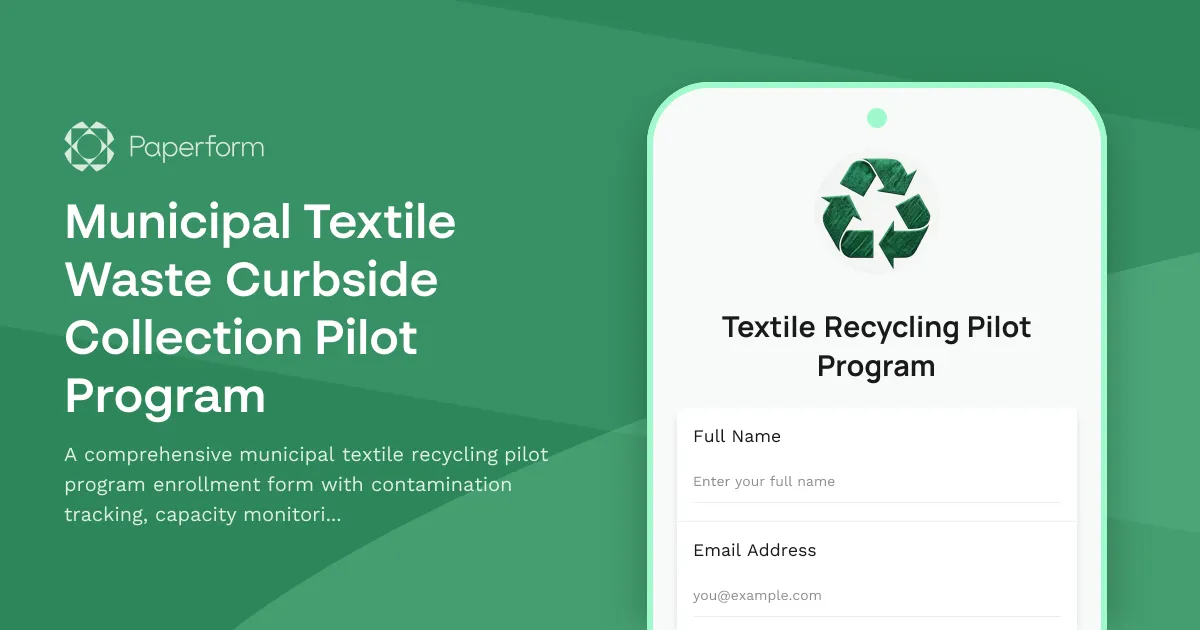
Municipal textile waste represents a growing challenge for waste management systems. Nearly 85% of textiles end up in landfills, yet the majority could be recycled, repurposed, or composted. This Municipal Textile Waste Curbside Collection Pilot Program form helps cities and municipalities launch effective textile recycling initiatives while tracking critical performance metrics.
Designed for municipal waste management departments, sustainability coordinators, and environmental services teams, this form streamlines resident enrollment, educates participants on proper textile sorting, and captures essential data for program evaluation and expansion planning.
Paperform makes it easy to launch and scale your textile recycling pilot program with conditional logic that adapts to different household types, integrated payment processing for optional premium services, and powerful data collection that tracks contamination rates and processing capacity in real-time.
The form includes comprehensive educational content about acceptable materials, contamination prevention, and program guidelines—ensuring participants understand how to properly prepare textiles for collection. Built-in calculations help monitor weekly collection volumes, contamination percentages, and facility capacity utilization.
Once submissions come in, use Stepper (stepper.io) to automate your program workflows: automatically send welcome packets and collection bags to new participants, route high-contamination alerts to education coordinators, update capacity dashboards in real-time, and trigger expansion planning reviews when enrollment thresholds are met. You can even sync participant data with your existing waste management systems and notify collection route planners when new addresses are added.
Whether you're a city sustainability office launching your first textile diversion program or an environmental services department expanding an existing initiative, this template provides the foundation for data-driven program management that demonstrates measurable impact and positions your municipality as a leader in circular economy practices.
More templates like this
Municipal Household Battery Collection Sign-Up
Register for municipal household battery collection services. Find your nearest drop-off location, track your battery disposal, and learn proper storage requirements for safe recycling.
Municipal Latex Paint Consolidation and Redistribution Program
A comprehensive form for collecting, consolidating, and redistributing leftover latex paint through community reuse stores, reducing waste while providing affordable paint options.
Community Paint Recycling Event Registration
A registration form for community paint recycling events that helps participants sign up, categorize their paint donations, and volunteer for collection shifts.
Community Yard Waste Composting Program Enrollment
Sign up for the community yard waste composting program with seasonal collection schedules, learn about proper sorting, and reserve your share of finished compost.
Municipal Bulky Item Collection Request
Schedule pickup of oversized household items through your municipal waste management program. Request collection of furniture, appliances, and other bulky waste items with transparent pricing and convenient scheduling.
Municipal Marina & Boat Launch Complaint Form
Submit complaints and concerns about marina facilities, dock maintenance, wait times, fees, safety equipment, and environmental issues at municipal boat launch facilities.
Recycling Service Complaint Escalation Form
Escalate recycling service issues including contamination concerns, missed pickups, contract violations, and environmental compliance problems to management for urgent review and resolution.
Street Tree Planting Petition
A community petition form to request street tree planting in your neighborhood. Collect signatures, tree species preferences, and location details for urban forestry departments.
Air Quality Monitoring Petition
A comprehensive petition form for collecting signatures and data to advocate for improved air quality monitoring. Map pollution sources, track health symptoms, and submit evidence directly to environmental authorities.
Anonymous Pollution Discharge Report
Report suspected pollution discharges anonymously to environmental authorities. Document environmental violations, health impacts, and provide evidence while maintaining complete confidentiality.
Climate Action Plan Stakeholder Interview Form
Gather input from residents, businesses, and environmental groups on climate action priorities, emission reduction strategies, adaptation plans, and implementation timelines for your community's climate action plan.
Community Compost Facility Grant Application
Apply for funding to establish a community composting facility. Include waste diversion projections, site details, equipment specs, distribution plans, and environmental impact metrics.