Improve Mental Health Crisis Response with Community Feedback
Municipal mental health crisis response programs are transforming how communities support residents in psychiatric emergencies. This Municipal Mental Health Crisis Response Feedback Form helps cities and counties evaluate police co-responder programs, crisis intervention teams (CIT), and mental health mobile units through direct community input.
Whether you're assessing a new co-responder model pairing officers with mental health clinicians, evaluating de-escalation effectiveness, or measuring follow-up care coordination, this template captures the critical data needed to strengthen your program and demonstrate accountability to stakeholders.
Built for Public Safety and Mental Health Agencies
This form is designed for municipal government agencies, public safety departments, behavioral health departments, and community oversight boards seeking to:
- Evaluate crisis response effectiveness: Gather feedback on response times, de-escalation techniques, and officer/clinician professionalism during mental health emergencies
- Measure program outcomes: Track family satisfaction, care coordination quality, and whether the response prevented hospitalization or incarceration
- Identify improvement areas: Collect constructive criticism and suggestions to refine training, protocols, and resource allocation
- Build community trust: Demonstrate transparency and commitment to continuous improvement in mental health crisis services
Streamline Data Collection and Reporting
Paperform makes it simple to deploy this feedback form across multiple channels—embed it on your municipal website, share via email to families who've interacted with crisis teams, or provide QR codes at community meetings. Conditional logic tailors follow-up questions based on the type of crisis response, and all submissions flow directly into your preferred database or case management system.
Use AI Insights to analyze hundreds of responses and surface key themes around de-escalation effectiveness, communication quality, or gaps in follow-up care. Generate reports for city councils, grant funders, or community advisory boards without manual spreadsheet work.
Automate Follow-Up and Case Coordination
Connect this form to Stepper to turn feedback into action. When a submission indicates a negative experience or unmet need, automatically route it to your quality improvement team, schedule a follow-up call, or trigger a case review. Keep families informed about how their feedback is being used to improve services, and maintain SOC 2 compliant records for audits and accountability reporting.
This template helps municipalities deliver compassionate, effective mental health crisis response while demonstrating measurable results to the communities they serve.



More templates like this
Community Health Needs Assessment Input Form
Gather community input on priority health conditions, social determinant barriers, prevention program gaps, and culturally responsive intervention design to inform public health planning.
Crisis Mobile Response Team Dispatch Form
A comprehensive dispatch form for coordinating behavioral health crisis mobile response teams, capturing critical incident details, individual information, and de-escalation needs to ensure appropriate care and support.
Maternal Depression Screening & Support Services Form
A comprehensive maternal mental health screening form using the Edinburgh Postnatal Depression Scale to assess perinatal and postpartum depression, evaluate bonding concerns, and connect mothers with appropriate support services and treatment resources.
Community Violence Intervention Worker Wellness Check
A comprehensive wellness check form for community violence intervention workers, designed to assess mental health, safety concerns, and vicarious trauma from street outreach and crisis mediation work.
Crisis Intervention Team (CIT) Dispatch Form
A comprehensive dispatch form for crisis intervention teams responding to mental health emergencies, including risk assessment, safety indicators, and coordination protocols for immediate psychiatric intervention.
Crisis Negotiation Recording Consent Form
A professional recording consent form for crisis negotiation scenarios, designed for law enforcement and emergency response teams to obtain proper authorization for training, tactical review, and mental health collaboration purposes.
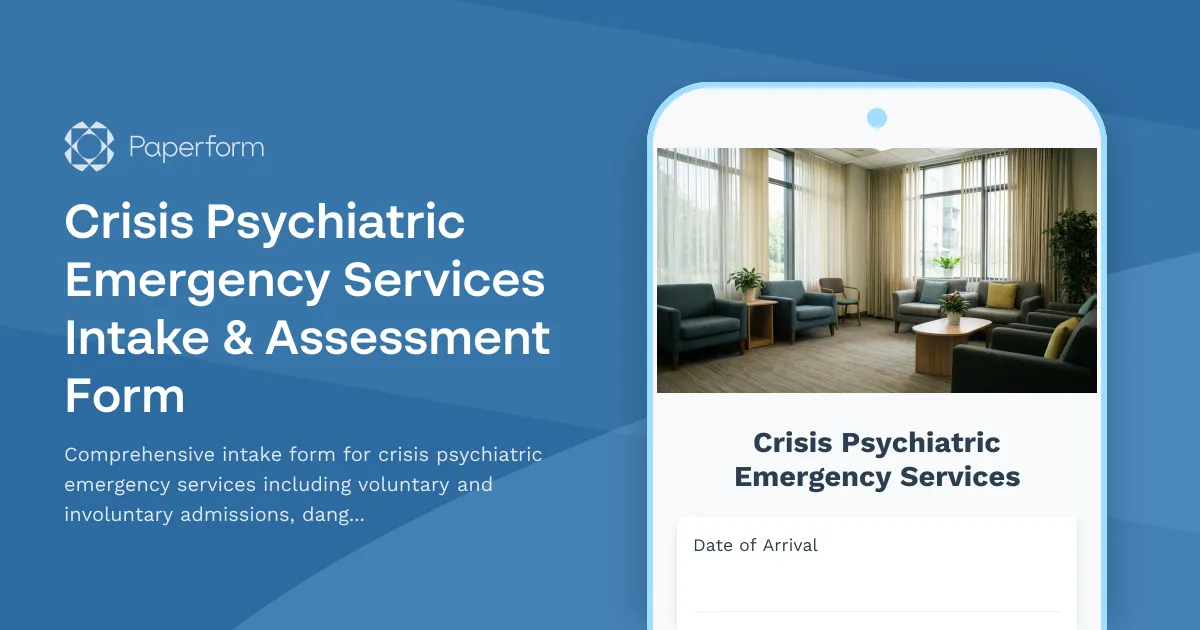
Crisis Psychiatric Emergency Services Intake & Assessment Form
Comprehensive intake form for crisis psychiatric emergency services including voluntary and involuntary admissions, dangerousness assessment, medication stabilization, peer support coordination, and discharge planning with community follow-up.
Mental Health Diversion Completion Certificate
A comprehensive certificate form documenting treatment progress, symptom management, and clinical recommendations for mental health diversion program completion in court proceedings.
Mental Health Involuntary Commitment Emergency Petition
A comprehensive emergency petition form for mental health involuntary commitment proceedings, including judicial review requirements, law enforcement coordination, and patient rights notification for healthcare facilities and crisis response teams.
Missing Psychiatric Hold Patient Report Form
A comprehensive form for healthcare facilities to report missing patients who left during an involuntary psychiatric hold period before their 72-hour evaluation, including danger assessment and legal authorization tracking.
Mobile Crisis Behavioral Health Unit Funding Application
Comprehensive funding application for mobile crisis behavioral health units, including response time targets, clinical team composition, co-responder models, and diversion rate projections.
Petition for Civil Commitment
A comprehensive court petition form for civil commitment proceedings, including mental health evaluation, dangerousness assessment, and treatment facility placement requests.